
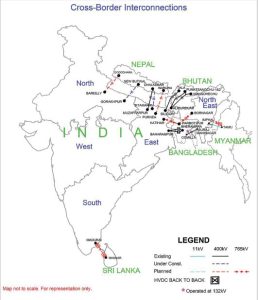
 Cross-border grid interconnections play a crucial role in facilitating the energy transition by enabling the efficient utilisation of surplus electricity across boundaries. Time diversity in renewable energy generation can be effectively leveraged through these interconnections. The cross-border power transfer between India and neighbouring countries occurs through intergovernmental bilateral cooperation via memorandum of understandings (MoUs) or power trade agreements. Planning, system operation, commercial agreements, and regulatory matters related to cross-border interconnection are conducted in accordance with bilateral agreements between governments.
India’s central location in the South Asian region and its political boundaries with SAARC/BIMSTEC countries such as Nepal, Bhutan, Bangladesh, Myanmar and Sri Lanka position it as a key player in coordinating interconnections with these nations. This collaboration aims to optimise regional resources effectively, thus enhancing the energy security of the entire region.
Currently, Bhutan and Nepal export hydroelectric power to India, which, in turn, exports power to these countries during lean hydro season. India also exports power to Bangladesh, with discussions underway for an advanced interconnection between the two countries.
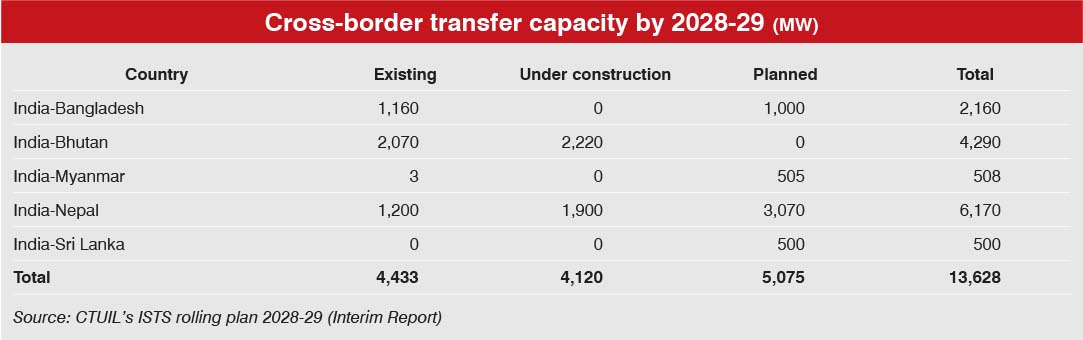
At present, exchange of power between India and neighbouring countries (Nepal, Bangladesh, Bhutan and Myanmar) is taking place in synchronous as well as in asynchronous mode. Transmission links (at 11 kV, 33 kV, 132 kV and 400 kV levels) have been established between the border states of Bihar, Uttar Pradesh, Uttarakhand, Tripura, West Bengal and Assam. Some interconnections are under construction and several cross-border interconnections have been planned. At present, about 4,100 MW of power is being exchanged with the neighbouring countries through cross-border links and the same is likely to increase to about 7,000 MW by the end of 2026-27. Interconnection between India and Sri Lanka is at an advanced stage of discussion. Under the One Sun One World One Grid initiative, interconnection of the Indian Electricity Grid with the electricity grids of Maldives, Singapore, UAE, Saudi Arabia, etc. is under discussion.
India-Bhutan
In 2006, an agreement was signed between India and Bhutan for cooperation in hydroelectric power, including the development of projects, transmission systems, and electricity trade, involving both public and private sector participation. At present, about 2,070 MW power from the existing hydroelectric projects (HEPs) in Bhutan is being exported to India. These projects are the Chukha HEP (336 MW), Kurichu HEP (60 MW), Tala HEP (1020 MW), Dagachu HEP (126 MW), and Mangdechu HEP (720 MW). The existing transmission links include the Chukha (Bhutan)-Birpara (West Bengal) 220 kV D/C line, Chukha (Bhutan)–Birpara (West Bengal) via Singhigaon (Bhutan) 220 kV S/C line, Kurichu (Bhutan)–Gelephu (Bhutan)-Salakati (Assam) 132 kV S/C line, Tala (Bhutan)–Siliguri (West Bengal) 400 kV 2xD/C line, Jigmeling–Alipurduar 400 kV D/c (Quad) line, Punatsangchu-I–Alipurduar 400 kV D/c (Quad) line and Punatsangchu-II–Alipurduar 400 kV D/c (Quad) line. Power from the HEPs in Bhutan along with other hydro project in Sikkim and north eastern region can be transferred to other parts of India through high capacity multi terminal ±800 kV, 6,000 MW Biswanath-Chariali– Alipurduar – Agra HVDC bipole link.
India-Bangladesh
An MoU was signed between India and Bangladesh in January 2010, regarding cooperation in the power sector. The MoU covers collaboration in power generation, transmission, energy efficiency, renewable energy development, and the establishment of grid connectivity between the two nations. India is supplying power to the extent of 1,160 MW to Bangladesh through the Baharampur (India)-Bheramara (Bangladesh) 2×400 kV D/C line along with the 2×500 MW HVDC back-to-back Station at the Bheramara as well as the Surajmaninagar (Tripura)–Bangladesh (Comilla) 400 kV D/C line (operated at 132 kV). Further, there is a planned linkage of the Katihar (India)–Parbotipur (Bangladesh)–Bornagar (India) 765 kV D/C line.
India-Nepal
India and Nepal signed an agreement on “electric power trade, cross-border transmission interconnection and grid connectivity” in October 2014. The agreement, inter alia, envisages cooperation in the power sector, including developing 112 transmission interconnections, grid connectivity, and power exchange and trading through the governmental, public and private enterprises of the two countries on mutually acceptable terms. The existing links include the Muzaffarpur (India)-Dhalkebar (Nepal) 400 kV D/C (Twin) line and the Tanakpur HEP-Mahendra Nagar 132 kV S/C line. The linkages between the Gorakhpur (India)–New Butwal (Nepal) 400 kV D/c (Quad) line and the Arun-3 HEP (Nepal)–Dhalkebar (Nepal)–Sitamarhi (India) 400 kV D/c (Quad) line for evacuating power from the Arun-3 (900 MW) HEP and other hydro projects that are under implementation.
There are existing as well as planned interconnections at voltage levels of 132 kV and below between Nepal and the power grids of Bihar, Uttar Pradesh and Uttarakhand. The links from Bihar (BSPTCL) to Nepal include the Kataiya–Kusaha S/C line, Ramnagar–Gandak/Surajpura (Nepal) S/C line, New 132 kV Katiya–Kusaha S/C on D/C line and New 132 kV Raxaul–Parwanipur S/C on D/C line (132 kV links). The links between Uttar Pradesh and Nepal consists of the Nanpara-Nepalgunj S/C line and the Paliya –Dhangadi line (33 kV links).
Further, planned links between Bihar and Nepal involve the stringing of the second circuit of the Kataiya-Kushaha and Raxaul-Parwanipur 132 kV lines. Similarly, Uttar Pradesh (UPPTCL)-Nepal projects include the Nanpara-Kohalpur and Nautanwa-Mainhiya 132 kV D/C lines for grid connectivity between the regions.
India-Myanmar
In October 2016, an MoU was signed between India and Myanmar concerning cooperation in the power sector. The MoU entails collaboration on power sector investments, generation, transmission, energy efficiency, renewable energy development, power trading, consultancy services and human resource development to enhance productivity and efficiency.
Since April 2016, India has been supplying approximately 2-3 MW of power from Manipur to Myanmar via an 11 kV transmission line running from Moreh in Manipur, to Tamu Town in Myanmar. Furthermore, both countries have agreed to set up a 500 MW HVDC interconnection between Imphal in India, and Tamu in Myanmar. Discussions are also underway regarding the setting up of low-voltage radial interconnections between the Indian states of Arunachal Pradesh, Manipur, Mizoram and Nagaland, and Myanmar.
India – Sri Lanka
The detailed project report for a HVDC link between Madurai and Mannar, featuring 2×500 MW HVDC terminals utilising voltage source converter technology, is currently in its finalisation stage.
Outlook
In sum, cross-border grid interconnections play a crucial role in the energy transition. Through intergovernmental cooperation and agreements, countries in the South Asian region are collaborating on power generation, transmission and trade, aiming to enhance energy security and promote sustainable development. India’s central role in coordinating interconnections with neighboring countries is further strengthening regional cooperation. With ongoing projects and agreements, India is poised to achieve greater integration and resilience in its energy infrastructure, ultimately benefiting the entire South Asian region.
Aastha Sharma