

The Ministry of Power (MoP) recently published the 12th edition of the Annual Integrated Rating Report for the review year 2022-23, with insights and ratings on the operational and financial performance of around 72 discoms.
Despite a challenging year, 17 discoms witnessed an improvement in their grades. Notably, 14 discoms received the highest A+ rating. Further, the report noted an improvement in aggregate technical and commercial (AT&C) losses, billing efficiency and dues of gencos and transcos. During financial year 2023, AT&C losses further reduced to 15.4 per cent, driven by improvement in billing efficiency to 87 per cent, whereas collection efficiency remained high at 97.3 per cent.
However, the financial deficit in the power distribution sector widened to Rs 790 billion, primarily driven by an 8 per cent increase in gross input energy and a substantial rise in power purchase costs during the year. The absolute cash gap also increased from Rs 440 billion in financial year 2022 to over Rs 790 billion in financial year 2023, driven by the increasing average cost of supply (ACS)–average realisable revenue (ARR) gap. The total sectoral debt increased by 11 per cent, from Rs 6.17 trillion in financial year 2022 to Rs 6.87 trillion in financial year 2023. The average power purchase costs during financial year 2023 rose by 71 paise per kWh from financial year 2022, as compared to the marginal increase of 4 paise per kWh in financial year 2022 over financial year 2021.
Key highlights from the latest ratings exercise and the performance of discoms…
Ratings assigned
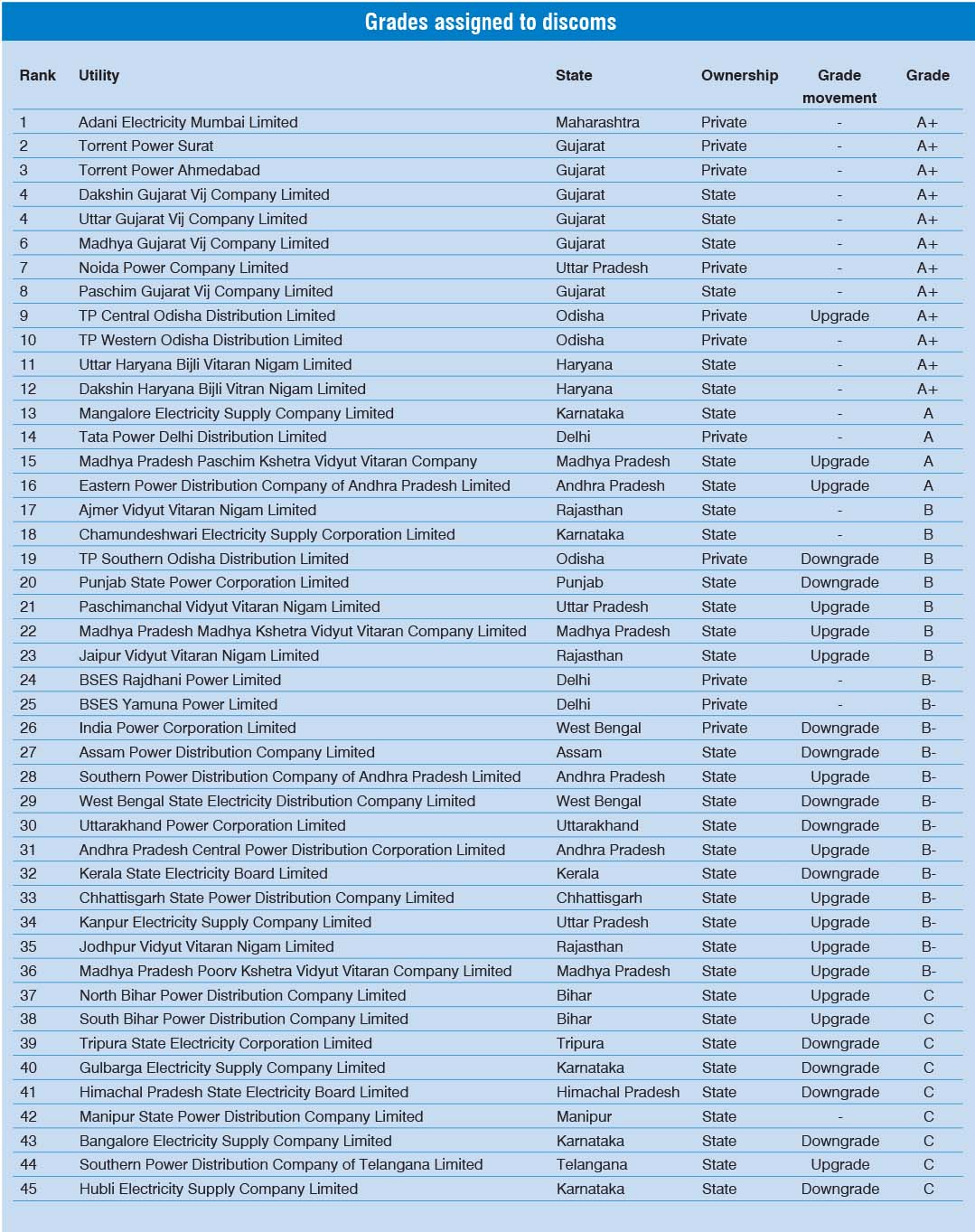
Among the 55 discoms covered in the 12th integrated ratings, 30 witnessed improved scores. The top 10 performing discoms included Adani Electricity Mumbai Limited, Torrent Power Surat and Ahmedabad, followed by Gujarat’s state power utilities Dakshin Gujarat Vij Company Limited, Uttar Gujarat Vij Company Limited and Madhya Gujarat Vij Company Limited. Next were Noida Power Company, Paschim Gujarat Vij Company Limited and TP Central Odisha Distribution Limited and TP Western Odisha Distribution Limited.
Tata Power Northern Odisha Distribution Limited and Dadar Nagar and Haveli and Daman & Diu Power Distribution Corporation Limited also received an A+ rating, but they were not included in the main ranking list since they have not completed three full years of operations.
Four discoms received an A grade and seven received a B grade. The number of discoms awarded a C or lower grade (C-, D) reduced from 32 in financial year 2021 to 17 in financial year 2023.
Among the 42 state government power utilities rated, nine utilities from Gujarat, Haryana, Karnataka, Madhya Pradesh and Andhra Pradesh earned a rating of either A+ or A. All 11 private discoms received a performance rating of either A+, A, B or B-.
The 12th edition also gave integrated performance ratings to the power departments of 11 states and union territories. Among these, the Thrissur Corporation Electricity Department of Kerala emerged on top, with an A rating, followed by the power departments of the New Delhi Municipal Council at second, Puducherry at third, Goa at fourth and Nagaland at fifth positions, all with a B rating.
 State of the sector
As per the report, Madhya Pradesh Paschim Kshetra Vidyut Vitaran Company Limited, South Bihar Power Distribution Company Limited and Kanpur Electricity Supply Company Limited recorded an improvement of more than Rs 1 per unit in the ACS-ARR gap. In fact, 25 of the 55 discoms rated showed improving ACS-ARR gap (cash adjusted) trajectories over the past two years. These discoms collectively accounted for 65 per cent of the debt and 54 per cent of the trade payables in the sector. This is a significant shift from the 10th Integrated Ratings, where only 15 utilities, holding 22 per cent of the sector’s payables and 29 per cent of its debt, showed an improving trajectory.
The reduction in payables to generation and transmission companies was driven by the Late Payment Surcharge Rules. The days payable reduced to 126 and days receivable to 119 days.
Meanwhile, AT&C losses reduced to 15.4 per cent in financial year 2023, almost 6 per cent lower than the 21.2 per cent in financial year 2021 and 1 per cent lower than financial year 2022. During financial year 2023, 39 discoms and four power departments witnessed an improvement in AT&C losses. The breakdown of AT&C trends shows that between financial years 2021 and 2022, AT&C loss improvement was driven by an increase in both billing efficiency (by 1.3 per cent) and collection efficiency (by 4.4 per cent).
Billing efficiencies continued to increase, reaching 87 per cent in financial year 2023. Further, 18 utilities had billing efficiency higher than 92 per cent, while 16 reported less than 82 per cent. These utilities contributed 17 per cent and 14 per cent of aggregate gross input energy respectively.
The notable increase in collection efficiency was driven by better tariff subsidy disbursal by states and an improved customer collection process. Aggregate tariff subsidy disbursement by state governments exceeded 100 per cent of booked tariff subsidies. On an aggregate national level, the state governments disbursed 108 per cent of the tariff subsidy booked during the year. Further, past tariff subsidy arrears were cleared in some states. Utilities also focused on improving customer collections through digital payments, rural awareness drives, etc.
The way forward
In addition to assigning grades, the report provides recommendations for further improvements. One major highlight from this year’s exercise, as noted in the report, has been an unprecedented rise in power demand, especially during the summer months of financial year 2023. Therefore, it suggests that careful planning is needed to meet the increasing demand. Discoms may need to reconsider their medium- and short-term power contracting strategies.
Further, smart infrastructure development is crucial for the development of the sector. The pace of smart meter installation at all levels, including customer, feeder and transformer, could be accelerated to reduce losses and improve the working capital cycle of utilities.
Also, the central government has implemented process reforms, such as establishing subsidy accounting on a per unit basis and encouraging distribution utilities to undertake energy accounting, aimed at improving financial transparency and efficiency. Support from regulators, particularly in ensuring timely implementation of tariff orders and pass-through of fuel costs, is essential for discoms’ financial health. Furthermore, the report notes that state governments, particularly those with significant regulatory assets, need to be encouraged to collaborate with regulators to develop solutions for liquidating these assets, thus alleviating financial strain on utilities. Timely payment of government dues and transition to prepaid metering for government consumption are also suggested measures. States may continue providing support to utilities facing substantial financial losses in the form of loss-takeover grants until their financial performance improves.
Several best practices have been proposed for discoms to improve their billing and collection efficiencies and manage working capital more effectively. These include GIS mapping, deploying ERP tools, installing self-service kiosks, and developing integrated customer applications, among others.