
In construction and urban development, green and smart buildings represent a significant shift towards sustainability and efficiency. Driven by factors such as energy efficiency, sustainable materials, water conservation, renewable energy integration and indoor environmental quality, these initiatives promote holistic approaches that enhance both environmental impact and occupant well-being.
Green buildings are propelled by a synergy of key drivers aimed towards sustainability and efficiency. Energy efficiency stands as a foundational pillar, leveraging innovative design strategies and cutting-edge technologies to curtail energy consumption. These include orientation to harness natural light and heat, alongside high performance insulation and energy-efficient windows and doors. Renewable energy integration plays a pivotal role, with the seamless incorporation of solar panels, wind turbines, and geothermal systems to power building operations, thereby diminishing reliance on fossil fuels and advancing towards a greener energy paradigm. Further, sustainable materials with a focus on selecting construction elements that are renewable, recycled or sustainably sourced are prioritised, thereby diminishing the ecological footprint associated with building materials. Water conservation emerges as another critical driver, facilitating the implementation of systems for rainwater harvesting, efficient wastewater management and the adoption of water-saving fixtures to mitigate the building’s impact on local water resources.
Drivers
Energy efficiency remains paramount in green building design, with a focus on materials that demand less energy to produce, such as concrete walls and insulated glass. This entails designing buildings to harness solar and other renewable energy sources, alongside integrating energy-efficient appliances, lighting, heating and cooling systems. Over time, these measures contribute to cost savings on energy bills and mitigate the building’s carbon footprint. According to the Bureau of Energy Efficiency’s (BEE) estimates, in 2021-22, the energy savings in commercial buildings from energy efficiency measures were 498.3 MUs.
Government initiatives
BEE is working on the energy efficiency of buildings through the support of state-designated agencies. It has collaborated with many international experts and agencies, learning from their experiences and best practices and adopting them as suited. The Indo-US Partnership to Advance Clean Energy-Deployment programme, the Indo-Swiss Building Energy Efficiency Project, GIZ and the United Nations Development Programme are some of the noteworthy initiaitves. To widen the scope of the labelling programme for buildings based on energy consumption, the BEE has introduced a programme for net zero energy buildings (NZEBs) and net positive energy buildings (NPEBs). Two types of labels are proposed – one is the Shunya label for NZEBs and the other is Shunya+ (Shunya Plus) for NPEBs. Under this programme, the Shunya label will be awarded to buildings with an energy performance index (EPI) between 0 and 10 kWh per sq. metre (m2) per year, while the Shunya+ label will be awarded to buildings with an EPI below 0 kWh per m2 per. The programme will encourage building owners and promoters to construct energy-efficient buildings and further make improvements to make it net zero or net positive energy buildings.
To promote green building construction practices, there are various certifications for evaluating buildings on multiple parameters and certifying them accordingly. These certificates and ratings lend credibility to projects and endorse their pro-environment claims. For buyers or investors seeking sustainable structures, this serves as a valuable tool to gauge the building’s environmental impact.
Launched by the Ministry of Power, the Energy Conservation Building Code (ECBC) marks the initial step towards promoting energy efficiency in the building sector. It sets minimum requirements for energy-efficient design and construction, considering factors such as climatic zones, application and usage patterns. Many states in India have amended and adopted the code to suit their regional and climatic needs, making it an integral component of government energy efficiency and climate change policy. ECBC compliance and star ratings are becoming mandatory for buildings and factories in the manufacturing sector, emphasising the importance of energy efficiency and performance in both new and existing projects. The effective implementation of the code provides comfort to occupants by adopting passive design strategies and daylight integration. It is technologically neutral, promotes renewable energy and emphasises the life cycle cost of buildings. The code has additional priorities of renewable energy integration, ease of compliance, inclusion of passive building design strategies and flexibility for the designers.
 The LEED (Leadership in Energy and Environmental Design) rating system stands as one of the most recognised green building certifications. It assesses projects based on criteria such as water usage, energy conservation and sustainable materials, assigning scores that categorise buildings as certified (40-49 points), silver (50-59 points), gold (60-79 points) and platinum (80+ points), with platinum being the highest rating. India has over 1,600 LEED-certified buildings, including notable structures such as Terminal 3 at the Indira Gandhi International Airport in Delhi, the American Embassy School in Delhi and the Anna Centenary Library Building in Chennai.
The IGBC rating systems, supported by the Confederation of Indian Industry and managed by the Indian Green Building Council since its inception in 2001, offer another avenue for green building certification. Buildings are assessed and rated silver, gold or platinum based on various parameters. There are nine distinct certifications tailored to different project types, covering new and existing buildings, schools, factories, homes, townships, special economic zones, landscapes and metro systems. Among the IGBC-rated green buildings are the Thermax Corporate House, Navi Mumbai Municipal Corporation Building and Oval Nest.
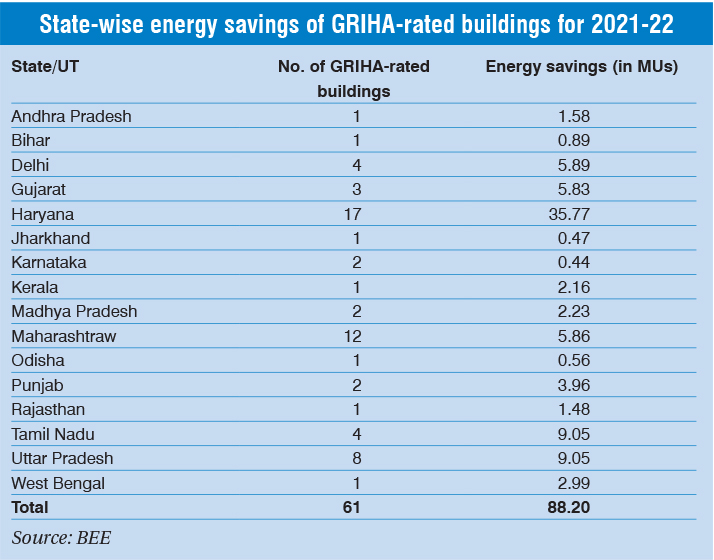
The Energy and Resources Institute spearheaded the development of the Green Rating for Integrated Habitat Assessment (GRIHA) rating system in India, with support from the Ministry of New and Renewable Energy. GRIHA is a rating tool that helps assess the performance of buildings against certain nationally acceptable benchmarks. It evaluates the environmental performance of a building holistically over its entire life cycle, providing a definitive standard for what constitutes a green building. GRIHA adopts a star-based rating system, where five stars denote the highest ranking. Each star corresponds to a specific range of points, with one star awarded for 25-40 points, two stars for 41-55 points, three stars for 56-70 points, four stars for 71-85 points and five stars for 85 points and above. Notable examples of GRIHA-rated projects include the Hotel Grand Chola in Chennai, Indira Paryavaran Bhawan in New Delhi and the Manipal University Campus in Jaipur. As of March 31, 2022, 61 buildings have been rated by GRIHA and these buildings have contributed in energy savings of 88.2 MUs (0.082 BUs).
Based on the anticipated urban growth of India, it is projected that if the future building stock is made in compliance with this code, about 300 BUs of electricity will be saved by 2030. It will translate to a peak demand reduction of 15 GW and about 250 mt of CO2. It is estimated that Rs 350 billion will be saved by implementing ECBC-compliant buildings. ECBC 2017 is technology-neutral, providing architects and engineers with artistic and technical freedom as long as minimum efficiency requirements are fulfilled. Passive design strategies such as daylight and shading are promoted in the code. Additional parameters include lighting, electrical and renewable energy, offering flexibility to designers to design buildings efficiently for various components. The ECBC has been implemented in Andhra Pradesh, Assam, the Andaman & Nicobar Islands, Haryana, Karnataka, Kerala, Punjab, Sikkim, Telangana, Uttarakhand, Madhya Pradesh and Uttar Pradesh, and about 270 urban local bodies have been covered under these states.
Issues and challenges
Despite the benefits, the widespread adoption of smart, eco-friendly buildings faces several challenges. High initial costs, technological complexity and the need for special skills can be key barriers. However, these challenges also present opportunities for innovation, education and collaboration across the construction and technology sectors. As awareness of the environmental and economic benefits of smart, green buildings grows, so does the demand for skilled workers.
Among the array of challenges faced, cyberattacks emerge as the most critical concern. With the proliferation of internet-connected devices, numerous new attack vectors have surfaced. Attackers can exploit these devices to gain access to a building’s IT system, enabling them to manipulate data and disable critical building features with relative ease. Consequently, there is a pressing need to enhance the skill sets of operators. This entails amalgamating traditional technical expertise in processes and machinery with a diverse range of new technologies.
Going forward, the integration of smart technology and green design will play a key role in addressing the global challenges of climate change and resource scarcity, paving the way for a more sustainable and resilient built environment.
Akanksha Chandrakar