

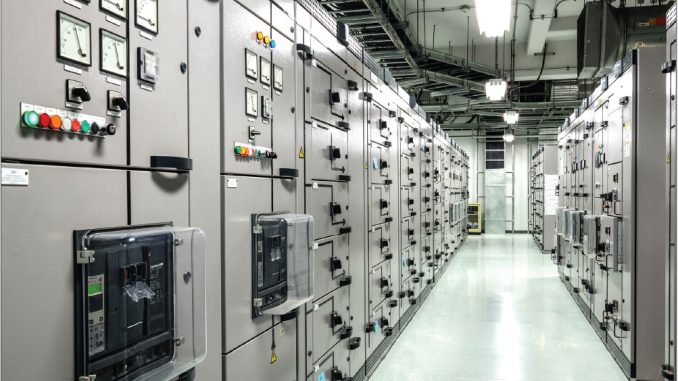
The substation and switchgear industry is currently witnessing a significant wave of technological innovation across all voltage levels. Manufacturers are actively pursuing the development of substations and switchgear that exhibit enhanced intelligence, compactness and reliability while also prioritising environmental sustainability and streamlining installation and commissioning processes. These advanced solutions offer several advantages, including reduced right-of-way requirements and the ability to facilitate reliable network expansion. One notable trend in this regard is the growing adoption of digital substations by utilities, which enable real-time monitoring and automation of processes, thereby improving operational efficiency and minimising outages.
An overview of the substation and switchgear industry…
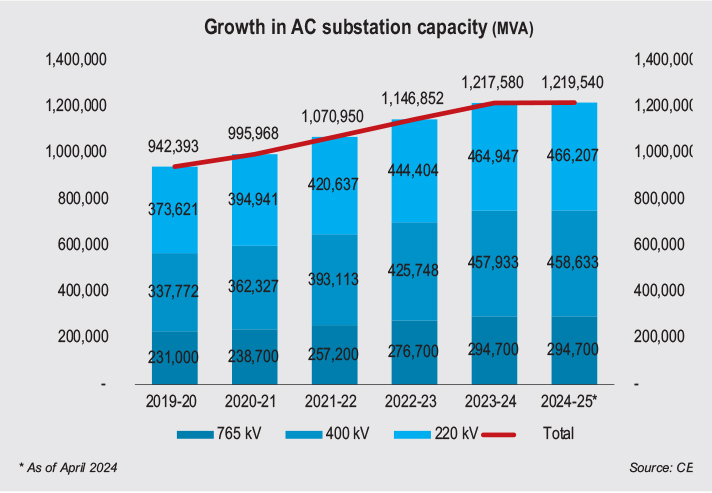
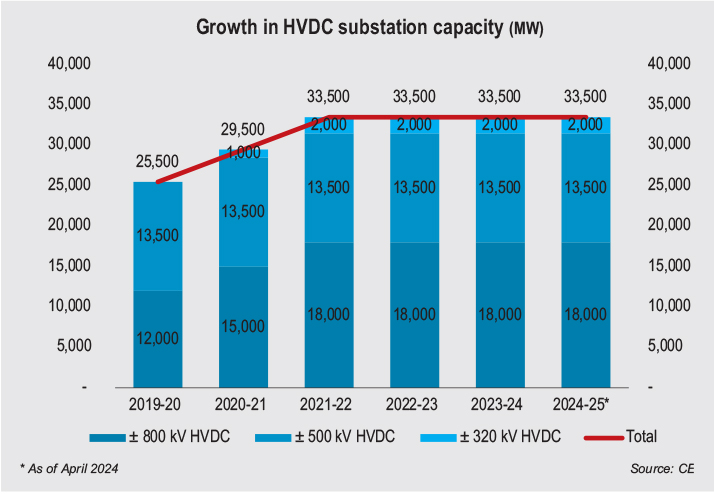
Substation capacity: In the Indian context, high voltage direct current (HVDC) substation capacities include ±800 kV, ±500 kV and ±320 kV, while alternating current (AC) substations broadly range from 132 kV to 765 kV. In the case of distribution, substation voltages are typically at 33 kV and below. As per the Central Electricity Authority (CEA), the AC substation capacity stood at 1,219 GVA as on April 2024. Between 2019-20 and 2023-24, the AC substation capacity has grown at a compound annual growth rate (CAGR) of 5.29 per cent. The HVDC substation capacity stood at 33,500 MW, having grown at a CAGR of 8.3 per cent between 2018-19 and 2023-24. Meanwhile, in the distribution segment, as per India Infrastructure Research, nearly 902 GVA of transformer capacity was operational in March 2022 at the 33 kV level and below, across 46 utilities. Between 2017-18 and 2021-22, transformer capacity grew at a CAGR of 7.6 per cent.
Switchgear market: The switchgear market is segmented based on load-bearing capacity into low voltage (LV), medium voltage (MV) and high voltage (HV) categories. LV switchgear, encompassing switchgear rated up to 1 kV, is used across distribution utilities, industries, residential and commercial buildings, original equipment manufacturers and agricultural consumers. Common LV switchgear products include air circuit breakers, molded case circuit breakers, miniature circuit breakers, residual current devices, fuse gear products, thermal overload and protection relays, contactors, starters, distribution boards, and factory-built assemblies.
Meanwhile, the MV and HV segments cover switchgear ranging from 6.6 kV to 1,200 kV. MV and HV switchgear, often grouped due to their similar usage, are extensively deployed by transmission and generation utilities in power systems. HV switchgear is classified into three major types based on the insulating medium: air-insulated switchgear (AIS), gas-insulated switchgear (GIS) and hybrid switchgear. As per the Indian Electrical and Electronics Manufacturers’ Association, in 2023-23, the LV switchgear industry recorded a growth of 6.1 per cent, while the HV switchgear industry recorded a decline of 5.5 per cent. The growth of the LV switchgear industry can be attributed to sustained demand from realty, infrastructure and other manufacturing industries as well as exports.
Technology trends
The power sector is witnessing a rapid increase in the adoption of digital substations, which utilise real-time data to improve diagnostics and reduce downtime. Digital substations integrate real-time data into the system, reducing the need for troubleshooting by enabling timely diagnosis of problems.
In the switchgear segment, utilities are increasingly adopting GIS, hybrid switchgear and intelligent switchgear. GIS substations, which employ sulphur hexafluoride gas, are gaining popularity due to their compact size. The other key features of GIS include high modularisation, high safety index, lower maintenance requirements and the ability to resist vibration and avoid electromagnetic pollution.
The use of hybrid switchgear is also fast gaining popularity as it provides the advantages of both AIS and GIS technologies. Hybrid switchgear strikes a balance between the costs of land and facility construction while optimising space and cost for future extensions. Hybrid switchgear is compact, with the AIS functionality integrated in a gas-insulated enclosure.
Vacuum switchgear, initially popular for MV applications, is gaining traction for HV applications due to its compact size, higher reliability and reduced maintenance requirements. The renewed interest in vacuum switchgear can be attributed to a focus on reducing the use of sulphur hexafluoride gas.
 Growth drivers
The increasing demand for electricity due to rapid urbanisation, industrialisation and infrastructure development across the country is a major growth driver for the substation and switchgear market in India. As India continues to progress economically, the need for reliable power transmission and distribution infrastructure is also increasing, leading to the expansion and modernisation of substations and switchgear installations.
The government’s initiatives to enhance the efficiency and reliability of the power grid through programmes such as the Revamped Distribution Sector Scheme (RDSS) are fuelling the demand for substations and switchgear. The infrastructure strengthening works envisaged under the scheme include the construction of new substations and the upgradation of existing ones. The scheme has a total outlay of Rs 3,037.58 billion, with an implementation timeline of five years (2021-22 to 2025-26). The Integrated Power Development Scheme, the Deendayal Upadhyaya Gram Jyoti Yojana and the earlier Prime Minister’s Development Package 2015 for Jammu & Kashmir have all been subsumed into the RDSS. These initiatives aim to improve electricity access, reduce transmission losses and upgrade aging infrastructure, thereby creating a conducive environment for market growth.
Moreover, the growing focus on renewable energy integration into the grid is driving the demand for substations and switchgear that can accommodate variable renewable energy sources such as solar and wind power. As India strives to achieve its ambitious renewable energy targets, the need for grid modernisation and smart grid solutions becomes paramount, further promoting the market for advanced substations and switchgear technologies.
 Increasing investments in the transmission and distribution sector, from both the government and private players, are contributing to market expansion. The implementation of flagship programmes such as Green Energy Corridors and the development of transmission projects are driving investments in high-capacity substations and advanced switchgear technologies. Furthermore, technological advancements such as the adoption of digital substations, smart switchgear and advanced protection and control systems are revolutionising the industry, enhancing operational efficiency and reducing downtime. These technological innovations are attracting investments from utilities and industry players looking to improve grid reliability and optimise asset management, thus driving growth in the substation and switchgear market.
Conclusion
To conclude, the substation and switchgear market in India is witnessing robust growth, driven by increasing electricity demand, government initiatives such as RDSS and a focus on renewable energy integration. Investments in transmission and distribution infrastructure, coupled with technological advancements such as digital substations and GIS technology, are reshaping the industry landscape.
Looking ahead, continued government support, sustained technological innovation and growing investments are expected to drive further growth and development in the substations and switchgear market, paving the way for a more resilient and efficient power infrastructure in India.