

The UK has set ambitious clean energy and decarbonisation targets – a zero-carbon electricity system by 2035 and net zero by 2050. However, the road to meeting these targets is fraught with challenges, especially as the offshore wind (OSW) industry, which is a crucial component in the government’s green energy mission, is struggling. The government has set a target of 50 GW of OSW capacity by 2030.
OSW developers are facing headwinds due to increasing construction costs, while the government is looking to bring down bidding prices. The maximum strike price of £44 per MWh for OSW in the UK’s fifth allocation round (AR5) in September 2023 did not attract any OSW developers, which was quite a setback for its 2030 target. Inflationary pressures and supply chain disruptions have affected the OSW industry, and the government needs to offer developers a reasonable return on their investments, taking into account current economic conditions. Earlier, in July 2023, Swedish company Vattenfall had halted work on the Norfolk Boreas OSW project after deeming it unprofitable. Vattenfall had secured the project in 2022 after bidding a record low price of £37.35 per MWh, but a 40 per cent increase in construction costs tooks a toll on the project. Recently, in March 2024, Vattenfall exited the project after entering into a sale agreement to transfer it to RWE.
In addition to the concerns of OSW developers regarding auction design and market mechanisms, there are challenges arising from inadequate transmission capacity. Customers seeking network connections are experiencing significant delays, with some customers being offered connection dates in the late 2030s. Great Britain’s current electricity network is reaching its capacity, and developing a future-proof grid would require massive investments, which have not been undertaken since the development of the supergrid in the 1950s. Currently, about 14 GW of OSW capacity is connected to the system, and the rapid deployment of OSW turbines over the next decade will require significant investment in the transmission network, so that this generation can be connected in a timely and efficient way.
The National Grid Electricity System Operator (NGESO) proposed an investment of £58 billion in the electricity grid to meet the growing demand for decarbonised electricity in Great Britain by 2035 in its recently released report, “Beyond 2030”. The NGESO has recommended investments across both onshore and offshore network infrastructure to facilitate the connection of new wind farms and other new renewable energy sources (RES). This investment comprises two parts, split between offshore network design and 91 reinforcements to the transmission system.
Building on the “Pathway to 2030 Holistic Network Design (HND)” published in 2022, which signified the first major move towards a more centralised and strategic approach to network planning, the latest report is another key step in the effort to upgrade electricity transmission infrastructure across the UK, and towards ESO’s first centralised strategic network plan, due in 2026. The first HND laid the foundations to facilitate the UK government’s ambitions of connecting 50 GW of OSW by 2030. The second report goes further, and together, the two reports support the connection of 86 GW of OSW and an array of other low-carbon technologies. The “Beyond 2030” report’s recommendations will facilitate the connection of an extra 21 GW of OSW and other low-carbon generation across the UK.
In total, there will be over 30 GW of OSW in Scottish waters compared to 6 GW of peak electricity demand in Scotland in 2035. OSW projects under development off the coast of Scotland will have their green energy transported via a new electrical spine, potentially running from Peterhead in Scotland to Merseyside in northwestern England. The recommendations presented in the report could contribute up to £15 billion to the UK economy, and sustain an average of 20,000 jobs annually.
The three transmission owners (TOs) – National Grid Electricity Transmission, SP Transmission, and SSEN Transmission – who are responsible for building and maintaining the UK’s networks, will take forward the NGESO’s recommendations and work on detailed network designs (DNDs) in collaboration with OSW developers where appropriate, to refine and improve on these high-level recommendations.
Power Line presents the key findings of the report below.
System needs
Increase in demand by 60 per cent: At present, the primary contributors to CO2 emissions in the UK are heating and transportation, both heavily reliant on fossil fuels. To curb these emissions, a shift to cleaner energy sources is imperative. In line with the legally binding Sixth Carbon Budget, the UK government aims to achieve a zero-carbon electricity system by 2035. This transition is planned to be achieved through a ban on the sale of new petrol and diesel vehicles and the gradual phasing out of fossil fuel heating systems. By 2035, all newly manufactured vehicles will be electric or use other zero-emission options such as hydrogen. Similarly, domestic heating systems will progressively transition to cleaner alternatives throughout the 2020s. The electrification of these sectors is expected to increase the UK’s electricity demand by up to 60 per cent from current levels.
Strong pipeline of RES projects: Crown Estate Scotland awarded about 28 GW of OSW capacity for development around the Scottish coastline under the ScotWind leasing round in 2022. The Scottish government also aims to have 20 GW of onshore wind capacity by 2030, nearly double its current capacity. Furthermore, solar capacity in the UK is projected to increase from 15 GW to 41 GW during the same period. Consequently, by 2035, the country is expected to generate twice as much electricity as was produced in 2023. However, RES generation largely depends on weather conditions, and the UK’s unpredictable weather requires diversification of the locations and types of low-carbon energy sources to meet demand reliably. Further, increasing transmission network capability and developing grid-scale storage will play a key role in facilitating energy transition. Additionally, the NGESO’s evaluations indicate that expanding the UK’s interconnection capacity by at least an additional 5 GW (from 9 GW at present) would position it as a net exporter to the European continent.
Other OSW leasing rounds: In 2022, Crown Estate Scotland launched the Innovation and Targeted Oil & Gas (INTOG) OSW leasing round to boost innovation, develop technologies such as floating OSW and reduce carbon emissions from offshore oil and gas extraction by connecting wind farms to offshore platforms. Under this round, at least 13 projects aggregating over 4 GW have been offered exclusivity agreements. Further, in late 2023, Crown Estate announced a leasing round for 4.5 GW of floating OSW capacity in the Celtic Sea. The latest NGESO report incorporates the ScotWind elements of the HND follow-up exercise (HNDFUE), while the other elements of the HNDFUE – Celtic Sea and INTOG – are yet to be concluded and will be incorporated in subsequent reports. The NGESO is currently working with the TOs to develop a holistic design to connect this additional wind to their respective regions.
“Beyond 2030” national blueprint
Great Britain’s energy landscape is expected to witness a massive shift over the next decade. By 2035, the sale of new internal combustion engine cars will be phased out, leaving only electric vehicles (EVs) or other zero-emission alternatives available for purchase. Similarly, new domestic gas boilers will not be accessible by newly built properties after 2025 (April 2024 in Scotland). Consequently, NGESO projects up to 30 million EVs in the country by 2035, and nearly 13 million heat pumps in homes and businesses. The RES capacity expansion will play a crucial role in fuelling the industries of the future. Furthermore, the production capacity of clean hydrogen is forecasted to reach up to 22 GW by 2035.
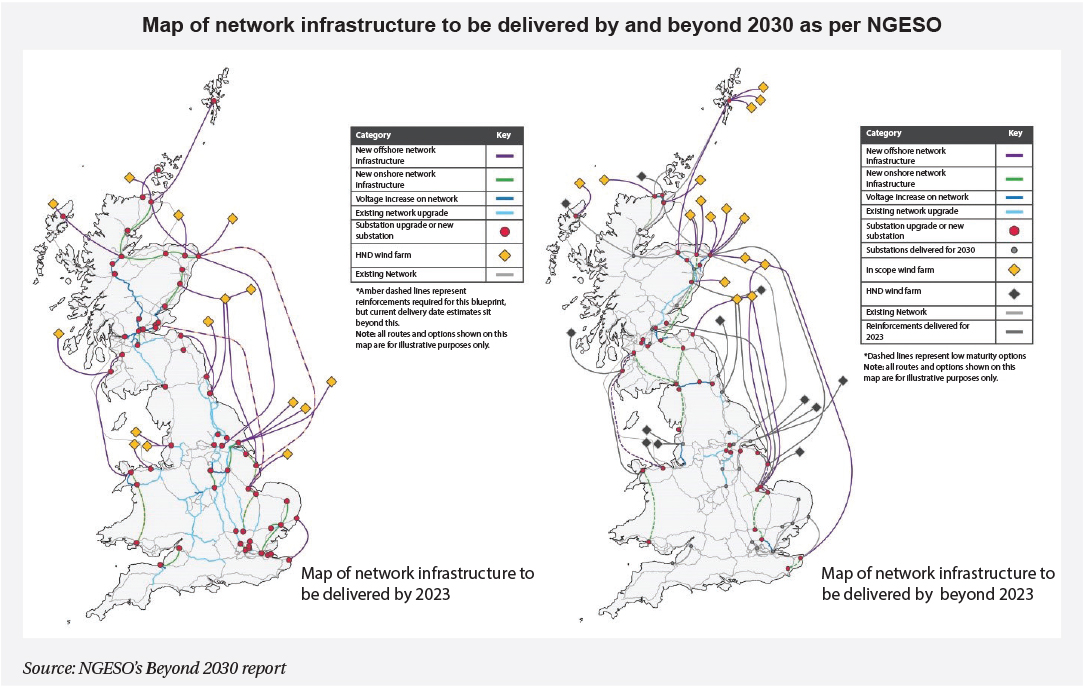 The Beyond 2030 plan essentially outlines the network prerequisites for advancing the targets set by the UK, Scottish and Welsh governments, facilitating the connection of an additional 21 GW of OSW energy from Scottish waters. This OSW capacity will supplement the NGESO’s 2030 strategy, which outlined a framework for connecting 23 GW of OSW projects situated along the Great Britain coastline. Notably, the current plan builds upon the 2030 strategy by making provisions for upgrading the existing network, implementing new infrastructure both onshore and offshore, and using innovative solutions to optimise the location of strategic and adaptable demand connections in the future.
The NGESO realises the need to transmit electricity from both new offshore sources, primarily off the coast of Scotland, and other onshore RES spread throughout Great Britain, to the south of the network where the demand for electricity is greater. It therefore proposes the development of a significant amount of coordinated offshore infrastructure by 2035, to reduce the cumulative impact on communities and the natural onshore environment.
Key recommendations
The NGESO’s recommended design, combined with its 2030 blueprint, facilitates Crown Estate Scotland’s full ScotWind leasing capacity (that is, 28 GW of OSW). Certain reinforcements in the design are in the early stages of the development cycle, and may change as detailed design work progresses. Some of the key recommendations are:
The NGESO’s design includes OSW capacity, aggregating about 3 GW, located off the coast of Shetland. Since much of the electricity produced here will not be consumed locally, it provides an ideal opportunity to co-locate large-scale strategic demand.
To integrate the planned large-scale wind farms (about 12 GW) across the north coast of Scotland, the NGESO proposes upgrading existing assets and establishing new power lines both onshore and offshore, to complement the six previously recommended offshore high voltage direct current links from Scotland to England.
To connect OSW projects off the east coast of Scotland, a continuous offshore link is proposed, connecting Peterhead in the northeast to the Torness area in the southeast of Scotland. This will facilitate the connection of four large-scale wind farms with the onshore network, while reducing the number of landing points in Scotland. Long-distance offshore cabling is recommended to transmit power from these wind farms to Lincolnshire and Kent directly, reducing the impact of onshore infrastructure.
Although a large portion of the future requirement to transmit power will be met via offshore links, it is vital that new onshore circuits are also developed, as they are cheaper, more flexible and can carry significantly more power than offshore circuits. Given the requirement to export power from the new ScotWind capacity, NGESO recommends a potential new high-capacity electrical spine running from the northeast of Scotland through to the northwest of England.
In addition, NGESO recommends strengthening the link between Scotland and North Wales. This would entail doubling the offshore circuit between the two nations, previously proposed in the 2030 blueprint. This reinforcement is expected to improve power flow and complement the previously recommended circuit that, for the first time, directly links North and South Wales.
Further, the NGESO recommends a new offshore connection hub along the coast of Lincolnshire. This will help reduce the impact on protected marine areas in the Wash and around the coast of East Anglia.
The NGESO has revised some of its recommendations, too, changing the scope of the third Eastern Green Link, which will continue to be routed offshore from Scotland to Lincolnshire but will now also link the new offshore connection hub in Lincolnshire with the network further south, shortening the onshore transmission circuit between the new offshore connection node and the Home Counties.
Finally, a high capacity link from a Scottish wind farm to Kent is recommended, which will help in receiving power directly from Scotland and further diversify the renewable energy supply in the southeast of Britain. This will improve the capability of the local network while facilitating the transfer of clean electricity to and from Europe.
In southwest England, the NGESO’s previous recommendations are primarily focused on upgrading existing assets and further infrastructure may be recommended in the future, based on its ongoing design work for the Celtic Sea leasing round.
The way forward
Going forward, the NGESO’s recommendations will require meticulous optimisation through detailed design to mitigate any adverse effects on communities. Both industry stakeholders and the UK’s energy regulator, the Office of Gas and Electricity Markets (Ofgem), will assess these recommendations before implementation. Meanwhile, TOs will commence the DND phase, which will involve optimising the NGESO-proposed designs further, determining routing, technology choices, and where other onshore and offshore assets should be located.
Overall, the NGESO’s recommendations, along with those outlined in the previous 2030 blueprint, signify a transformative shift in the UK’s collective energy infrastructure. It is expected to facilitate a just and timely transition, ensuring that the country achieves its net zero ambitions.