
The power sector in the north-eastern region poses unique challenges in meeting the increasing power demand owing to geographic and infrastructural constraints. However, efforts are being made to overcome these challenges. Tripura, for instance, achieved 100 per cent household electrification in 2019. It has a current peak demand of 490 MW and also depends on power purchases from outside the state.
Tripura State Electricity Corporation Limited (TSECL), which was set up in 2005, has been playing an instrumental role in strengthening the state’s electricity grid and meeting its power requirements.
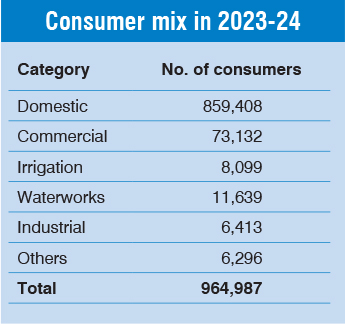
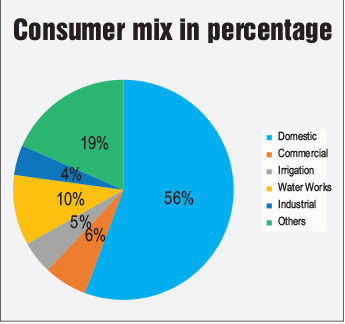
TSECL currently supplies electricity to a consumer base of 0.96 million consumers, of which the majority (859,408) are domestic consumers. Its network spans 54,503 ckt. km and it has 18,379 distribution transformers. In recent years, the utility’s aggregate technical and commercial losses (AT&C) have shown a significant improvement, from 37.4 per cent in fiscal year 2021 to 28.2 per cent in fiscal year 2023. It has also maintained a collection efficiency of 98.2 per cent. It is one of the few utilities to have introduced distribution franchisees in its divisions to reduce losses. TSECL has also recently undertaken unbundling of the transmission segment, with the establishment of a state transmission company, Tripura Power Transmission Limited.
Going forward, significant investments are being planned by the utility to improve its network through the Revamped Distribution Sector Scheme (RDSS). It has proposed an outlay of Rs 11.35 billion to bring down its losses to 19 per cent by 2024-25. Conversion of conventional meters to smart meters will be a key priority for the utility under the scheme, with more than 80,000 meters targeted to be deployed in 2024-25. TSECL will also replace low tension (LT) bare lines with aerial bunched (AB) cables, construct HVDC lines and bifurcate long feeders for improvement of voltage losses under RDSS.
Source of input energy
The corporation’s in-house generation assets comprise two open cycle gas power plants and a small-hydro power plant. These are the 3×21 MW Rokhia gas thermal project, the 2×21 MW Bamanura gas thermal project, and the Gumti hydro project of 2×5 MW capacity (with one standby unit).
The Asian Development Bank, in November 2022, approved a $220 million loan to finance the replacement of the low-efficiency open cycle gas turbines at Rokhia with high-efficiency modern combined cycle technology, doubling its capacity to 120 MW and doubling the plant’s efficiency to 53 per cent.
TSECL also receives 286 MW of power from the central sector allocation pool. Another 196 MW comes from private sector allocation, from ONGC Tripura Power Company Limited.
Revenue–related initiatives
TSECL has undertaken various initiatives to enhance its operational efficiency. It has implemented a revenue management system, consolidating its billing processes on to a single platform, alongside the launch of the Bidyut Bandhu mobile application for consumer ease. To expedite the recovery of long-pending arrears against energy bills, TSECL has implemented an e-collection module, streamlining the payment process and improving revenue collection efficiency.
In another key initiative, TSECL has appointed input-based distribution franchisees through public-private participation in five loss-making divisions. These are Mohanpur, Sabroom, Kailashahar, Ambassa and Manu.
Approximately 184,000 consumers have been provided prepaid meters, promoting transparency and facilitating efficient energy consumption management. It has also introduced photo-based billing on actuals. Consumers are able to get bill information through SMS and email and are able to view bills online via the portal. Consumers can conveniently make online bill payments through various channels such as net banking, credit and debit cards, e-wallets and mobile payment platforms. TSECL has established customer service centres for bill collection in remote and rural areas.
TSECL has also introduced a 24×7 smart centralised customer care centre, which has successfully registered and redressed 150,000 complaints over the past two years. Further, a 24×7 fault rectification team has been introduced to promptly address consumer complaints relating to faults in the system. Additionally, the corporation is set to launch a smart customer care centre system on a SaaS basis, equipped with breakdown attendance vans for enhanced service delivery.
TSECL has also initiated the implementation of an enterprise resource planning system to increase transparency.
 Modernisation and augmentation
TSECL has commissioned three extra high voltage (EHV) substations and 22 substations at the 33 kV level at strategic locations for enhancing supply redundancy and the voltage profile across the network. Efforts are also being directed towards upgrading the existing infrastructure. These include converting the 66 kV EHV networks to 132 kV with the aim of reducing system losses.
To enhance fault detection and restoration, auto-reclosers and sectionalisers have been introduced in overhead lines. Additionally, approximately 25 ckt. km of overhead lines have been converted into underground cables to bolster supply reliability.
TSECL has also undertaken the conversion of 21.52 ckt. km of bare conductors to covered conductors, mitigating transient tripping issues. Furthermore, the introduction of ring main units in the distribution network has helped enhance supply reliability and mitigate redundancy.
Detailed project reports are currently being prepared, indicating a commitment to enhancing operational capabilities and service delivery.
 Future focus
TSECL is gearing up for significant transformation and advancement in the near future. Under the RDSS, out of the total proposed project outlay of Rs 11.35 billion, Rs 4.84 billion has been allocated for loss reduction works, Rs 3.16 billion for smart metering and the remaining Rs 3.33 billion for network modernisation (yet to be sanctioned).
One of the key initiatives is the conversion of conventional meters to smart meters, with the aim of reducing AT&C losses from the current 26 per cent to 19 per cent within the next two years, in alignment with the RDSS trajectory. The tendering process for smart meters has been successfully completed, with letters of award issued for the same.
Under loss reduction works, TSECL plans to undertake the replacement of 4,400 ckt. km of LT bare lines with AB cables in the current fiscal, as well as feeder bifurcation for 22 feeders. Under the network modernisation component of RDSS, it plans to install three GIS substations and supervisory control and data acquisition systems in nine towns.
Another focus area is geographic information system mapping of the entire asset and consumer base, facilitating better asset management and consumer indexing.
TSECL is also planning to augment its generation capacity with 100-150 MW of renewable energy. This strategic move aims to not only meet renewable purchase obligation (RPO) requirements but also to strike a balance between conventional and renewable energy sources. Tripura’s RPO target was fixed at 105 MW by the Ministry of Power, comprising 70 MW of solar and 35 MW of rooftop solar.
Furthermore, TSECL plans to undertake energy auditing post the completion of metering for all distribution transformers and feeders. This initiative will help optimise energy utilisation and improve overall operational efficiency in the long run.
The utility is also planning to set up electric vehicle charging stations in Agartala and other strategic locations over the next two to three years.
Challenges and outlook
Despite implementing new tariffs in 2023-24, TSECL faces cash losses due to a lack of cost-effectiveness. Its average cost of supply-average revenue realised gap increased to Rs 3.19 billion in 2022-23 from Rs 1.7 billion in 2021-22. The revenue for 2022-23 stood at Rs 17.16 billion, up from Rs 15.88 billion in 2021-22.
TSECL also has accumulated arrears for cross-border transactions, stemming from internal issues in neighbouring regions, thus impacting its financial stability. Increased electricity pilferage has further exacerbated the financial strain of the utility. A sudden rise in point of connection charges has disproportionately affected smaller discoms such as TSECL.
These challenges notwithstanding, TSECL’s aim is to transform into a self-sustainable organisation by optimising power purchase costs and ensuring financial stability and viability. Furthermore, TSECL is committed to embracing digitalisation across its business operations, leveraging technology to streamline processes and improve efficiency. Distribution automation is another focal point for the utility, with an emphasis on enhancing system reliability and redundancy to ensure uninterrupted power supply. These strategic initiatives underscore TSECL’s commitment to adaptability, innovation and sustainability in the evolving energy landscape.
With inputs from a presentation by Debasish Sarkar, managing director (in-charge) and director (technical), TSECL, at a recent Power Line conference