

The Central Electricity Regulatory Commission (CERC) recently released a staff paper on “Regulatory Oversight on Bidding Behaviour in Power Exchanges” with the aim to address unprecedented situations such as abnormal increases in power prices on power exchanges. To enhance market predictability, the paper discusses price discovery mechanisms, uniform market clearing prices (UMCPs), pay-as-bid (PAB) and bid screening.
To recall, in October 2022, the CERC had released a staff paper on “Power Market Pricing”, which analysed pricing methodologies in power exchanges to address concerns of abnormal price increases. A total of 39 stakeholders submitted comments on various issues raised in the CERC pricing staff paper. Some of them expressed support for the UMCP mechanism, while some suggested combining it with the high-price day-ahead market (HP-DAM) using PAB. The suggestions also included benchmarking costs and categorising bids based on historical data. Concerns were raised about spikes in power exchange prices, prompting discussions on regulatory intervention to restore market confidence. The new staff paper has been prepared in this context, to outline potential measures for addressing such situations and to ensure consistency in market interventions.
Price discovery in collective transactions
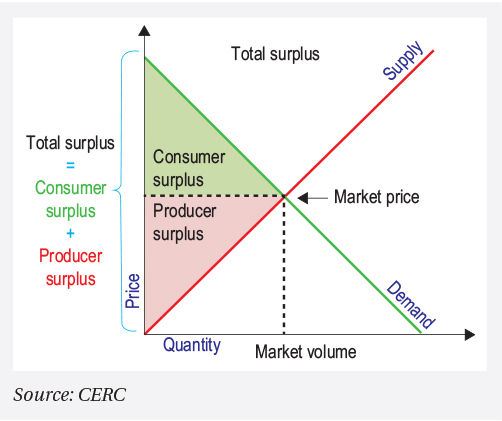
In collective transactions, that is, integrated day-ahead contracts and real time contracts, price discovery follows a closed, double-sided anonymous auction model, conducted in 15-minute time blocks. This UMCP mechanism aims to maximise economic surplus, adhering to PMR 2021 regulations. Both buyers and sellers submit anonymous bids of various price-quantity combinations, forming aggregated demand and aggregated supply curves as shown in the image below. The intersection of these curves determines the market clearing volume (MCV) and market clearing price (MCP). All the buyers and sellers on the left of the intersection point are cleared in the market. After considering transmission constraints, if any, the final MCP and MCV are determined. The price discovered for an unconstrained market is uniform for all buyers and sellers who get cleared.
Uniform market clearing and market surplus
The high prices on the power exchange not only indicate efficient consumption and production in the short term, but also the need for long-term investment opportunities. For instance, past instances of high prices in the Southern Region and low prices in other grids prompted investment in transmission capacity between them.
During the period, January-December 2023, the MCP hit the price cap in about 21 per cent of day-ahead market (DAM) time blocks, and approximately 17 per cent of real-time market (RTM) blocks. This trend, particularly since 2022-23, suggests insufficient supply compared to demand during peak hours. On several occasions, the aggregate demand and supply curves intersected at the ceiling price for price formation. For instance, buyers willing to purchase over 20,000 MW at Rs 10 per kWh faced limited supply of about 3,969 MW, mostly offered at Re 0-8 per kWh. In order to arrive at a pricing equilibrium while fulfilling the basic demand and supply conditions, the supply and demand were made to intersect at the ceiling price of Rs 10 per kWh. Therefore, it is possible that buyers could be paying abnormally high prices, even when the cost of generation by infra-marginal producers is not that high.
The CERC had intervened in March 2022 and later in 2023 by imposing a price ceiling of Rs 10 per kWh (except 20 per kWh for HP-DAM) to address market volatility. However, concerns persist regarding infra-marginal sellers and MCP volatility, especially during high-demand seasons. The regulations aim to minimise information asymmetry, with the power exchange using double-sided closed bidding to encourage honest cost and utility disclosures. Under UMCP, sellers with lower bids in supply shortages or high demand blocks gain extra profit, constituting a seller’s surplus. The literature and market experiences suggest UMCP promotes economic efficiency for homogeneous commodities, as this aligns with sellers’ variable costs. Conversely, PAB mechanisms often lead to higher overall prices, reducing incentives for infra-marginal sellers to improve efficiency. Hence, UMCP remains economically efficient, based on experiences in other electricity markets.
 Proposed framework
The CERC has been actively monitoring market performance and implementing corrective measures. Moving forward, individual market participant behaviour monitoring has been proposed, with corrective and punitive actions at the individual level. Regular monitoring is crucial to prevent bid price manipulation and quantity withholding, ensuring fair and transparent market outcomes. Stakeholders, including the Grid Controller of India, stress the importance of stringent monitoring to foster disciplined behaviour and uphold market fairness.
A review of sell bid data from the January-December 2023 period reveals varied pricing strategies among sellers on the power exchange, including independent power producers, discoms and open access consumers. Some sellers exhibited inconsistent pricing within the same time block, prompting the need for discerning regulatory oversight to address potential market abuse. The proposed monitoring of seller price quotes relative to generation/supply costs aims to ensure fair and targeted regulatory intervention.
Screening of sell bids
All sellers must disclose their variable costs to a designated agency every month, while merchant sellers must also provide technical parameters to support their declared costs. This information will be confidential and solely used for screening and surveillance by the designated agency. The benchmark supply offer (BSO) for each seller will be determined based on their variable costs, with specific criteria for different seller categories outlined. The designated agency will communicate the BSO to the power exchanges every month. The power exchanges must ensure that bid prices do not exceed 1.6 times the BSO in a time block, and 1.2 times the BSO on average throughout the day. Further, sell bids will undergo ex-post evaluation for potential market manipulation, utilising a pivot supplier index and pivotal supplier tests to identify dominant sellers abusing market power. Cases of uncompetitive behaviour will be reported to the commission for further investigation and action.
Screening of buy bids
The power exchanges must ensure that at the beginning of the bidding session for the DAM or the RTM, the total quantity bid by a buyer does not surpass the remaining available transfer capability (ATC) of the state. For intra-state buyers, their total bid quantity must adhere to either the drawal limit or the intra-state entity-specific ATC limit set by the sctate load despatch centre. The residual ATC signifies the remaining capacity after utilising ATC through bilateral contracts. Put simply, the combination of the quantity bid by the buyer and the scheduled quantity from the interstate power system should not exceed the state’s ATC.
Further, as per the staff paper, the agency shall develop and host software to verify the declared variable costs against the estimated variable costs of the merchant suppliers. The power exchanges utilise similar software to evaluate the validity of sell and buy bids before they are incorporated into the market clearing mechanism, thereby promoting fair market competition. Furthermore, the power exchanges submit their monthly order books to the CERC for regulatory oversight, ensuring compliance with established guidelines. To enhance communication and transparency, the power exchanges have developed application programming interfaces through which they share market monitoring results with the CERC, fostering collaboration and efficiency in the electricity market.
Conclusion
In conclusion, the comprehensive staff paper released by the CERC delves into the intricacies of pricing methodologies at power exchanges, addressing concerns of abnormal price fluctuations and market volatility. Through stakeholder engagement and meticulous analysis, the paper proposes measures to enhance market predictability and fairness, focusing on price discovery mechanisms, regulatory oversight and stakeholder engagement. By advocating for a uniform market clearing price mechanism and stringent monitoring of bidding behaviour, the framework aims to ensure transparency, discourage market abuse, and foster a competitive and efficient electricity market. The proposed framework, coupled with regulatory intervention and collaborative efforts among stakeholders, endeavours to uphold market integrity and stability, ultimately benefitting consumers and industry participants alike.