
 Diesel generator sets (gensets) have long been a reliable solution for uninterrupted backup power during instances of power outage, serving the commercial, industrial and consumer segments. These gensets are characterised by low initial investments, short installation times and quick start-up. Consequently, they are widely utilised in industries such as railways, marine, mining, building and construction, telecom and data centres. However, the cost of diesel gensets tends to be relatively high compared to other power sources like natural gas or solar, driven by high diesel fuel prices and substantial maintenance requirements. In fact, fuel costs constitute a staggering 75-80 per cent of the overall power generation cost associated with diesel gensets. Additionally, these gensets entail significant capital and operational expenses. In recent years, technological advancements in the diesel genset space have picked up pace, with innovations such as hybrid or multifuel technologies, thermal storage and electronic control systems enhancing fuel efficiency and transforming the market for diesel gensets.
Capital cost
The capital cost of a diesel genset constitutes 6-7 per cent of its total running costs. In India, these systems are available in power generation capacities of 2 kVA to 7,000 kVA, with 15 kVA-2,000 kVA being the most commonly used. While the initial capital investment for diesel gensets tends to be low, it varies widely depending on the specifications and technology. Generally, capital costs increase with the rating and speed of the genset. For instance, a 15 kVA diesel genset typically costs around Rs 0.2 million, whereas the cost of a 125 kVA set ranges from Rs 0.55 million to Rs 0.7 million. Further, gensets with ratings of 1,000-2,000 kVA can cost nearly Rs 5 million and Rs 11 million, respectively. Notably, there has been a 20-40 per cent increase in their capital cost due to technological shifts following new emission regulations laid down by the Central Pollution Control Board in collaboration with the Ministry of Environment, Forest and Climate Change. These norms apply to all diesel gensets assembled, manufactured and imported to India. Nonetheless, the improved fuel efficiency and engine performance resulting from these advancements and upgrades in the technology offset this increase to a large extent. Regarding engine speed, the typical cost of high speed engines with 1,500 revolutions per minute (rpm) ranges between Rs 15 and Rs 18 million per MW, while for intermediate speed engines with 1,000 rpm, it is Rs 20 million and Rs 25 million per MW. Low speed engines with 600-750 rpm cost over Rs 35 million per MW.
Fuel costs 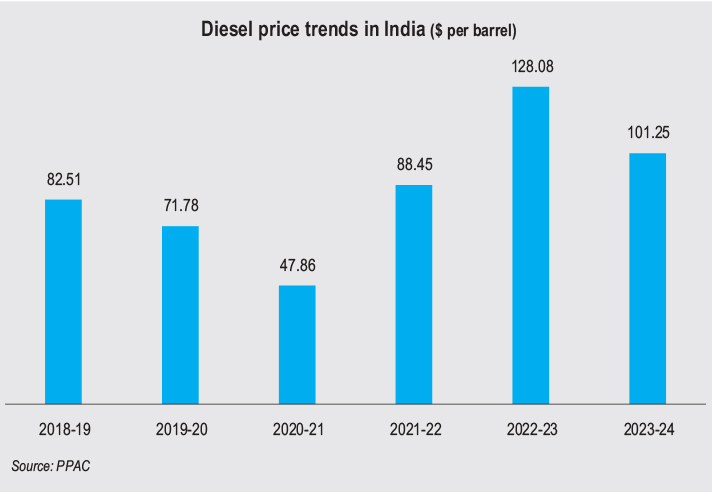
Diesel fuel prices fluctuate significantly, but certain trends remain consistent. Essentially, fuel costs account for about 80 per cent of the lifetime expense incurred on a set. Fuel consumption depends on fuel efficiency and runtimes, along with load levels, which typically range between 50 per cent and 75 per cent.
According to the Petroleum Planning and Analysis Cell (PPAC), the retail selling price of diesel in Delhi was Rs 87.62 per litre in June 2024 as against Rs 89.62 per litre in June 2023, marking a
2 per cent decrease. This decline in the price of diesel is attributed to falling international crude oil prices as well as a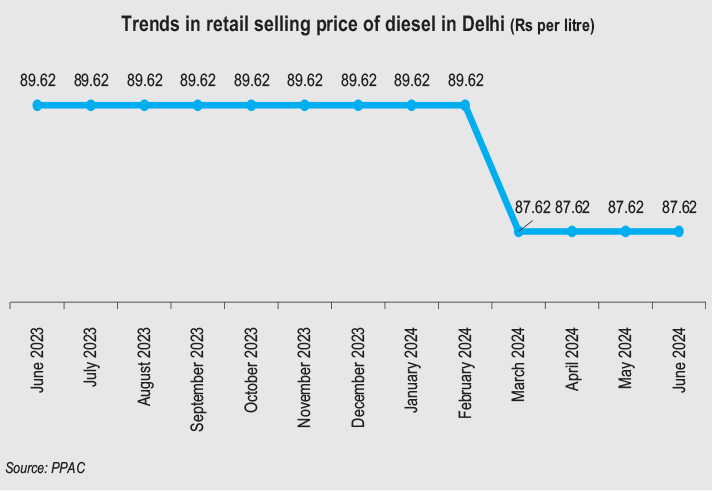 demand slump in the transport and agricultural sectors, which are predominately reliant on diesel.
Similarly, diesel prices averaged $101.25 per barrel in 2023-24, registering a 20 per cent decrease from the $128.08 per barrel in 2022-23. Meanwhile, the power generation cost of diesel hovers in the range of Rs 25-Rs 30 per kWh, driven by routine maintenance requirements for protection against failure modes such as fuel depletion, instability/varnishing, gelling and moisture. As a result, many industries and establishments have been shifting to cleaner sources of power supply that offer greater economic viability. The upscaling of emission standards is further accelerating the growth and adoption of these energy alternatives.
Generation cost
The cost of electricity generated from diesel gensets is in the range of Rs 25 to Rs 40 per unit. As such, these sets are about three to four times more expensive on average, diminishing their market appeal. The high generation cost of these gensets is primarily attributed to fuel pilferage and elevated fuel transportation expenses. In comparison, gas-based gensets produce electricity at a cost of Rs 13-Rs 14 per unit, despite their higher initial investment. Moreover, the operating expenses of renewable energy sources tend to be on the lower spectrum.
Issues and challenges
The fluctuating cost of diesel fuel can significantly impact operational expenses, making budgeting and financial planning difficult. Additionally, the initial capital investment required for purchasing and installing diesel gensets is substantial, and this high upfront cost can be a barrier for many businesses. Maintenance and repair costs are another critical concern, as gensets require regular servicing to ensure efficiency and longevity, adding to the total cost of ownership. Environmental regulations and compliance costs also pose challenges, as diesel gensets are subject to stringent emissions standards, necessitating investments in cleaner technologies or additional equipment such as exhaust treatment systems. Moreover, the rise of alternative energy sources, such as solar and wind power, presents competitive pressure, potentially reducing the demand for diesel gensets and impacting their economic viability. Further, technological advancements and the need for constant upgrades can lead to additional costs, as businesses strive to keep their gensets efficient and in line with the latest industry standards.
The way forward
Diesel generators have long been the backbone of off-grid power systems in the country, meeting peak power demand even in remote locations. However, there has been a gradual shift in recent years among commercial and industrial establishments. These entities are moving towards variable renewable energy alternatives such as rooftop solar, which offer greater scalability and cost-effectiveness. Despite this, renewable energy remains inherently intermittent, causing imbalances in the grid and necessitating the continued use of diesel gensets as reliable backup solutions during periods of inadequate electricity supply. Moreover, the coming years are poised for significant technological advancements and upgrades in the engine and genset industry. Innovative hybridised solutions, coupled with battery energy storage systems, are set to revolutionise the industry by mitigating intermittency issues associated with wind and solar power. Going forward, the future viability of diesel generators will be influenced by the rising adoption of energy storage and renewable energy technologies across the world.