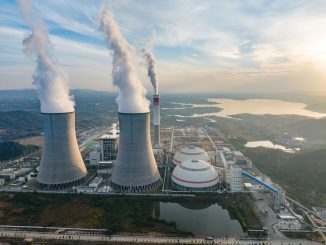
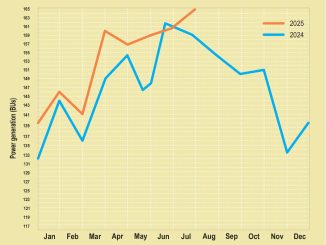
Thermal power remains vital in India’s energy landscape, especially in meeting peak summer demand, contributing 54 per cent of the total installed capacity of 446 GW (as of June 2024). However, coal-based capacity addition has slowed down and its share in the generation mix has decreased due to a policy shift towards renewables and rising stressed assets in the thermal sector. As India pursues its net-zero targets and aims for 500 GW of non-fossil capacity by 2030, the role of coal is shifting from baseload to balancing renewable energy. To support this, thermal plants must be retrofitted for flexible, efficient operation during peak demand.
Segment growth and performance
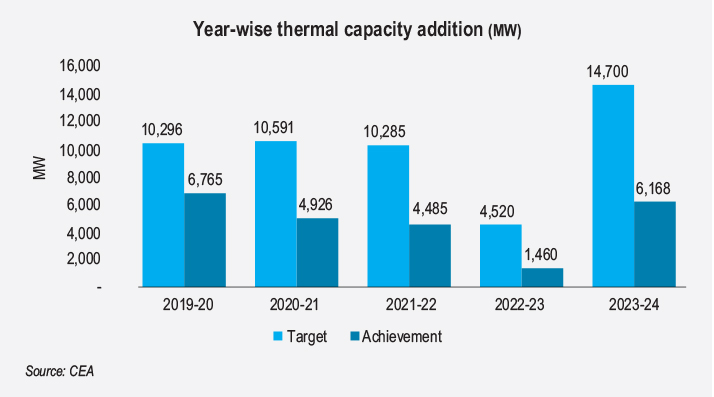
Thermal generation capacity has increased from 226 GW in March 2019 to 243 GW in March 2024, recording a compound annual growth rate of 1.46 per cent. As of June 2024, thermal generation capacity stands at around 243 GW. Of this, coal accounts for around 86.8 per cent (or 211 GW) of thermal generation capacity, while the rest is contributed by gas at 24.8 GW (10.2 per cent), lignite at 6.6 GW (or 2.7 per cent) and diesel (0.2 per cent or 589 MW). Thermal capacity addition has slowed down significantly in the past five years, with generators as well as lenders moving away from coal-based projects owing to environmental concerns and gas-based projects are stalled due to the lack of domestic gas. Only about 6.17 GW was added by thermal power plants (TPPs) in 2023-24 vis-à-vis 8.7 GW in 2017-18.
The national plant load factor (PLF) of thermal power stations registered an increase from 54.5 per cent in 2020-21 to 69.09 per cent in 2023-24. On a year-on-year basis, the PLF has shown a slight improvement over the 63.95 per cent recorded in the previous year (2022-23). This could be attributed to a healthy demand growth and limited capacity addition, leading to improved capacity utilisation. During 2024-25 (as of June 2024), the PLF of TPPs has been recorded at 75.71 per cent.
Recent developments and project announcements
In cope with the peak demand season, in June 2024, the Ministry of Power (MoP) advised coal-fired TPPs to import coal for blending at 4 per cent until October 15, 2024, following a similar order in March 2024 for 6 per cent blending until June. In April 2024, the MoP took steps to activate underutilised gas-based power plants to meet the rising summer electricity demand, issuing directives under Section 11 of the Electricity Act, 2003, for maximising generation from May 1 to June 30, 2024. Additionally, the MoP directed power generators to sell surplus power in the markets to address unused capacity.
In an another development, the Union Budget 2024-25 proposes a joint venture between NTPC Limited and Bharat Heavy Electricals Limited (BHEL) that will set up a full-scale 800 MW commercial plant using advanced ultra super-critical (AUSC) technology. The government will provide the required fiscal support. The AUSC technology has been developed indigenously through a consortium of BHEL, Indira Gandhi Centre for Atomic Research and NTPC. The central government has reportedly spent Rs 15.54 billion on developing the technology.
Recently, several new contacts have been awarded in the thermal power segment. In August 2024, the Damodar Valley Corporation awarded a contract to BHEL to set up a 2×800 MW supercritical TPP in Koderma, Jharkhand. In July 2024, GE Power India Limited received a notice of awards from NTPC GE Power Services Private Limited with a contract value of Rs 3.48 billion. The contract focuses on the renovation and modernisation of steam turbines at NTPC’s Vindhyachal thermal power station units 1-3 (3×210 MW).
 In the same month, the central government gave in-principle consent to TUECO, a joint venture of UJVN Limited and THDC India Limited, to set up a coal-based TPP in Uttarakhand. The Central Electricity Authority (CEA) had previously recommended the supply of coal to Uttarakhand for the purpose of generating 1,320 MW of thermal power under the Scheme for Harnessing and Allocating Koyla (Coal) Transparently in India (SHAKTI) policy.
In June 2024, Adani Power Limited awarded an order to BHEL for setting up a 2×800 MW TPP at Raipur, Chhattisgarh. The project is estimated to be worth Rs 35 billion. In the same month, Mirzapur Thermal Energy UP Private Limited awarded a contract to BHEL for a 2×800 MW TPP at Mirzapur Phase I, Uttar Pradesh. The cost of the project is estimated to be over Rs 35 billion.
In January 2024, NLC India Limited awarded an EPC contract to BHEL for NLC’s 2,400 MW (3×800 MW) Talabira TPP in Odisha, featuring ultra supercritical technology. The power is tied up with Tamil Nadu, Odisha, Kerala and Puducherry, with the first unit scheduled for commissioning in 2028-29.
Issues and challenges
The thermal generation sector faces major challenges, particularly in maintaining a stable coal supply. Seasonal rainfall disrupts coal production and transportation, leading to critically low stocks, risking plant availability and potential blackouts. The sector’s heavy reliance on coal makes any supply disruption impactful. Another challenge is the issue of stranded or stressed assets, where significant investments in TPPs remain underutilised, creating financial burdens. Tighter environmental regulations are also on the horizon, which, while necessary, may increase operational costs and complicate long-term planning. Additionally, the growing presence of renewable energy requires TPPs to operate more flexibly, straining equipment and increasing maintenance costs.
 Future outlook and the way forward
To tackle these challenges, the thermal generation sector must strategically plan and execute by ensuring a stable coal supply chain, even during disruptions, by diversifying sources, improving logistics and maintaining higher stockpiles. The sector should learn from past mistakes by adopting prudent investment strategies and optimising existing assets. To meet stricter environmental regulations, thermal plants must upgrade to ultra-supercritical units, install SOx and NOx reduction equipment and explore carbon capture solutions.
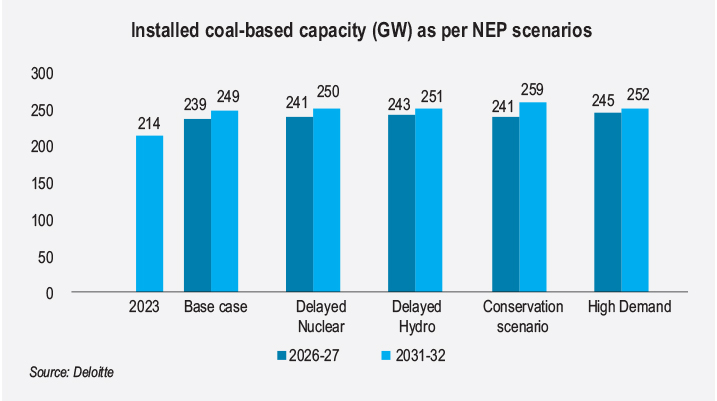
Additionally, to meet the country’s baseload power needs, an additional 80 GW of thermal power capacity is required by 2031-32. Currently, 27 GW of capacity is under construction. Therefore, to meet the growing power demand, an additional 55 GW-60 GW of thermal capacity must be added, which is significantly higher than the planned addition of 25 GW.
Moreover, the capacity addition in 2023-24 is expected to reach approximately 26-27 GW, significantly higher than the 16.9 GW achieved in 2022-23. This increase is driven by improvements in capacity addition across the renewable energy and thermal segments, as well as the commissioning of the 700 MW Unit-3 at Kakrapar Atomic Power Station in June 2023.
Going forward, coal-based power generation plants must focus on four key considerations to remain competitive and sustainable. First, preparing for flexible operation is essential as the increased penetration of renewable energy will require thermal plants to operate more flexibly. This will necessitate additional capital and operational expenditures, along with changes in control systems. Second, there must be a focus on adopting more efficient and sustainable technologies. Future capacity additions will likely involve high-efficiency ultra-supercritical and advanced ultra-supercritical units, along with investments in SOx and NOx reduction equipment and evaluations of cost-effective carbon capture and storage solutions. Third, digitalisation will play a critical role, with data-driven decision-making powered by AI/ML for performance optimisation and predictive maintenance, IIoT initiatives for equipment performance monitoring and the use of analytics to enhance market participation. Investments in emerging technologies such as AR/VR, drones and robotics will also be important. Finally, achieving operational excellence will be crucial, with a focus on optimising heat rate, auxiliary power consumption and oil consumption, as well as maintaining adequate coal stock, which has recently averaged seven to ten days.
The outlook for thermal generation remains stable, supported by several positive developments. An improvement in the thermal PLF has been observed, alongside a reduction in outstanding dues from state discoms, driven by the implementation of the late payment surcharge rules. Additionally, sustained growth in electricity demand is expected to enhance the prospects for signing new power purchase agreements for thermal independent power producers, providing greater visibility and stability for the sector in the coming years.
Akanksha Chandrakar