
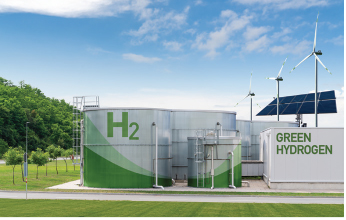
India is emerging as a key player in the global green hydrogen economy, recognising hydrogen’s potential as a versatile and clean fuel essential for achieving decarbonisation targets. Its versatility positions it as a potential game changer across various industries including aviation, maritime, refining, fertiliser, transport, power generation and the hard-to-abate sectors. The Indian government sees green hydrogen not only as a solution to meet domestic power demands but also as an opportunity to become a major global exporter. This aligns with the country’s broader objectives of expanding renewable energy capacity, ensuring energy security and achieving self-sufficiency in energy needs. Recently, the sector has witnessed various policy announcements and tender activity.
This article provides a brief overview of these initiatives and future outlook for the sector.…
Policy environment
The launch of the National Green Hydrogen Mission (NGHM) in January 2023 marked a significant milestone in India’s green hydrogen journey. With an initial outlay of Rs 197.44 billion, the mission aims to establish at least 5 million metric tonnes of annual green hydrogen production capacity by 2030. This ambitious target is expected to attract over Rs 8,000 billion in investments, generate more than 600,000 jobs, and significantly reduce fossil fuel imports and greenhouse gas emissions. A key component of the NGHM is the Strategic Interventions for Green Hydrogen Transition (SIGHT) programme, which offers financial incentives to promote the domestic manufacturing of electrolysers and green hydrogen production. The NGHM’s budget allocation is strategically divided, with Rs 174.9 billion dedicated to the SIGHT programme, Rs 14.66 billion for pilot projects, Rs 4 billion for research and development, and Rs 3.88 billion for other mission components.
In February 2024, the Ministry of New and Renewable Energy (MNRE) issued guidelines under the NGHM for pilot projects in the mobility, steel and shipping sectors. For the transport sector, the scheme allocates Rs 4.96 billion until FY 2025-26 to replace fossil fuels with green hydrogen in vehicles and develop refuelling infrastructure. In the steel industry, Rs 4.55 billion is budgeted until FY 2029-30 to substitute fossil fuels with green hydrogen. For the shipping sector, Rs 1.15 billion is allocated until FY 2025-26 to promote green hydrogen use for ship propulsion and establish bunkering facilities at ports.
In May 2024, the MNRE waived the Approved List of Models and Manufacturers (ALMM) requirement for solar projects and the Revised List of Models and Manufacturers requirement for wind projects to be used for green hydrogen production. This waiver, applicable to renewable energy projects situated within export-oriented units or special economic zones and providing electricity only to green hydrogen production facilities within these demarcated zones, will be in effect for all projects operational by December 31, 2030. However, it remains to be seen whether industry stakeholders will fully embrace this indirect incentive, given the inconsistency of the ALMM policy over the years.
Additionally, the government has extended the waiver of interstate transmission system charges for green hydrogen and ammonia production units using renewable energy. Projects commissioned on or before December 31, 2030, are eligible for this waiver, which has been a key incentive for both renewable energy and green hydrogen developers.
In July 2024, the MNRE issued guidelines for disbursing incentives for the production of up to 450,000 metric tonnes of green hydrogen annually under Component II (Mode 1, Tranche II) under the SIGHT programme. Solar Energy Corporation of India Limited (SECI) has been tasked with supervising the competitive bidding process and managing the programme’s implementation. Incentives for green hydrogen producers will be distributed over three years, with limits set at Rs 50 per kg in the first year, Rs 40 per kg in the second year and Rs 30 per kg in the third year. For products like green ammonia, derived from green hydrogen, incentives will be based on the quantity of green hydrogen used in production, with an established equivalence factor of 0.1765 kg of green hydrogen per kg of green ammonia.
In the same month, the government introduced funding guidelines for green hydrogen testing facilities as part of the NGHM. These guidelines by the MNRE aim to establish standards and a regulatory framework by providing financial support for testing facilities, infrastructure and institutional backing. With a total budget of Rs 2 billion, the programme will run until 2026, focusing on identifying gaps in existing testing facilities for components, technologies and processes within the green hydrogen value chain. It also aims to establish new testing infrastructure to validate, certify and assess these essential elements. It encourages collaboration between private and government entities to establish advanced testing facilities in India and promotes the creation of specialised centres of excellence to meet diverse testing needs. The National Institute of Solar Energy will serve as the programme implementation agency, with the MNRE funding covering costs for equipment, installation and commissioning.
Recent tender activity
The sector has been experiencing good tender momentum, which bodes well for the sector. Tenders for electrolyser manufacturing, green ammonia production and green hydrogen hubs have been launched recently. The following are some recent tenders:
Green hydrogen hubs (August 2024): SECI issued calls for proposals to identify an executing agency and establish green hydrogen hubs under the NGHM. This aims to create regions that can support large-scale production and use of green hydrogen, with a budget of Rs 2 billion allocated for this period until fiscal year 2025-26. The tender aims to fund at least two such hubs, each with a planned capacity of at least 100,000 metric tonnes per year.
Green hydrogen production facilities (July 2024): SECI launched a tender to allocate 450,000 metric tonnes per annum (mtpa) of green hydrogen capacity, divided into two buckets: 410,000 mtpa for technology-agnostic pathways and 40,000 mtpa for biomass-based pathways. This is under the SIGHT programme.
The last date for proposal submission was August 21, 2024.
Green ammonia production (June 2024): SECI released a tender for green ammonia production and supply through cost-based competitive bidding under the SIGHT programme. Suppliers were required to meet at least 90 per cent of the annual requirement outlined by the procurer, with a bid submission deadline of July 29, 2024.
Electrolyser manufacturing (March 2024): SECI issued a tender for 1,500 MW of electrolyser manufacturing capacity, divided into three buckets based on technology requirements. The bid deadline was April 30, 2024, with a 30-month commissioning period and five-year sales incentives for successful bidders. The tender received an overwhelming response, with 23 companies bidding for a total of 2,847 MW of annual capacity, significantly oversubscribing all three buckets. Major players such as Adani Enterprises, Avaada Electrolyser, Newage Green Electro and Waaree Energies were among the bidders.
Future outlook
Green hydrogen holds immense potential for India to decarbonise its economy, reduce dependence on fossil fuel imports and emerge as a leading exporter by 2030, supported by significant investments and strategic initiatives. If it aims to take the lead in the global green hydrogen race, India should work with key importing countries to implement common standards. In addition, it should consider providing more subsidies to match those being provided in other countries, especially in the US after the introduction of the Inflation Reduction Act, 2022.
Despite the government’s supportive policies and ambitious targets, financing green hydrogen projects in India faces several significant challenges. According to a recent report by the Clean Finance Leadership Initiative and the Council on Energy, Environment and Water, the high production costs, currently ranging from $3.5 to $5 per kg, far exceed the break-even price of $2.5 per kg for green hydrogen. Achieving these targets within the set time frame will require considerable investments in technology, infrastructure and supply chains, all of which are still in their early stages. The lack of proven technology and a reliable supply chain for green hydrogen and ammonia further complicate financing. Investors are wary of the financial risks associated with such a nascent market, especially when production costs remain high and the global market for green hydrogen and ammonia is still developing. Additionally, the long-term profitability of these projects is uncertain, with future demand and price trajectories highly dependent on the evolution of global and domestic policies and market dynamics.
Going forward, as the sector grows, green hydrogen and ammonia are projected to become increasingly competitive, generating further demand. Public and private sector collaboration will be crucial in creating innovative financing mechanisms that can de-risk investments and attract the necessary capital. Establishing special purpose vehicles or issuing green bonds dedicated to financing green hydrogen projects can attract capital from institutional investors interested in sustainable investments. Green bonds offer investors an opportunity to support environmentally friendly projects while generating financial returns.
Generating carbon credits through emission reduction can offer an extra source of revenue for green hydrogen projects. Participating in carbon markets or implementing carbon pricing mechanisms can incentivise investments in low-carbon technologies, including green hydrogen production. Policy interventions, such as guaranteed offtake agreements and price support mechanisms, could also play a critical role in ensuring the financial viability of green hydrogen projects.
In conclusion, while India’s green hydrogen sector holds tremendous potential and is supported by a robust policy framework, overcoming the financial challenges will be key to realising this potential. Concerted efforts from all stakeholders, including the government, industry and financial institutions, will be essential in driving the growth of this promising sector.
Preeti Wadhwa