
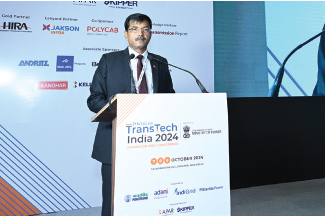
 Inaugural Address
R.K. Tyagi, Chairman and Managing Director, Power Grid Corporation of India, delivered the inaugural address at the Power Line TransTech India 2024 Conference and Exhibition. He began his address by highlighting the global shift towards cleaner energy, driven by the urgent need to combat climate change and reduce carbon emissions. India, being rich in renewable energy resources (especially solar and wind), has the potential to become energy secure through renewable energy development, he noted. India is already making progress in this direction, with renewables capacity surpassing 200 GW, and is on track to achieve 500 GW by 2070. To manage the variability of renewable energy, it is essential to integrate diverse renewable energy sources across regions.
Further, Tyagi observed that the energy transition can only be achieved with a reliable and robust transmission system, and that there can be no transition without transmission. Under the new National Electricity Plan, the transmission network is set to grow from 485,000 ckt km in 2024 to 650,000 ckt km by 2032. Transformation capacity will also increase from 1.25 million MVA to 2.34 million MVA. The plan entails an estimated investment of Rs 9,150 billion. He noted that this expansion is critical for meeting the rising electricity demand, integrating renewable energy and accommodating green hydrogen loads into the grid.
Tyagi also highlighted that building transmission infrastructure comes with geographical, technical and social hurdles. Laying transmission lines through difficult terrain, while balancing environmental concerns and community opposition can lead to delays and cost overruns. Securing clearances is a time-consuming process that impacts project timelines. Further, global supply chain disruptions pose a challenge, particularly for high-tech components such as transformers and HVDC parts. To mitigate this, local manufacturing and initiatives such as Make in India are crucial. One of the most pressing challenges is the shortage of skilled manpower, and there is a need for training and capacity building across the value chain. Tyagi noted that while advanced technologies such as drones, artificial intelligence (AI) and predictive maintenance are helping enhance grid reliability and reducing downtime, the shortage of skilled personnel remains a critical issue.
In conclusion, Tyagi stated that energy transition is one of the most significant challenges of our time, with the power transmission sector at its core. From overcoming geographical, technical and social challenges to leveraging AI, drones and advanced analytics for asset management, there is a need to innovate and adapt. Although the road ahead is long and challenging, the potential rewards of a cleaner, more sustainable energy future make every effort worthwhile, he added.
 Industry Perspective
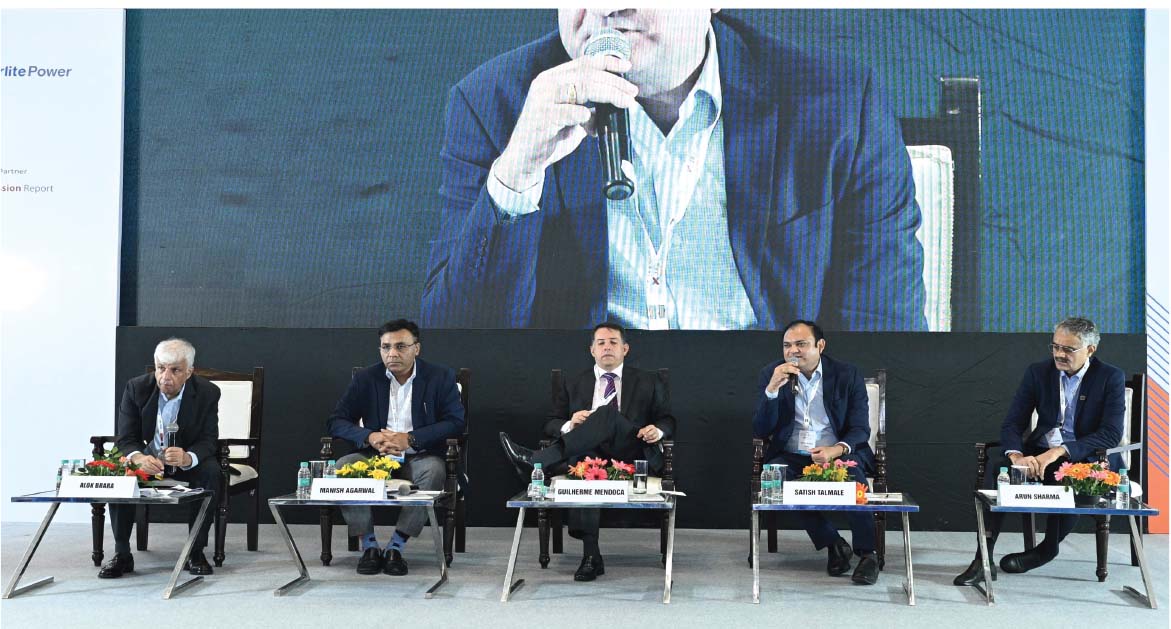
The Industry Perspective session featured a panel discussion among Manish Agarwal, CEO (Conductors and Telecom), MD (T&D), APAR; Guilherme Mendonca, Head, Energy, Siemens; Arun Sharma, CEO, Sterlite Power; and Satish Talmale, COO, IndiGrid, on a wide range of topics, including the state of the sector, industry priorities, new technologies being adopted, challenges and outlook…
According to Manish Agarwal, two key considerations to meet India’s renewable energy targets are the development of a robust transmission network and addressing right of way (RoW) and land-related issues. Approximately $5 billion-$6 billion worth of annual investments will be needed for infrastructure development. He noted that RoW issues have been the primary cause of delays for both greenfield and brownfield projects.
On the technology front, he noted that the use of monopoles and lattice towers can significantly help address space challenges. It is also crucial to focus on reconductoring and augmenting existing transmission lines at the planning stage itself, as it is less expensive than setting up new lines.
He emphasised that the industry must focus on indigenisation and reducing the reliance on imports. This will facilitate the development of India as a hub for exports to global markets such as Europe and South America, enabling it to compete on a global scale alongside Chinese players. There is also a need for India to promote free trade agreements at the policy level to promote India’s export competitiveness.
Overall, he noted that the outlook for the industry for the next 10-20 years is extremely positive. However, challenges such as higher attrition rates and a lack of skilled manpower persist. It is also critical for India to improve the safety and quality of its products.
Guilherme Mendonca highlighted the rapidly increasing electricity demand in India, which is expected to increase substantially over the next few years due to the growth in high energy-demand sectors, such as electric vehicles, which are yet to achieve full market penetration. He added that decarbonisation will become critical, as India is expected to enforce carbon trading targets by 2026, necessitating industries to transition towards decarbonised operations. Further, economic growth in India’s large middle class will lead to a significant increase in electricity consumption.
Regarding future technological requirements, he anticipates a major focus on high voltage direct current (HVDC) systems, for which long-term planning will be crucial. While point-to-point HVDC project implementation has been carried out, DC-level switching will soon be undertaken to connect large generation areas to consumption centres. Further, grid stabilisation technologies and digitalisation will play pivotal roles.
According to Arun Sharma, a key challenge is ROW. He noted that cross-country power transmission line projects have benefitted from strong state support. Stakeholder management, especially by local communities, remains crucial.
Another critical aspect is supply chain management. The volume of work getting awarded is substantial; therefore, the pace of project execution should be improved through mechanisation. Currently, in India, completing around 1 km of lines takes 1,400-1,500 days, compared to less than 1,000 days in Brazil, and only about 350-400 days in the US and Canada. He added that bidding documents should be structured in a way that provides developers with opportunities to deploy technologies that reduce time and costs.
He stated that, going forward, offshore wind, solar, pumped hydro and hydrogen are key emerging technologies expected to play a critical role in achieving the net-zero targets by 2070. He also acknowledged that tariff-based competitive bidding is performing exceptionally well in India and that no other country in the world, except for Brazil, has such an efficient process. The support and efforts of the central government in land acquisition, RoW and coordination with states have been commendable.
According to Satish Talmale, while TBCB has certainly improved efficiency, the challenge for developers now lies in integrating the best technologies into the systems. This is crucial for ensuring the long-term sustainability of projects. While technologies are available, as developers, we need to determine whether there is willingness to incorporate them into the e-reverse auction framework.
As an operator in the renewable energy space, Talmale noted that rapid changes brought by renewable energy trends are making it increasingly difficult to manage the grid in a smarter and more resilient manner. Dynamic shifts are taking place, and while other parts of the world are adapting, India needs to focus on building an ecosystem that can keep pace with these changes.
A key challenge he highlighted is the shortage of skilled labour, particularly in areas such as cybersecurity and digitalisation, which are becoming critical as we move toward smarter grid management. There is also significant potential for capacity building in the battery storage segment, offering a massive opportunity to develop an ecosystem around renewable energy.
On the technology front, he shared that Indigrid has implemented digital asset management, with 100 per cent of its assets now on the platform. They are also implementing an asset health index that monitors the condition of individual equipment, such as transformers circuit breakers and other critical components in the transmission line. They have also implemented a weather forecasting platform to predict challenges such as high wind speeds or lightning that could impact transmission lines.
 Transition to Clean Energy
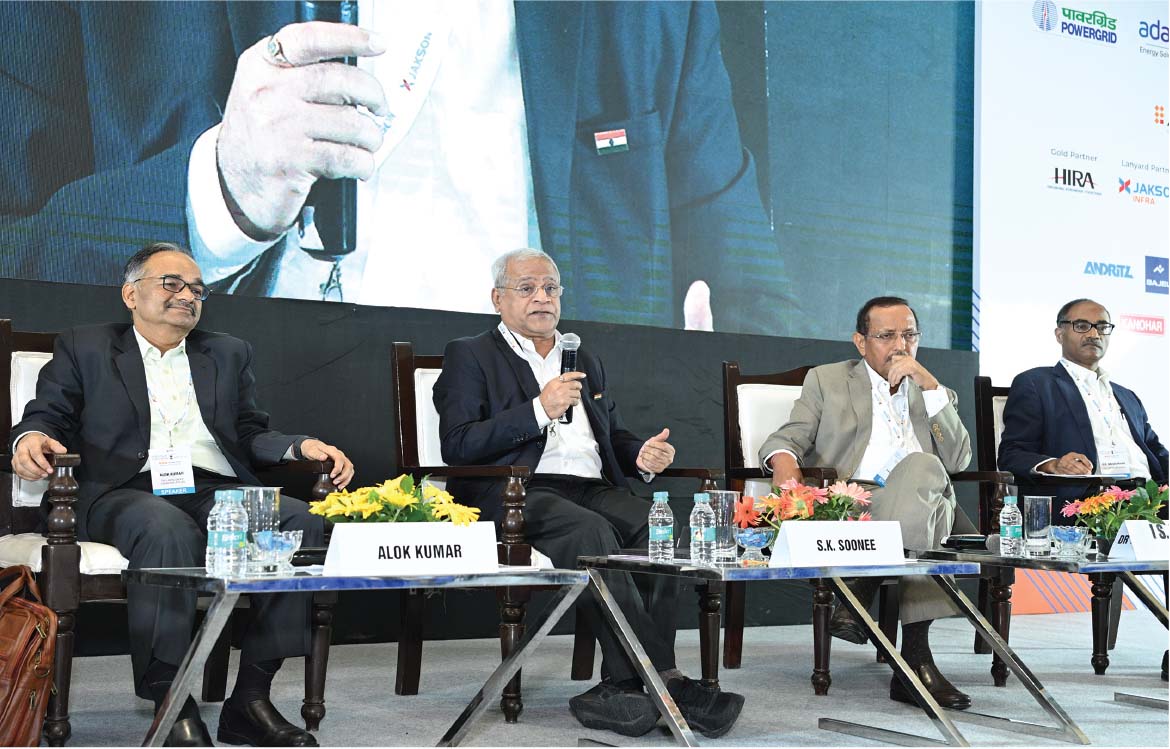
The panel discussion on “Transition to Clean Energy” brought together key sector leaders to discuss the critical role of a robust power transmission system in India’s renewable energy future. The esteemed panelists included Alok Kumar, Former Secretary, Ministry of Power; I.S. Jha, Former CMD, Powergrid and Former Member, CERC; S.K. Soonee, Former and Founder CEO, POSOCO (now GRID-India); and S.R. Narasimhan, CMD, Grid Controller of India.
Mr Kumar opened the panel discussion by sharing his views on India’s progress towards achieving the country’s renewable energy targets. According to him, transmission will be the key to the clean energy transition. However, there are a few challenges. The first is affordability, where the unit cost of high-voltage direct current (HVDC) lines has almost risen fourfold. It is crucial to cost-effectively augment the transmission capacity by appropriately pricing transmission services. The second challenge is the intra-state system, which has been lagging; although the country has done well in developing interstate infrastructure. To achieve the Central Electricity Authority’s renewable energy capacity projections, more states must participate in tariff-based competitive bidding.
The third challenge, according to him, is technology, which needs to be addressed by optimising cost, flexibility, quality and resilience. Kumar emphasised that policy certainty and the visibility of long-term planning are the most important factors for attracting investors and supporting the local manufacturing ecosystem.
Reflecting on the current state of the country’s energy sector, I.S. Jha emphasised the critical role of advanced technologies, such as higher voltage levels and HVDC systems. He noted that the central challenge that India faces is not technical but rather the enormity of the task at hand. It is evident that current planning processes are insufficient, and the sector requires coordinated planning that encompasses all stakeholders. He emphasised that coordinated planning is a global best practice that must be embraced. The involvement of transmission planners from the outset is essential to address supply chain complexities, including manufacturer engagement and voltage regulation challenges.
Moreover, he stated that prioritising technical criteria is needed to navigate these challenges effectively. It is imperative to ensure that India’s transmission grid, one of the best globally, operates in harmony with evolving policies to foster sustained growth and efficiency in its power infrastructure.
Soonee began by addressing key issues concerning the valuation of transmission systems. He emphasised that the functions of transmission lines are often underappreciated, a trend that is expected to change as the sector evolves. He underscored the urgent need for significant investments in transmission infrastructure to enhance efficiency and reliability.
He pointed out that India has the opportunity to reconfigure its transmission topology, and urged planners to prioritise the re-optimisation of the existing network to address current inefficiencies. Effective optimisation, he noted, necessitates comprehensive studies that incorporate locational marginal pricing, loss factors and congestion pricing.
Highlighting the complexities of transmission networks, S.K. Soonee advocated for a systems-based approach, viewing transmission as a system of systems. He expressed concern over the shortage of qualified planners in large states. While congestion levels have remained low for the past five years, he warned that future growth may present new challenges.
S.R. Narasimhan expressed his belief that India is gradually progressing towards net zero targets by 2070 and 500 GW of non-fossil energy capacity by 2030. He discussed the work of the Grid Controller of India, and its close involvement in the interconnection of regional grids. He opined that regional transmission capability has become extremely important, and highlighted the number of states that are discussing the need to increase their import capabilities. He also stated that India, with its large geographical footprint, needs to have more transmission planning energy scenarios. Currently, there are nine scenarios covering three seasons, three times a day.
Narasimhan also emphasised the need to improve the technical standards in the power transmission space. This will help build a more resilient power system without the loss of valuable time. Three main areas need attention in the sector, according to him. These are the creation of planning resilience to avoid damage to transmission structures from the increased occurrences of cyclones in coastal zones, stronger concession agreements with defined work responsibilities, and cybersecurity.
In conclusion, power transmission network needs to expand significantly and become highly robust to cater to the large volumes of renewable energy integration expected in the coming years. Further, adequate focus needs to be given to cross-border trading and integration of distributed renewable energy systems into the power grid.
 State Utility Perspective
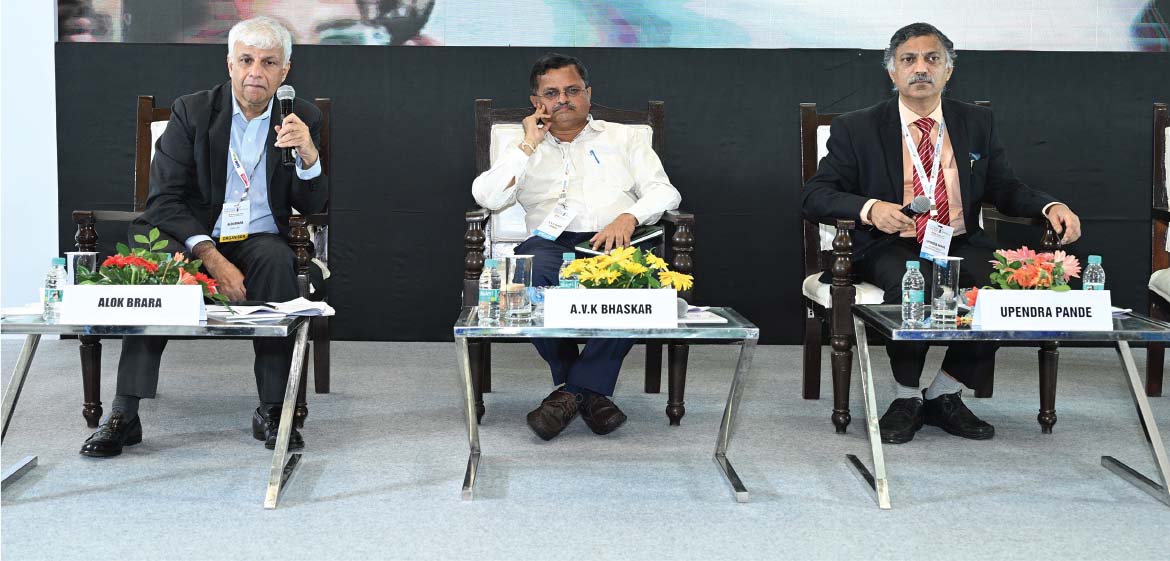
The session on State Utility Perspective featured remarks by Upendra Pande, Managing Director, GETCO; and A.V.K. Bhaskar – Director Grid, APTRANSCO, on their state transco’s performance, plans, challenges and outlook.
Upendra Pande began his address by highlighting Gujarat’s key role in renewable energy integration in India, contributing 22.4 GW or 12 per cent of the country’s total renewable capacity. The state’s overall installed capacity stands at 45,500 MW, with about 50 per cent coming from renewable energy. By 2030, the state aims to contribute 100 GW toward India’s target of 500 GW.
Pande emphasised that Gujarat’s transmission system is being expanded to meet future needs. From 2,300 substations as of 2023-24, the state plans to increase this number to over 3,300 by 2029-30. It also plans to add 55,000 ckt km of transmission lines and expand its transmission capacity to 250,000 MVA by 2030. Gujarat is committed to harnessing its immense solar (235 GW) and wind (142 GW) potential through a combination of solar and wind energy projects. This will necessitate the development of 14 GW of additional transmission infrastructure. A key initiative in the state is the provision of daytime power for agriculture, which would require special infrastructure to deliver solar power during peak solar hours.
The state has also launched the Akshay Urja Setu Portal, which simplifies the process for renewable energy developers. This portal provides a transparent platform, mapping existing substations and available transmission capacity while tracking applications in order to streamline the connectivity process for developers, enhancing the ease of doing business in Gujarat.
In addition, the state is investing in advanced transmission infrastructure, including high-capacity HTLS conductors to reduce its land footprint. The introduction of 765 kV systems will facilitate bulk power transmission, particularly to remote regions or urban areas with growing energy demands. The state is also focusing on improving power quality through STATCOMs for stable power supply.
 He added that the state is prioritising sustainability in its transmission network, with the addition of green substations that use environment-friendly materials such as ester-oil filled transformers and SF6 free circuit breakers. Gujarat is also prioritising cybersecurity in its transmission infrastructure.
By 2030, the state aims to play a pivotal role in achieving India’s renewable energy targets while integrating innovative and sustainable technologies to enhance power generation and transmission capabilities.
According to A.V.K. Bhaskar, Andhra Pradesh has achieved energy surplus and the state’s per capita consumption has increased from 1,480 kWh in 2019 to 1,797 kWh in 2024. The transco also maintained one of the lowest transmission losses in the country at 99.82 per cent in FY 2024. The utility’s current network comprises 371 extra high tension substations with a total capacity of 66,638 MVA, and over 32,569 ckt km of transmission lines. Andhra Pradesh’s grid handled around 81,000 MUs in 2023-24, with a peak demand of 13,712 MW this summer.
Outlining the company’s key priorities, Bhaskar noted that in order to address the intermittency of wind and solar generation, the company is planning pumped storage projects and battery storage systems, which will also support future grid expansion. Smart grid technologies and green energy corridors for renewable energy evacuation are being prioritised, along with data analytics for predictive maintenance. Further, digital skill development programmes for employees are another focus area. Over the next five years, 71 new substations are planned, along with 4,696.32 ckt km of transmission lines and 16,506.5 MVA of transformation capacity augmentation.
Gas-insulated substations (GISs) are being installed at critical locations, including a 400 kV GIS at Thallayapalem, 400 kV and 220 kV GISs at Atchutapuram, and a 132 kV GIS at Kapuluppada (a 132 kV GIS at Moghalrajpuram is operational). In addition, APTRANSCO is using monopole transmission towers to reduce space requirements, with the 220 kV Nunna-Gundala line currently being upgraded to monopoles. Underground cables are also being deployed in cyclone-prone areas to enhance reliability.
However, the utility faces several key challenges such as rising wind speeds and natural disasters. Highlighting APTRANSCO’s swift response, Bhaskar shared that power was restored within 48 hours after cyclones Hudhud and Titli. Meanwhile, land acquisition and right-of-way issues in forest areas have emerged as hurdles, leading to increased costs and project delays.
Read all the updates from TransTech exhibition and conference here