
 EPC Perspective
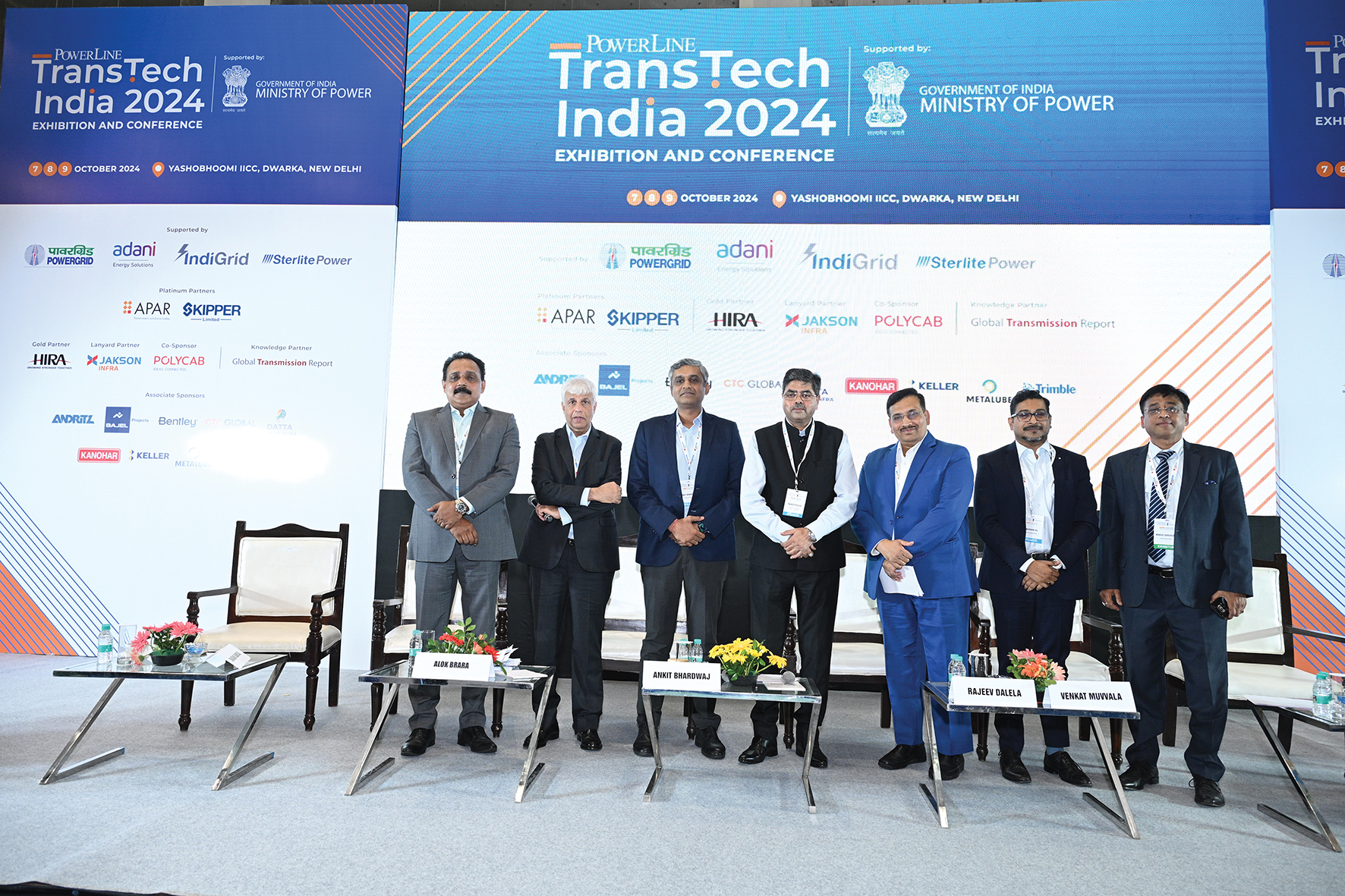
The panel on EPC Perspective featured a discussion among Ankit Bhardwaj, EVP and BD, Global Product and Services, Sterlite Power; Rajeev Dalela, President, Kalpataru Projects International; Venkat Muvvala, CEO-Infra and EPC Business, Jakson Group; Jijo Sebastian, VP and Head T&D, Larsen & Toubro; Abhishek Sil, VP-Sales and Tendering, KEC International; and Manish Srivastava, Business Head, Transmission and Distribution, APAR. The session focused on key industry challenges such as reverse auctions, dispute resolution and the shortage of skilled manpower, as well as technological innovations and strategic approaches to improving project efficiency in the EPC space.
Bhardwaj emphasised that the next four to five years will present significant growth opportunities in the transmission sector. However, despite many projects nearing completion, a significant skills gap persists in the industry. He highlighted the demand for on-the-job training to upskill the team. Another challenge relates to contractual frameworks in the sector, as managing documentation and closing contracts after work and trials are completed is cumbersome. This underscores the need for improved processes and potential ring-fencing to streamline transitions. Despite these hurdles, Bhardwaj remains optimistic about the future, noting that the increasing volume of projects provides incredible growth opportunities.
Dalela discussed the significant potential for EPC in the coming years, with transmission lines expected to grow by nearly 30 per cent, adding over 20,000 ckt km annually. Over the past five years, around 18,000 ckt km per year has already been constructed. He also discussed the major advancements in the use of drones for surveys, which have significantly reduced the time needed for certain tasks, particularly in challenging areas such as railway crossings, where time is critical. He noted that a key challenge remains the shortage of skilled manpower and the lack of necessary skill sets.
Muvvala highlighted the key challenges and strategies in the transmission sector. He stated that timely right-of-way (RoW) acquisition is critical to maintaining project timelines. To address such issues, the company is strengthening its capabilities by hiring and training staff, and leveraging advanced project management tools and analytics. Techniques such as drone surveys and digital assessments are being employed to enable faster decision-making and improve project delivery. Referring to the National Electricity Plan, Muvvala noted that it sets ambitious targets, aiming for a 30 per cent increase in transmission capacity over the next eight years. This will require constructing 20,000 ckt km annually, a fivefold increase. To achieve these goals, he suggested reevaluating the selection criteria for EPC players and contractors to attract top talent in the sector.
Sebastian began his address by stating that the power transmission sector is at the cusp of transformation, with significant investments expected in the coming decade. One of the biggest challenges facing the sector is the RoW issue, he noted. In addition, the industry still is still struggling with the conventional mode of operation and the increasing demand for upskilling the workforce. Sebastian also shared the efforts being made at L&T to address these challenges through mechanisation, including the deployment of drone-based services. The company is also enhancing productivity and improving worker safety by assembling towers in three sections on the ground. To close the skills gap, L&T has established nearly three dozen skill development centres across the country. Looking ahead, he said that this is an exciting time for the sector, with ample opportunities for all players as the market expands.
Sil noted that awarding projects through reverse auctions presents a key challenge for the sector, impacting the entire value chain. While this approach has led to significant tariff reductions, it is negatively affecting project quality and straining the value chain. He also discussed issues within the sector’s dispute resolution mechanisms, identifying the primary causes of disputes as contract execution issues, delays in client obligations and postponed compensation. Regarding technological advancements, Sil highlighted KEC’s innovative use of laser surveys, which has reduced the time required to survey a 100 km line from 25-30 days to just five to six days.
Srivastava observed that, as an EPC player, managing shutdowns is a key challenge. In brownfield projects, conducting timely surveys and identifying potential issues during pre-bid meetings help minimise these problems. He also highlighted the relevance of innovative technologies, particularly carbon composite cores for transmission lines, stating that this technology could reduce power losses by 30 per cent and double power transfer capacity at lower temperatures.
 State Utility Perspectives and Plans
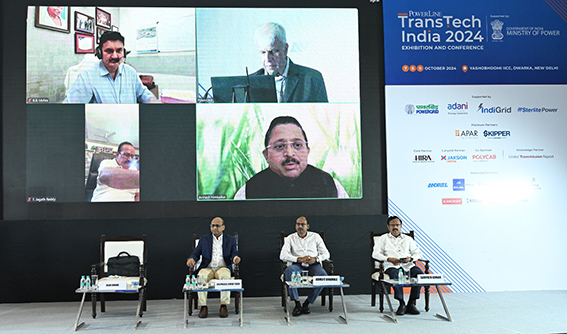
The session on State Utility Perspective and Plans featured a panel discussion with B.B. Mehta, Director, SLDC, OPTCL; Avinash Nimbalkar, Director – Projects, MSETCL; Swapnendu Kumar Panda, Member – Technical, DVC; and T. Jagath Reddy, Director – Transmission, TG Transco, on state-level progress on transmission network expansion, strategies to overcome challenges, the growing adoption of digitalisation, and future expansion plans and focus areas.
Mehta highlighted the unique challenges faced by Odisha’s power sector due to its geographical location and environmental conditions. Being a cyclone-prone state, special designs for towers and transmission networks are crucial. To this end, the state is transitioning to high temperature low sag (HTLS) conductors. He also spoke about the challenges faced in equipment testing in Odisha, and the plans to establish a testing laboratory in collaboration with IIT Bhubaneswar and the state government. Another significant challenge relates to the state’s extensive forest cover, which complicates the process of obtaining state- and national-level clearances for power projects. In addition, the state faces the unique challenge of rerouting transmission lines to protect elephants from electrocution. Mehta also emphasised the state’s focus on technological advancements. A pilot project for drone-based surveys is currently under way, with plans to scale up and include hilly, forest-heavy and inaccessible areas.
Other technologies being deployed in the state include remote accessibility systems, mobile-based tower monitoring systems and SAP-based linear asset management systems. Mehta outlined the state’s ambitious expansion, noting that several tenders are in the pipeline. OPTCL plans to invest over Rs 20 billion in 2024-25, with this amount expected to double in 2025-26. Further, asset monetisation is being considered for the future.
Nimbalkar began his address by highlighting the company’s current infrastructure and future plans for transmission network expansion. MSETCL currently operates 745 substations, 52,000 ckt km of transmission lines and a transformation capacity of 142,000 MVA. The plan for the next 10 years includes the development of 138 new substations, 12,000 ckt km of new transmission lines and 27,000 MVA of transformation capacity. The company also aims to replace approximately 3,700 ckt km of its conductors with high-performance conductors.
Further, Nimbalkar highlighted that one of the key challenges in the expansion of transmission line capacity is right-of-way (RoW) constraints. The Maharashtra government has introduced a new compensation policy, offering significantly higher compensation for tower foundations and erections, as well as transmission line corridors. This is expected to ease RoW concerns, especially in the Mumbai, Pune and western Maharashtra regions. Going forward, MSETCL will focus on technological advancements such as undersea transmission cables, converting single-circuit towers to multi-circuit towers, and using monopole towers and insulated platforms to maximise the efficiency of existing RoW. With these initiatives and the increase in tariff-based competitive bidding to encourage competition, Nimbalkar is confident that the state’s transmission network will be successfully expanded over the next five years.
Panda shared that DVC has a transmission line capacity of 9,300 km, operates 60 substations and supplies power at the 11-400 kV levels. In the future, DVC aims for a comprehensive transformation and upgradation of its transmission system, with a proposed investment of Rs 280 billion. The utility is focusing on increasing its transmission infrastructure capacity by upgrading existing transmission lines, transformers and substations. Panda also discussed the significant investments planned for upgrading transmission lines with HTLS conductors, as well as for the digitalisation and renovation of substations. Regarding digitalisation, he stated that DVC is automating its substations, with nearly 10 automated in 2023-24.
Reddy highlighted that TG Transco is actively working on enhancing transmission capacity through various measures, with a primary focus on constructing new transmission lines and increasing the transmission capacity of existing ones. He observed that one of the key challenges in this expansion is RoW issues. He noted, however, that the Indian government has recently developed guidelines for compensation rates, and a proposal has been submitted to the state government for its implementation. Once approved, this is expected to significantly ease RoW concerns for building transmission lines and substations. He also highlighted the innovative solutions being employed to address congestion at existing substations, particularly for supplying power to data centres and large consumers.
Reddy also discussed technological advancements, noting that approximately 10-12 substations are now being operated remotely with minimal on-site staff. He emphasised that the company is well-equipped to handle increasing power demands, including those from data centres, without affecting consumers. He added that the deployment of multiple operations and maintenance teams for regular line inspections has resulted in minimal power interruptions across the network.
 O&M/Asset Management
This session featured presentations and remarks by Nihar Raj, Head, O&M, Adani Energy Solutions Limited (AESL); and Amitanshu Shrivastava, Head, Transmission, IndiGrid. Both sector experts shared their views on the key challenges in the operations and maintenance (O&M) of transmission assets, best practices implemented and key initiatives in this space.
According to Raj, sustainable O&M is critical for transcos. To enhance risk predictability, decision-making and asset longevity within the O&M portfolio, AESL leverages data analytics and technology. A key initiative by AESL has been the incorporation of weather analytics as part of its maintenance protocol due to weather-related risks. It assists in preventive maintenance activities based on weather data and ensures better workforce planning. Raj also discussed the zoning concept that has been adopted for the company’s linear assets, where zones are created at intervals of 10 per cent of the transmission line length. Each zone is monitored for performance and issues are identified based on data visualisation. He also detailed the use of other systems adopted by AESL, such as asset performance management tools with CXO-level dashboards for fleet analytics, drones for the inspection of critical lines, artificial intelligence (AI)/machine learning (ML) for detecting safety violations in substations, and internet of things-based sensors.
Shrivastava emphasised that reliability, robust risk mitigation plans, and the adoption of digital technologies are essential for ensuring optimal asset performance. The O&M of transmission assets is becoming challenging due to changes in climate patterns, unauthorised construction beneath transmission lines, lack of coordination in infrastructure project development and frequent changes in regulations, he noted. For transitioning to predictive maintenance, Indigrid is using technologies such as AI, ML and satellite-based vegetation management as well as tools to mitigate the impacts of lightning/thunderstorms on insulators/end equipment. Indigrid has also installed avalanche protection structures for its 400 kV Sambha-Amargarh line to protect it from landslides and snow avalanches. Other strategic initiatives that have been adopted for operational excellence include the zero-harm zero-defect approach, a reliability-centred framework, and DigiGrid (Maximo), which is integrated with tools such as SAP and Power BI. The company also employs weather monitoring solutions, drone-based inspections for enhanced safety and predictive analytics. Further, it has implemented an asset health index platform for health assessment at the portfolio, substation and equipment levels.
In conclusion, both panellists agreed that proper O&M of transmission assets can significantly enhance reliability and safety in the sector.
Transmission System Planning
In the session on Transmission System Planning, Ashok Pal, Deputy COO, CTUIL, provided an overview of the expected capacity additions in the renewable energy space and the corresponding transmission infrastructure requirements. He also discussed the key issues and potential solutions for setting up an adequate future-ready grid network capable of handling 500 GW of renewable energy transmission by 2030.
Pal began by sharing statistics on the development of the ISTS network in India. He noted that planning has been done for 335 GW of ISTS networks, primarily to support renewable energy transmission. Of this, 42 GW is already completed, 85 GW is under construction, 65 GW is under bidding and 143 GW is awaiting approval. The development of these networks will require a total capital investment of Rs 5,000 billion, he added.
He then provided a region-wise breakup of the expected renewable energy integration into the grid. The northern region leads with a total capacity of 123 GW, with Rajasthan accounting for the highest share at 110 GW, followed by the western region at 117 GW (64 GW from Gujarat). The southern region is expected to reach 94 GW, while the north-eastern region has a relatively smaller target of 1 GW.
A key challenge, he noted, is that much of this transmission capacity is concentrated in just two states – Rajasthan and Gujarat. To address this challenge, Pal suggested that distributed renewable energy projects across India could help optimise transmission system efficiency and alleviate pressure on the grid. He emphasised that leveraging the transmission system during non-solar hours with additional renewable energy, storage, and green hydrogen or green ammonia at the source can help manage transmission-related issues.
Pal concluded that to support the integration of renewable energy and ensure grid stability, there is a need to strengthen intra-state transmission systems, deploy adequate energy storage solutions and adopt voltage control technologies. These measures will collectively contribute to a clean, reliable and sustainable energy future for India.
Regional and State Plans
The session on Regional and State Plans featured a presentation by Sanil C. Namboodiripad, MD, NETC, a joint venture between OTPC, Powergrid, AEGCL and the north-eastern states. The company owns and operates the Palatana-Bongaigaon transmission line, spanning 1,327 ckt km at the 400 kV level. The line helps in evacuating power from OTPC’s gas-based power project. The project has been instrumental in improving power supply in the north-eastern region, helping it transition from a power-deficit to a power-surplus region. The line not only meets one-third of the region’s power needs but also facilitates power exports to Bangladesh.
Elaborating on the background of the power infrastructure in the Northeast region (NER), he noted that the region’s key interstate generating stations, including NEEPCO, NHPC and OTPC, collectively have a total installed capacity of 5,497 MW. The NER is connected to the eastern region grid through key transmission links including the 400 kV D/C Bongaigaon-New Siliguri, 400 kV D/C Bongaigaon-Alipurduar and 220 kV D/C Birpara-Salakati lines. The region is also linked to the northern region through the 800 kV multi-terminal Biswanath Chariali-Alipurduar-Agra HVDC line, which can transmit 6,000 MW of power.
One of the key issues for the region is RoW, he notes. These challenges are compounded by the region’s difficult terrain, with rivers frequently changing course, heavy rainfall, poor soil quality, high seismic activity and frequent lightning, leading to higher construction costs. Despite these challenges, Namboodiripad noted that NETC has maintained an asset availability rate exceeding 99.75 per cent over the past seven years.
Some of the strategies adopted by the company include the use of special earthing methods and transmission line surge resistors to prevent lightning strikes from reaching substations. NETC also employs drone patrolling. Further, it is leveraging artificial intelligence and machine learning to detect faults in transmission lines. This initiative, in collaboration with Powergrid, involves app-based patrolling to capture and document any damages. In Meghalaya, where lightning strikes are frequent, NETC has installed lightning protection system (TLSA) units. Further, it is focusing on maintaining sub-offices and storing spare parts for towers in separate locations to efficiently manage tower collapse issues.
Renewable Energy Evacuation
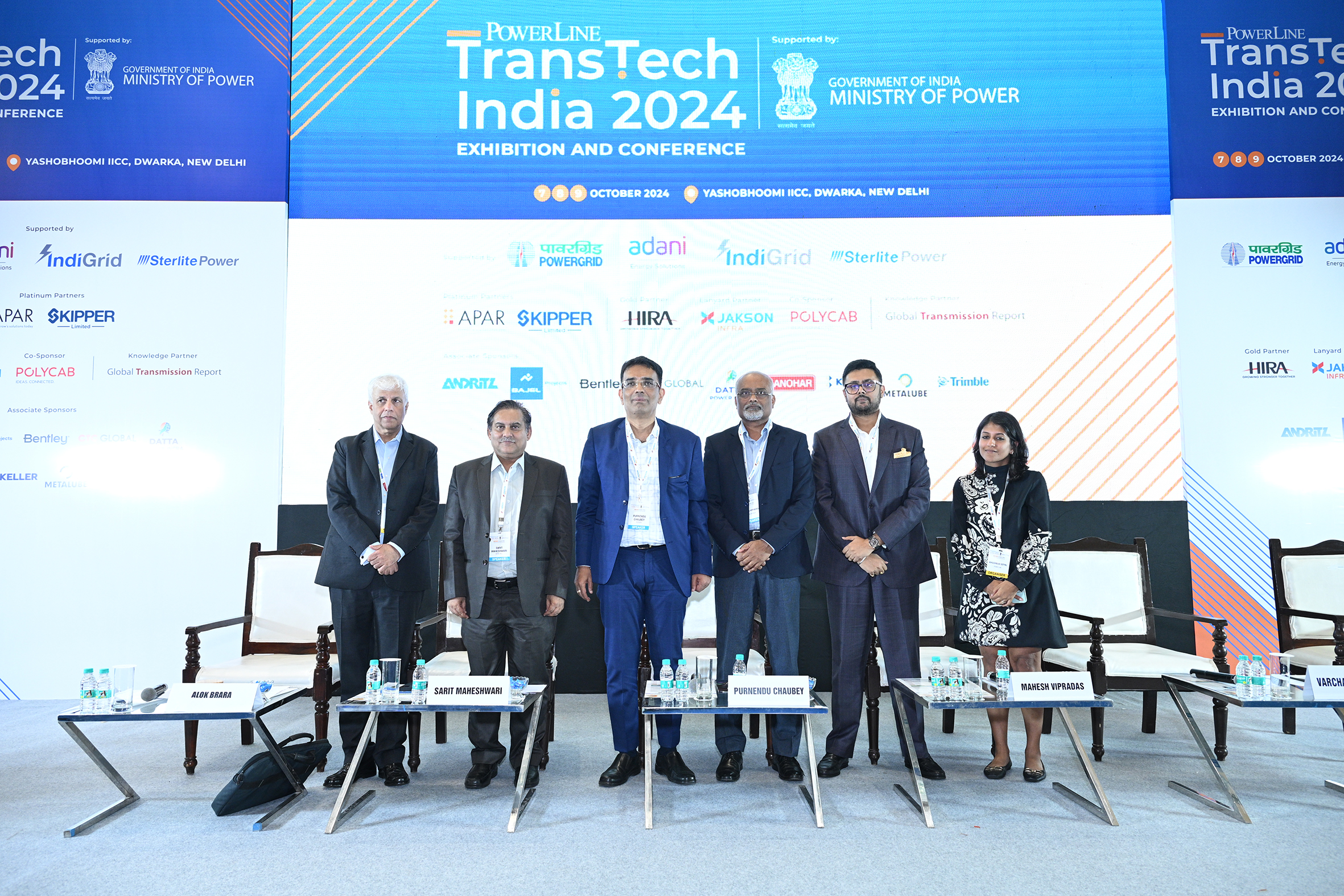
The Focus on Renewable Energy Evacuation session explored key areas related to renewable energy evacuation, including developers’ needs, progress in enhancing grid connectivity, current issues and potential solutions. The panel featured an impressive line-up of speakers including Purnendu Chaubey, Senior Vice-President, ReNew; Varchasvi Gagal, CEO, Datta Power Infra; Sarit Maheshwari, CEO, NTPC REL; and Mahesh Vipradas, Vice-President, Sembcorp India. While all panellists acknowledged the commendable work done to strengthen transmission infrastructure, they expressed concerns about the significant delays in securing grid connectivity for renewable power projects. According to these industry experts, significant work is required to reduce the lag in timelines for developing power evacuation infrastructure.
Chaubey began by highlighting the difference in the commissioning timelines of renewable energy generation plants and transmission systems. While the transmission system typically requires 36-48 months, renewable energy plants can be set up within 15-18 months. This issue has been partly addressed through proactive planning. He noted that India has achieved 200 GW of renewable energy capacity, with an additional 300 GW targeted by 2030. He estimates that 270 GW of transmission capacity has already been planned, with some projects already under way. For this, approximately 50,000 ckt km of transmission lines and 400,000 MVA of transformation capacity will be necessary by 2030.
Chaubey remarked that progress on the ISTS networks has been largely positive; but since the ISTS waiver is set to end in June 2025, this will significantly change the power evacuation landscape for renewable energy. He explained that more intra-state projects are expected, as developers may want to avoid transmission charges. For this reason, intra-state network growth is now expected to accelerate.
Maheshwari highlighted the success of green energy corridors in evacuating significant power capacities from renewable energy-rich states. However, he emphasised that power affordability remains crucial for technology adoption in India, regardless of whether it is renewable or conventional power. He discussed the impending phase-out of the ISTS waiver regime, which will necessitate a recalculation of power plant locations. Developers will need to weigh the advantages of setting up plants in renewable energy-rich states against the increased transmission costs. He noted that this decision will vary by state and project, requiring individual assessment.
 Maheshwari anticipates the emergence of various new models to address connectivity challenges, including the use of connectivity post-solar hours. He echoed the industry sentiment in hoping for an extension of the ISTS waiver, noting that the planned renewable energy bidding trajectory provides ample opportunities for project development. However, he stressed the need for a dynamic planning strategy for renewable energy developers, stating that a singular approach cannot persist long-term. Factors such as market strategy, power pricing and other variables necessitate continual adaptation.
Gagal emphasised the importance of achieving the renewable energy target of 500 GW. He then highlighted the government’s proactive measures, particularly the establishment of the green energy corridor, which aims to evacuate approximately 32 GW of renewable power across nine states. Additionally, he mentioned the creation of renewable energy zones and the development of solar parks. He expressed optimism regarding the government’s initiatives and its potential to help achieve the 500 GW renewable energy target. Gagal observed that developers frequently inquire about grid connectivity schedules with specific commissioning dates for renewable energy parks, which requires a thorough analysis of radiation levels and wind resource assessments. He also observed a significant gap between the outputs of Rajasthan and Gujarat compared to the costs incurred when exploring opportunities in the southern states, with major developments taking place in Gujarat, Karnataka, Rajasthan and Madhya Pradesh. He noted that while there are renewable energy zones in certain states, there is a significant gap in the connectivity schedule, extending until 2030. He also acknowledged the efforts of robust PSUs such as ONGC, IOCL and HPCL, which are targeting 2-6 GW of renewable energy capacity annually. However, he expressed concern about the tariff structures and highlighted the need for better planning.
Vipradas began by addressing the mismatch between the commissioning of renewable energy projects and the availability of required transmission lines. He also pointed out the differences between intra-state and interstate transmission network development. While the planning and connectivity processes have been streamlined over the past two years, providing renewable energy projects easier access to the market, he noted that challenges remain. Improvements in the planning of ISTS have facilitated the growth of renewables and encouraged investments. However, despite the ISTS waivers sparking increased interest in state-related projects, grid connectivity remains a significant hurdle. Further, he remarked that more than 70 per cent of the required capacity for renewable energy projects is still pending approval, and primarily concentrated in two states. The timeline for these transmission systems remains unclear.
When asked for recommendations, Vipradas emphasised the need to transition from planning to execution, describing the situation as a “chicken and egg” scenario. He stressed that execution should not wait for connectivity applications. He highlighted the importance of executing projects promptly to meet the growing demand for renewable energy evacuation systems. A robust supply chain is essential to support the scaling up of transmission, he noted.
In conclusion, the panellists believe that the transmission network is the backbone for renewable energy development in the country. The session ended with agreement on the need for better planning as well as coordinated action by all stakeholders.
Read all the updates from TransTech exhibition and conference here