
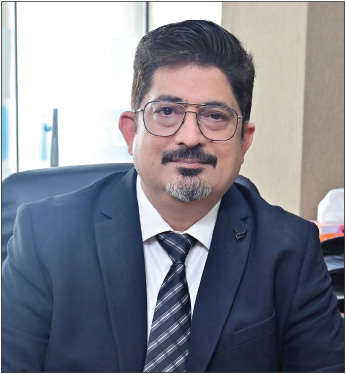
 In an interview with Power Line, Vishal Kapoor, Chief Executive Officer, Energy Efficiency Services Limited (EESL), spoke about the current state of the power sector, the progress in setting up electric vehicle (EV) charging infrastructure and the outlook for the energy efficiency market. He also talked about EESL’s key priorities, achievements and future plans. Excerpts…
What is your assessment of the current state of the power sector?
The power sector is being transformed by the global imperatives of sustainability, decarbonisation and enhanced energy efficiency. The sector is evolving from traditional centralised energy production to a more decentralised, integrated system driven by renewable energy, energy storage advancements and smart grid technology.
With a renewable energy capacity of 203.1 GW as of mid-2024 – a remarkable 165 per cent increase since 2014 – India ranks fourth globally in terms of installed renewable capacity. Solar energy, which has expanded nearly thirtyfold to over 85.47 GW, is spearheading this green revolution.
However, achieving the government’s ambitious target of 500 GW of renewable capacity by 2030 will require sustained annual capacity additions of around 50 GW. Encouragingly, India added 16.4 GW in the first seven months of 2024 alone, underscoring the country’s strong momentum. EESL is committed to playing a pivotal role in this transition, focusing on reducing peak demand through energy efficiency measures, promoting low-carbon technologies and ensuring equitable energy access.
How has been the progress on the expansion of EV charging infrastructure? What more needs to be done?
India’s rapid adoption of EVs has driven the need for an expanded EV charging infrastructure, with both the public and private sectors playing vital roles. EESL/Convergence Energy Services Limited (CESL) has already installed 455 public EV chargers in urban areas and highways, boosting public confidence in EV adoption.
However, scaling up brings challenges, including the high costs of upgrading power infrastructure and inconsistent low tension connections. Non-uniform EV tariffs across states complicate deployment further. Standardising tariffs, simplifying approvals and streamlining electrical load sanctioning are key to accelerating charger installations.
Security is another concern, as vandalism and misuse of public chargers jeopardise investments and expansion, particularly in remote areas. Law enforcement and strict regulations are needed to safeguard this infrastructure.
The PM eDrive scheme, launched in 2024 with a budget of Rs 109 billion, has allocated Rs 20 billion for expanding the public charging network. It aims to install over 22,100 fast chargers for cars, 1,800 for buses and 48,400 for two- and three-wheelers in key locations. By addressing these challenges and leveraging the PM eDrive scheme, India can create a secure and robust EV charging ecosystem.
What have been the key business highlights of EESL in the last one year or so?
EESL has made substantial progress in the energy efficiency domain over the past year. A notable achievement has been the launch of three new products: five-star 6 W light emitting diode (LED) bulbs, induction cooktops and five-star brushless direct current (BLDC) fans. These products are not only reducing energy consumption, but also enhancing the sustainability quotient in
Indian households.
In collaboration with the National Efficient Cooking Programme (NECP), EESL has distributed over 2,000 induction cooktops to anganwadi workers in Ladakh, significantly improving energy efficiency in rural cooking. Furthermore, we secured Rs 7 billion in MoUs during the 14th Clean Energy Ministerial under India’s G20 Presidency, underscoring our commitment to fostering energy efficient technologies.
Another significant milestone has been the expansion of our e-commerce platform, EESLMart. Initially, EESLMart offered a curated selection of energy efficient appliances procured and vetted by EESL. However, we recognised the need to provide consumers with greater choice. Today, we are evolving EESLMart into a more inclusive marketplace, allowing products from multiple manufacturers that meet minimum assured levels of quality and energy efficiency. This ensures that environmentally conscious consumers can access a broad range of energy efficient products across different price points, makes and varieties.
What are the key projects/initiatives that EESL is currently focusing on?
EESL is focused on expanding access to affordable energy efficient products through physical franchise shops and digital platforms. We are launching a retail franchise model to offer appliances such as LED lights, air conditioners and fans to consumers. Additionally, we are scaling the NECP and promoting induction cookstoves in government departments, including anganwadis, with support from public institutions to drive wider adoption. We are partnering with progressive government departments that can help socialise the concept of energy efficiency across all domains through a whole-of-government approach. Our tie-ups with organisations such as Andhra Pradesh Eastern Power Distribution Company Limited are key steps in this direction.
We aim to build an energy efficient ecosystem by empowering rural youth, local entrepreneurs and women through training initiatives that foster economic growth and environmental sustainability.
In electric mobility, CESL is aggregating electric buses under the PM-eBus Sewa and PM eDrive schemes, with plans to introduce electric trucks to reduce emissions in logistics. We are also exploring solar street lights for underserved areas, expanding our sustainable lighting solutions.
Solar street lights also interest us greatly, and we are exploring opportunities to expand our portfolio in this segment. These lights provide sustainable, energy efficient lighting solutions, particularly in underserved areas.
Our focus also extends to energy efficient heat pumps, including geothermal models, with pilot projects in Ladakh. If successful, these technologies will be scaled nationwide. Lastly, we are prioritising energy efficient IE3 and IE4 electric motors to cut industrial energy consumption, driving efficiency across multiple sectors.
How has the energy efficiency market evolved in the last few years? What can be expected in the next few years?
India’s energy efficiency market has seen remarkable growth, driven by favourable government policies, increased private sector participation and a growing consciousness about climate change. Estimates suggest an investment potential of Rs 8,000 billion in the energy efficiency space in India, with significant opportunities in the industrial and domestic segments, where the greatest energy savings can be achieved. These sectors offer a substantial bang for the buck in terms of energy reductions and cost savings, positioning them as key drivers for the next phase of energy efficiency adoption.
The COP28 drive to double the rate of energy efficiency globally is expected to further accelerate growth, pushing the market to leap forward. This emphasis on achieving more aggressive energy efficiency targets underscores the urgency for countries such as India to scale up their efforts to meet global commitments.
Given the increasing demand for energy efficiency, India’s ability to meet its climate goals will require a doubling of the current efficiency investments by 2030. EESL is well positioned to lead this charge by promoting affordable and scalable energy solutions while working closely with regulatory bodies to ensure that energy efficient products in the market live up to their claims.
What are the biggest challenges in advancing the adoption of energy efficient technologies? How can these be addressed?
A key challenge is the lack of saliency and grandeur associated with energy efficiency projects compared to renewable energy initiatives such as solar and wind farms, which are often seen as more visible and transformative. Energy efficiency tends to be less centralised and disaggregated, involving smaller-scale interventions such as upgrading appliances or retrofitting buildings, which can dilute its impact on public perception. This often leads to energy efficiency being under-prioritised, despite its significant potential for energy savings.
Misleading marketing also plays a role, with products like one-star-rated bulbs labelled as “super savers,” causing consumer confusion. This not only diminishes trust, but also delays the adoption of truly efficient products. Stricter regulations and clearer product labelling are crucial to addressing this issue.
Another major hurdle is the high upfront cost of energy efficient technologies, which deters adoption despite their long-term benefits. Expanding financing options, such as subsidies through philanthropies for an initial kick-start, would be beneficial.
High upfront costs also hinder the adoption of energy efficient technologies, despite their long-term benefits. Expanding financing options such as subsidies and low-interest loans could make these solutions more accessible, especially for low-income households. The lack of product standardisation further complicates consumer decisions, making it harder to compare true efficiency levels.
Organisational resistance due to concerns about system compatibility and potential disruptions slows industry uptake. Demonstrating the economic benefits of energy efficient technology through successful case studies could help address these hesitations. Finally, policy gaps and inconsistent implementation across India’s states impede progress, underscoring the need for a cohesive regulatory framework. Addressing these issues could significantly accelerate energy efficiency adoption and contribute to India’s climate goals.
How do you see the market for smart meters shaping up in the near to medium term?
The global smart meter market is on an upward trajectory, and is projected to grow from $23.1 billion in 2023 to $36.3 billion by 2028. Government policies focused on reducing carbon emissions and enhancing grid reliability are key drivers of this growth. In India, the Smart Meter National Programme aims to replace 250 million traditional meters with smart meters by 2025.
EESL has already deployed over 4.4 million smart meters, a significant step towards reducing transmission and distribution losses, demonstrating that large-scale smart metering is possible. Despite this progress, high upfront costs and limited consumer awareness still pose challenges to mass adoption.
Additionally, some regions still face infrastructure challenges in ensuring smooth deployment. To address these issues, policy support, incentives for smart meter adoption and robust public awareness campaigns will be crucial. EESL is working to further scale up this initiative and collaborate with utilities to ensure seamless deployment across the country.
What are your top priorities for EESL in the near to medium term? What are some of the opportunities that EESL is pursuing?
EESL’s upcoming priorities are advancing energy efficiency in household appliances and electric cooking. Plans include distributing 10 million BLDC fans and 2 million energy efficient induction cooktops across India. As household appliances account for 45 per cent of global energy consumption, promoting efficient alternatives is crucial.
EESLMart, EESL’s e-commerce platform, offers energy-efficient products such as LED bulbs, BLDC fans, air conditioners and induction cooktops. We are also exploring electric bicycles to support India’s low-carbon transition and socio-economic empowerment. Electric mobility remains a key focus, with the PM-eBus Sewa scheme aimed at transforming urban transport through electric buses. We are also exploring electric trucks to decarbonise the logistics sector, while piloting electric micromobility initiatives.
Through partnerships, innovative financing and public awareness campaigns, EESL aims to drive the adoption of energy efficient technologies.