

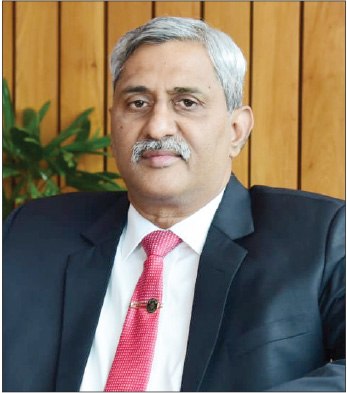
 In a recent interview with Power Line, P. M. Prasad, Chairman and Managing Director, Coal India Limited (CIL), talked about the key operational and business highlights of the company, the measures being taken to ensure environmental sustainability in operations, as well as future plans and priorities. He also discussed the coal requirements of the power sector, the initiatives being taken to improve coal transportation and logistics, and the plans to meet future coal demand. Edited excerpts…
What have been CIL’s key operational and business highlights in the past one year?
There were several big gains in our physical and financial performance in the last one year. By producing 773.6 million tonnes (mt) in FY 2024, we logged a double-digit growth of 10 per cent for the second successive year, which is a record. Coal supplies to both the power sector and the non-regulated sector were also on a higher trajectory. Significantly, a single-year output increase of 70 mt was registered over the already high base of 703 mt from FY 2023. Our Odisha-based coal producing subsidiary, Mahanadi Coalfields Limited, emerged as the country’s first coal company to have breached 200 mt of coal production, achieving an inspiring 206 mt during FY 2024.
In the current fiscal year, till the end of July, CIL’s production was on the right course at 244 mt – a year-on-year increase of 15 mt. Then the seasonal heavy downpours hit our production, with rainfall affecting our coalfields. But this is a temporary interruption, and we shall regain our pace in the second half of the fiscal.
CIL’s profit after tax (PAT) scaled up to Rs 373.69 billion in FY 2024, registering a 17.8 per cent growth over the preceding fiscal’s restated PAT of Rs 317.23 billion. In absolute terms, the profit increase was Rs 56.46 billion. Market capitalisation, an indicator of the company’s worth, more than doubled to Rs 2,675.24 billion as of March 31, 2024, compared to Rs 1,316.67 billion on the same date in the preceding year – a phenomenal 103 per cent growth. CIL also reported a strong 18 per cent growth in earning per share in FY 2024 at Rs 60.69, compared to Rs 51.54 in the previous fiscal.
What steps is CIL taking to enhance its coal mining and production efficiency, while ensuring environmental sustainability?
CIL has adopted several measures to push our production to a higher gear. Timely conclusion of contracts for production and overburden removal; sub-delegation of power to the management teams of subsidiary companies for flexibility in operations and quicker decision-making; determined coordination with district, state and central authorities for speedy acquisition of mining clearances; and engagement with reputed mine developers and operators (MDOs) to improve operational efficiency and facilitate many other advantages are a few of the important steps taken to enhance production. As such, 15 MDO projects – 11 opencast (OC) and four underground (UG) – with a combined capacity of 173 mt per year have been undertaken. Work orders have been issued for almost all of them, and production has begun for some. Under the Digi-Coal project, we have adopted digitalisation of mining processes in seven of our high capacity OC mines to maximise production at minimal cost. This has also led to environmental benefits. CIL closely monitors, at all levels, the production progress of 35 OC projects, accounting for 75 per cent of the company’s total annual output. Technology upgradation for improved productivity is also a constant endeavour.
While mining coal, we do not lose sight of ecological concerns. To minimise emissions, the company deploys environment-friendly technologies such as surface miners, which enable blast-free OC production, greatly reducing noise and dust pollution. In FY 2024, 57 per cent or nearly 425 mt of our total OC production capacity of 748 mt was facilitated using surface miners. By the end of August in the ongoing fiscal, this figure shot up to 65 per cent. We use vibro-rippers in some areas for overburden removal, which offer similar benefits. In addition, we are fast tracking eco-friendly mechanised coal transportation for first-mile connectivity – production points to loading points – through piped conveyor belts that circumvent road transport, thus increasing safety on roads and decreasing coal dust pollution. A total of 988 mt of coal will be moved through this mode by FY 2030. We are greening our mining areas through large-scale tree plantation, which peaked at 2,167 hectares in FY 2024. Our energy efficiency measures, taken to reduce CO2 emissions, resulted in the elimination of nearly 1.06 tonnes of emissions. Pursuing renewable energy to generate cleaner power, we are planning to set up 3,000 MW of solar capacity by FY 2028, and take it up a further 2,000 MW beyond that. A major portion of this will be used to power our own mining operations. We also have plans to produce 70 mt of coal from underground mines and expanding this capacity by FY 2030. UG mining is environmentally cleaner, avoids further usage and degradation of land, and is society friendly.
What are your top priorities and goals for CIL for the coming years?
Obviously, raising production to higher levels and meeting the country’s desired coal demand with quality coal supply remain our top priorities, with equal importance to the safety of our miners and mines. To be future ready, we are also diversifying into solar power generation; acquisition of critical minerals, for which the country is largely import-dependent; coal gasification; and setting up coal-based thermal power plants aggregating 4,000 MW of capacity in Sundargarh, Odisha. Speeding up these processes to ensure fruition and establish CIL as a dependable integrated energy company is a major goal as well.
What are the biggest challenges facing CIL? How are these being addressed?
For any mining company, especially coal mining, the major challenges are land acquisition and acquiring green clearances. In India, coal deposits occur in areas that are densely populated, and people get displaced from their original habitats due to mining activities. But we have strong rehabilitation and resettlement policies, comparable to the best in the country, and we pursue them with commitment through inclusive participation. Through persistent pursuit and cooperation from the concerned central and state-level ministries, we have been able to make considerable progress.
What is the current coal demand from the power sector? How does this demand compare to CIL’s supply?
The power sector is CIL’s major customer, accounting for 80-85 per cent of the company’s entire annual supply, depending on how the demand pans out. For FY 2025, CIL was given a coal demand of 661 mt, as programmed by the Central Electricity Authority and the Ministry of Power (MoP). As of August, we have supplied 253.4 mt, which is 4 mt higher than what we supplied a year ago during the same period.
What measures is CIL taking to improve coal transportation to power plants and associated logistics?
To synchronise our increasing production with well-laid transportation infrastructure, CIL is implementing three major rail infrastructure projects, on a deposit basis, at Mahanadi Coalfields Limited, South Eastern Coalfields Limited and Northern Coalfields Limited. These three CIL subsidiaries cumulatively account for 68 per cent of the company’s 1 billion tonne coal production target. We are also executing four similar projects on a joint venture basis. The evacuation capacity in these high-yield coalfields will increase substantially following the creation of this infrastructure. We are constructing 24 greenfield and brownfield railway sidings at four of our subsidiaries, as well as renovating old sidings, thus strengthening connectivity between the sidings and the main rail lines.
What is the projected coal demand trend for the power sector over the next five to ten years? How is CIL preparing to meet future demand forecasts?
The overall supply requirement for the power sector is assessed by the MoP. This is then divided among different coal suppliers, and CIL is informed about the quantity that it has to supply. The dynamic demand situation is assessed by a subgroup committee on a weekly basis, and supplies are prioritised accordingly. The coal demand trend for the power sector also depends on other factors such as contribution from commercial miners and renewables. The planned coal-based thermal power capacity addition of 80 GW by 2031-32 will translate into a coal requirement of around 400 mt, keeping demand buoyant. Meeting this demand means raising coal production, which CIL is committed to doing. As long as the country needs coal, CIL will relentlessly pursue its given targets.