
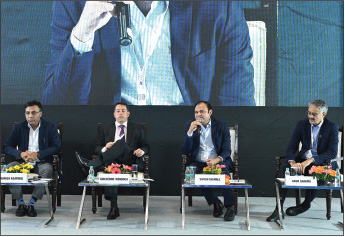
The Industry Perspective session featured a panel discussion among Manish Agarwal, Chief Executive Officer (CEO) (Conductors and Telecom) and Managing Director (T&D), APAR; Guilherme Mendonca, Head, Energy, Siemens; Arun Sharma, Chief Executive Officer, Sterlite Power; and Satish Talmale, Chief Operating Officer, IndiGrid, on a wide range of topics, including the state of the sector, industry priorities, the new technologies being adopted, the key challenges and outlook…
Electricity demand is rising rapidly in India and is expected to increase substantially over the next few years, led by the growth in high energy demand sectors such as electric vehicles, which are yet to achieve full market penetration. Decarbonisation will become critical, as India is expected to enforce carbon credit trading targets by 2026, necessitating industries to transition towards decarbonised operations. Moreover, economic growth in India’s large middle class will lead to a significant increase in electricity consumption.
The two key considerations for meeting India’s renewable energy targets are developing a robust transmission network and addressing right-of-way (RoW) and land-related issues. Approximately $5 billion-$6 billion worth of annual investments will be needed for infrastructure development. In the transmission space, while tariff-based competitive bidding (TBCB) has improved efficiency, the challenge for developers now lies in integrating the best technologies into the systems. This is crucial for ensuring the long-term sustainability of projects. While technologies are available, developers need to determine whether there is a willingness to incorporate them into the e-reverse auction framework.
Technology adoption
A major focus will be on high voltage direct current (HVDC) systems, for which long-term planning will be crucial. While point-to-point HVDC project implementation has been carried out, DC-level switching will soon be undertaken to connect large generation areas to consumption centres.
RoW issues have been the primary cause of delays for both greenfield and brownfield projects. The use of monopoles and lattice towers can significantly help address space challenges. It is also crucial to focus on reconductoring and augmenting existing transmission lines at the planning stage itself, as this is less expensive than setting up
new lines.
Further, transmission operators are implementing digital asset management strategies and using asset health indexing to monitor the condition of individual equipment such as transformers, circuit breakers and other critical components in the transmission line. They are also using weather forecasting platforms to tackle challenges such as high wind speeds and lightning that could impact transmission lines.
Challenges and outlook
A key challenge is ROW. Cross-country transmission line projects have benefitted from strong state support. Therefore, stakeholder management is crucial in tackling the RoW issue. Another challenge is the shortage of skilled labour, particularly in areas such as cybersecurity and digitalisation, which are becoming critical as we move towards smarter grid management.
The industry must focus on indigenisation and the reduction of reliance on imports. This will facilitate the development of India as a hub for exports to global markets such as Europe and South America, enabling it to compete on a global scale alongside Chinese players. There is also a need for India to promote free trade agreements at the policy level to augment the country’s
export competitiveness.
Another critical aspect is supply chain management. The volume of work being awarded is substantial; therefore, the pace of project execution should be improved through mechanisation. Currently, completing around 1 km of transmission lines takes 1,400-1,500 days in India, compared to less than 1,000 days in Brazil and only 350-400 days in the US and Canada. The bidding documents should be structured in a way that provides developers with opportunities to deploy time- and cost-
saving technologies.
The industry outlook for the next 10-20 years is positive. However, challenges like high attrition rates and a lack of skilled manpower remain. Improving product safety and quality is essential. The central government’s support in land acquisition, Right of Way, and state coordination has been commendable.
Click to read the TransTech Special Section from the October issue.