
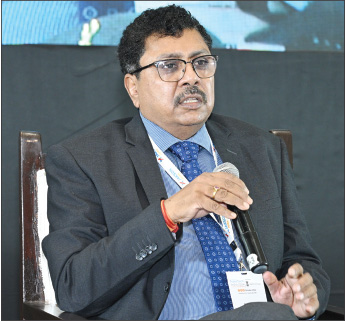
 At TransTech India 2024, Naveen Srivastava, Director (Operations), Power Grid Corporation of India Limited (POWERGRID), spoke about the current state of the power transmission system, technological advancements in the segment and the future outlook. Edited excerpts…
Generation capacity, particularly from renewable sources, can be developed rapidly, while establishing transmission infrastructure usually takes 24 to 36 months. To ensure smooth integration, it is essential to align the planning of transmission projects with
generation timelines.
India currently has a generation capacity of approximately 446 GW, with 206 GW coming from renewable energy sources. The country’s transmission infrastructure is also expanding rapidly. The transmission line length, which currently stands at 418,000 ckt km, is projected to grow by an additional 200,000 ckt km. The national transformation capacity is at 1,225,000 MVA, with POWERGRID contributing nearly 50 per cent of this at 530,000 MVA.
POWERGRID currently operates 280 substations. By 2030, many more will be added to support the growing energy demand. In the near future, POWERGRID plans to extend its transmission line network by approximately 50,000 ckt km, ensuring that the transmission system can handle the increasing generation capacity and maintain grid stability.
Technological advancements
Drones are increasingly being utilised for patrolling transmission towers. Artificial intelligence and machine learning technologies are playing a pivotal role in enhancing maintenance and operational efficiency of transmission infrastructure. Smart transmission lines, based on dynamic line rating systems and equipped with sensors for improved forecasting, are being developed.
In parallel, older substations are being modernised into process control substations, employing artificial intelligence- driven technologies and remote control systems for better management. Further, all of the 280 substations are being operated remotely from the National Transmission Management Centre. Any kind of upgradation and monitoring can be done from the centralised system.
Advanced tools and methods are being deployed for Vegetation Management and early-stage fault detection. The use of sensors for real-time monitoring and predictive maintenance is central to preventing faults and improving grid reliability. Additionally, gas-insulated substations have been implemented to further support these initiatives. In line with the government’s goal of achieving net zero carbon emissions by 2047, there is a shift towards environment-friendly SF6-free switchgear.
There is ongoing exploration of new technologies such as induction voltage for electricity generation, with pilot projects investigating how line induction can produce power. This innovation has the potential to benefit sectors such as telecommunications. However, there is a pressing need for advancements in ultra-high voltage direct current technology, as existing solutions such as voltage source converters and line commutated converters are approaching their voltage capacity limits. Further, as offshore wind energy continues to grow, the importance of offshore substations and transmission lines is increasing, necessitating new infrastructure to support this expansion. Critical concerns include addressing issues such as transients and harmonics, which can adversely affect system performance.
Future outlook
Going forward, sustainability and resilience are required in the power sector, which can be only achieved with innovation. The focus is on integrating advanced technologies such as artificial intelligence, digital transformation and condition monitoring systems to enhance grid efficiency and reliability. Additionally, green technologies are being prioritised to ensure that transmission infrastructure aligns with India’s long term sustainability goals, including the government’s commitment to net zero carbon emissions by 2047. The vision for India’s power transmission sector revolves around not only modernising the grid through smart technologies, but also ensuring its robustness and environmental sustainability. The future of the sector looks promising, with efforts directed towards creating future-proof infrastructure capable of supporting the country’s ambitious energy transition and growth objectives.
Click to read the TransTech Special Section from the October issue.