

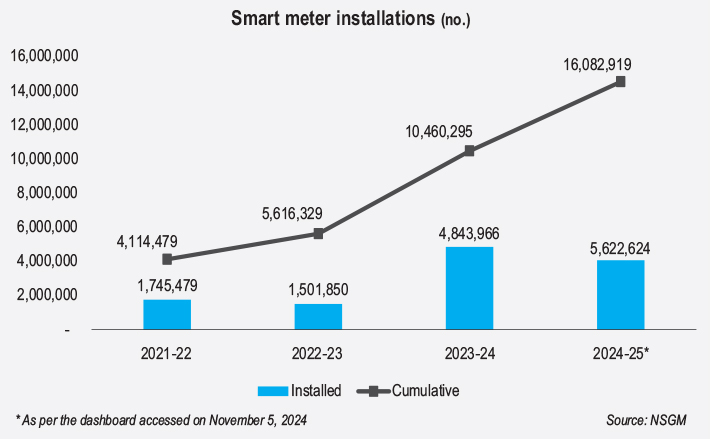
India’s smart metering market is on the cusp of exponential growth. Following the success of various pilot projects across the country and positive outcomes for stakeholders, the pace of smart meter awards and installation is increasing. As of October 16, 2024, over 14.5 million smart meters have been installed and a total of 222 million smart consumer meters have been sanctioned. In 2023-24, nearly 4.8 million smart consumer meters were installed, three times the number installed in the previous year.
Smart meters offer several advantages over conventional meters in terms of operational efficiency, grid operations and demand-side management. Conventional meters rely on manual readings prone to error and tampering, require manual disconnection for non-payment, and lack tools for outage detection and consumption monitoring. Smart meters, however, support two-way data transmission, enabling remote readings, accurate billing and better collection efficiency through prepaid options. They aid grid operations by quickly identifying faults, optimising power procurement and supporting demand-side management. Consumers benefit from real-time usage tracking, while utilities can implement measures such as time-of-day tariffs to balance load and reduce peak demand.
Smart metering progress so far
Approximately 222 million smart consumer meters, 5.26 million distribution transformer (DT) meters and 0.18 million feeder meters have been sanctioned across the onboarded states. As of November 5, 2024, over 131.97 million consumer smart meters have been awarded, which account for 59 per cent of the total sanctioned meters; and 16 million consumer smart meters have been installed till date as per the National Smart Grid Mission (NSGM) dashboard. Further, 4.5 million DT meters (86 per cent of the sanctioned meters) and 144,291 feeder smart meters (79 per cent of the sanctioned meters) have been awarded.
Notably, during 2023-24, 4.84 million smart consumer meters were installed, nearly thrice the installations in the previous year. With the government mandating the transition to a complete smart metering system, replacing the existing 250 million meters by 2025, the pace of smart meter awards and installations is expected to accelerate in the coming months. Bihar is leading with the highest number of installed smart meters, totalling 5,436,455, followed by Assam with 2,662,694 meters installed. Uttar Pradesh closely trails with 1,470,739 meters installed, while Madhya Pradesh and Haryana have installed 1,335,858 and 847,467 meters respectively.
 Progress of RDSS
The government launched the Revamped Distribution Sector Scheme (RDSS) in July 2021, with a substantial outlay of Rs 3.03 trillion and a budgetary support estimate of Rs 976.31 billion. The RDSS targets a reduction of aggregate technical and commercial losses to 12-15 per cent and seeks to eliminate the gap between the cost of power supply and tariff by 2025. Recognising the need for additional time for discoms to achieve these goals, the scheme is likely to extend beyond the initial 2025 timeline. The RDSS consists of two parts: Part A focuses on upgrading distribution infrastructure, including the deployment of prepaid smart meters and system metering, while Part B covers training, capacity building and other supportive measures. Through Part A, the scheme plans to replace 250 million conventional meters with smart meters across India, establishing advanced metering infrastructure (AMI) to enable remote meter reading and efficient data exchange. State discoms or their nodal agencies have initiated the deployment process by releasing tenders for smart meter installation by AMI service providers (AMISPs) through the design, build-finance-own-operate-transfer (DBFOOT) model.
The DBFOOT model enables discoms to deploy smart meters at scale without needing upfront capital, as the responsibility for investment is shifted to the AMISP. The AMISP handles the supply, installation, maintenance and operation of the metering system, including communication and data storage infrastructure, throughout the typical contract term of 90-93 months. To ensure continuous service quality, the AMISP must meet contract-defined service levels to qualify for monthly service charges. At the contract’s end, the AMISP transfers full ownership of the infrastructure, including all hardware, software, licences and data, to the utility at no cost, as per the exit management plan. The model also allows a hybrid payment structure, where part of the AMISP’s capital expenditure is covered by an RDSS grant upon project completion, providing Rs 900 per meter (Rs 1,350 for special category states).
According to the Rajya Sabha Report (December 2023), around Rs 1,217 billion has been sanctioned for loss reduction works and Rs 1,304 billion for smart metering works (aggregate value of detailed project reports approved). The overall physical progress of loss reduction works under the RDSS is currently at 15.69 per cent (as per the RDSS dashboard, accessed on October 16, 2024). So far, under the scheme, about 198 million prepaid smart meters, 5.2 million DT meters and 182,206 feeder meters have been sanctioned across 30 states/union territories, with a total sanctioned cost (including project management agency costs) of about Rs 1.3 trillion.
Issues and challenges
The adoption of smart meters faces several significant challenges. A key issue is the complexity of IT system integration and interoperability, as smart meters require seamless coordination between hardware and software from various vendors. With no standardised protocols in place, compatibility issues arise between smart meters, network interfaces and communication networks, making it difficult to integrate utility IT systems with meter data management platforms, often leading to delays and escalating costs. The risk of technological obsolescence over lengthy contract periods presents another challenge, potentially causing compatibility issues, increasing maintenance expenses and limiting the overall functionality of smart metering systems. Furthermore, network reliability issues such as latency and congestion create a dependency on telecom operators, which can hinder real-time data transmission and system responsiveness. The absence of standardised disposal procedures for old meters also complicates meter replacement, resulting in resource inefficiency. Additionally, limited adoption and inadequate training for utility officials restrict the ability to convert data insights into strategic decisions. From a security perspective, legacy systems in utilities often use outdated software and hardware, leaving them vulnerable to cyberthreats, which are constantly evolving and include sophisticated methods such as ransomware and phishing. Addressing these cybersecurity challenges necessitates robust encryption, strict authentication measures and frequent security updates to ensure data privacy, protect consumer information and maintain the integrity of energy infrastructure.
The way forward
On the technology front, new-age smart meters are being integrated with emerging technologies such as artificial intelligence and machine learning, enabling greater insights for utilities and enhancing consumer satisfaction. Utilities are increasingly leveraging data analytics to enhance demand forecast accuracy and reduce power purchase costs. The next phase of smart metering will focus on smart distribution, aiming to improve reliability, service quality, safety and resilience in distribution networks. These efforts will enhance operational efficiency, increase consumer-centricity and support better decision-making. The grid is also working towards greater flexibility and scalability to prepare utilities for the future. Key outcomes include reduced outages, improved reliability indices (such as SAIDI, SAIFI, CAIDI and CAIFI), and reduced unserved energy. Additional benefits include improved billing and collection efficiency, reduced technical and commercial losses, better integration of renewable energy, and enhanced consumer engagement and satisfaction.
That said, the successful implementation of a smart metering project requires proper planning and execution. A robust communication network facilitating seamless integration of meter data, with foolproof data privacy and cybersecurity, is essential.