
Coal-based power plants are integral to India’s power sector, supplying over 70 per cent of the country’s electricity despite representing less than half of the total installed capacity. This reliance on coal is projected to persist, with an additional 80 GW of coal-based capacity expected to be added over the next decade. However, this continued dependence on coal-fired power generation raises growing concerns about its environmental and public health consequences, particularly due to the emission of pollutants like sulphur dioxide (SO2), nitrogen oxides (NOx), particulate matter and heavy metals, which significantly impact air quality and contribute to climate change.
The Ministry of Environment, Forest and Climate Change (MoEFCC) introduced India’s first-ever emission standards in December 2015, targeting reductions in SO2, NOx and mercury emissions from coal-fired power plants. The MoEFCC’s 2015 notification mandated that power plants retrofit their facilities with flue gas desulphurisation (FGD) systems and other emission control technologies. Initially, a two-year window was given for power plants to comply with these regulations. However, challenges in meeting the retrofit deadline have prompted multiple extensions of this deadline. In April 2021, the MoEFCC subsequently introduced a tiered system that categorised plants into three groups, each with its own specific deadline for installing SO2 control technologies, with the final deadline set for December 2024. The deadline was extended to December 2026 in September 2022.
For power plants to stay compliant with these regulations, there are various control technologies available to operators for managing these emissions. These techniques eliminate both gaseous and particulate pollutants generated during the plant operation.
A closer look at the technology options for controlling SO2 and NOx emissions…
SO2
De-SOx technologies are essential for reducing SO2 emissions from coal-based power plants. Among the various methods, wet FGD, particularly limestone-based, systems, is the most commonly used in Indian thermal power plants (TPPs) due to its high removal efficiency (90-99 per cent) and cost-effectiveness. Wet limestone FGD also produces gypsum, a valuable by-product.
Seawater-based FGD systems use seawater as a reagent, making them suitable for coastal plants. These systems have low capital costs, minimal auxiliary power consumption and no by-products; however, they are not feasible for non-coastal plants.
Meanwhile, dry/semi-dry FGD systems are ideal for small to medium-sized plants, especially in areas facing water scarcity, as they reduce water consumption by about 60 per cent. They remove 70-98 per cent of SO2 but come with higher operational costs. GE Power completed India’s first semi-dry FGD system at Hindalco Industries’ Aditya aluminium plant in Odisha.
Dry sorbent injection (DSI) systems are cost-effective for small units (60-250 MW) with a relatively low life expectancy. Although reagent costs are higher, DSI systems can be installed quickly (12-14 months) and meet SO2 emission standards with a 50-60 per cent removal efficiency. NTPC Limited has implemented DSI at its Dadri and Tanda
power plants.
Another technology for managing SOx emissions is jet bubbling reactors, which inject limestone slurry into the flue gas, where it reacts with SO2 to form less harmful compounds. This technology uses air bubbling for improved mixing and offers high efficiency, compact design and low maintenance requirements.
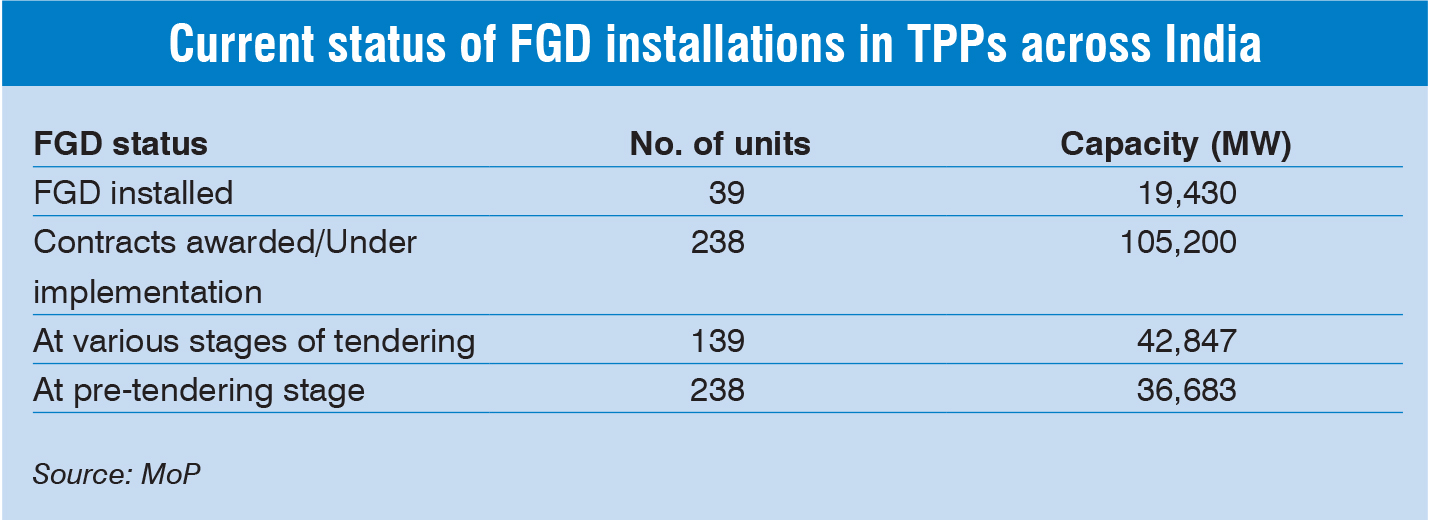
According to the Ministry of Power (MoP), FGD is being installed in 537 units (204.16 GW), out of which, FGD installation has been completed in 39 units (19.43 GW). Further, contracts/letters of award have been awarded for 238 units (105.2 GW). 139 units (42.85 GW) are at various stages of tendering and 121 units (36.68 GW) are at the pre-tendering stage.
 NOx
NOx
The combustion of coal produces a significant amount of NOx, including nitric oxide, nitrogen dioxide and nitrous oxide, with the quantity depending on combustion conditions and the coal’s nitrogen content. As per the MoEFCC framework, TPPs commissioned between 2003 and 2016 must adhere to a less stringent limit of 450 mg per cubic metre (Nm³), while plants commissioned after 2017 face a stricter limit of 100 mg per Nm³. Older plants built before December 2003 are allowed up to 600 mg per Nm³. These regulations will be enforced in phases, with progressively stricter compliance deadlines.
There are several technology options to regulate NOx emissions. In-combustion technologies regulate the combustion process to reduce thermal NOx formation, offering low-cost, easy-to-install solutions. India’s NOx emission standards for coal-fired power plants prioritise the adoption of cost-effective primary control methods such as advanced low-NOx burners (LNBs) and overfire air (OFA) systems. These technologies not only ensure compliance with the 450 mg per Nm³ limit but also have the potential to achieve lower emissions, below 300 mg per Nm³.
LNBs are widely used, burning fuel in a limited oxygen zone to create an environment that allows unburnt hydrocarbons to react with NOx, converting it into nitrogen gas. By controlling the initial combustion stage, LNBs reduce peak flame temperatures, further minimising NOx formation. Although LNBs may slightly reduce combustion efficiency, proper design and operation can mitigate increased carbon and carbon monoxide emissions.
OFA systems control oxygen availability near burners, creating a fuel-rich zone to limit NOx formation. The combustion air is introduced in stages: partly near the burners, and the rest higher in the furnace at lower temperatures. OFA systems can reduce NOx emissions by 20-45 per cent, and different variations may achieve higher reductions. When combined with LNBs, OFA systems provide a synergistic approach to minimising NOx.
Combustion optimisation involves actively managing the burning process in boilers to strike an ideal balance between maximum combustion efficiency and acceptable emission levels. For coal-fired boilers, achieving similar outcomes often requires significant efficiency reductions, ranging from 20 to 60 per cent. This technique employs active control measures, allowing manual adjustments to boiler settings to optimise performance. It provides a cost-effective solution for coal plants, enabling NOx emission reductions of 15-35 per cent. This approach is especially suitable for boilers commissioned between 2003 and 2016, which are likely already equipped with LNBs and OFA systems.
Flue gas recirculation involves diverting a portion of the hot exhaust gas back into the furnace, reducing combustion temperatures and oxygen availability. This creates an oxygen-limited environment that suppresses NOx formation and improves fuel mixing for better combustion efficiency.
Post-combustion control systems such as selective catalytic reduction (SCR) and selective non-catalytic reduction (SNCR) capture or chemically convert NOx into harmless nitrogen gas after the flue gas exits the boiler. These systems, however, are more expensive to implement and operate.
SNCR reduces NOx by injecting ammonia or urea into the furnace when the flue gas temperature is between 900 and 1,100 °C. Successful SNCR operation requires adequate residence time and proper mixing of the reducing agent. Plasma-assisted SNCR combines traditional SNCR with plasma technology, improving temperature distribution and enhancing the reaction for more efficient NOx reduction.
SCR injects ammonia into the hot exhaust gas after it exits the economiser and before it enters the air preheater. A catalyst speeds up the chemical reaction between ammonia and NOx, converting them into nitrogen gas and water vapour. The process is most efficient when flue gas temperatures are between 300-400 °C.
At NTPC, various de-NOx techniques and modifications have been applied in 49 units, with additional execution under way for one unit.
Conclusion
As the country continues to expand its thermal fleet and extend the lifespan of existing plants, there is growing pressure for more effective and timely measures to ensure compliance with emission standards. This includes fostering technological innovations in pollution control, accelerating the shift to renewable energy sources and holding power plants accountable for their environmental impact. The delays in meeting compliance standards highlight the difficulties of transitioning to cleaner, more sustainable energy sources in a nation where electricity demand is rapidly increasing. Despite this, coal remains the primary fuel due to its low cost and abundant supply. Balancing the need for energy security with environmental sustainability will remain a key challenge for India’s power sector in the coming years.
Aastha Sharma