

While the coal-based thermal power sector is a significant contributor to India’s energy supply, its operations are associated with substantial environmental concerns, particularly air pollution and greenhouse gas emissions. In 2015, the Ministry of Environment, Forest and Climate Change (MoEFCC) implemented tight emission norms for thermal power plants (TPPs) to address critical pollutants such as sulphur dioxide (SO2), nitrogen oxides (NOx) and particulate matter (PM), with emission limits tailored to the installation date and capacity of the power plants. Since then, extensions to implementation deadlines have been given till 2026 as TPPs faced immense challenges in achieving compliance. In a recent development, the country’s apex policy think tank, NITI Aayog, raised concerns over the proposal to halt the installation of equipment meant to curb sulphur emissions at coal-fired power plants.
Meanwhile, the Union Ministry of Power has sought a 36-month extension for the installation of flue gas desulfurisation (FGD) systems in TPPs, citing significant challenges in meeting the deadlines set by the MoEFCC. The Ministry of Power highlighted constraints such as limited domestic manufacturing capacity, a restricted vendor base, and dependency on imports for certain components, which has been exacerbated by a surge in demand.
A look at the key developments in the emission control space, challenges faced by TPPs and outlook…
Recap of emission norms
On December 7, 2015, the MoEFCC introduced enhanced environmental standards for coal-based TPPs under the Environment (Protection) Act, 1986. These standards imposed strict limits on emissions of key pollutants, tailored to the capacity and commissioning dates of TPPs.
For SO2 emissions, plants installed until December 31, 2016, were required to limit emissions to 600 mg per Nm³ for units under 500 MW and 200 mg per Nm³ for units with capacities of 500 MW or more. For plants commissioned from January 1, 2017 onwards, the SO2 limit has been reduced to 100 mg per Nm³. In September 2022, the MoEFCC extended the deadlines for installing SO2 reduction technologies based on the location of the TPPs. Category A plants, within 10 km of Delhi-National Capital Region (NCR) and cities with populations exceeding 1 million, have until December 31, 2024. Category B plants, near critically polluted areas or non-attainment cities, must comply by December 31, 2025. Category C plants, in other locations, have until December 31, 2026. Further, TPPs retiring before December 31, 2027, will not be required to meet the SO2 emission norms in case such plants submit an undertaking to the Central Pollution Control Board (CPCB) and the Central Electricity Authority (CEA) for exemption on grounds of retirement. In addition, TPPs declared to retire before December 31, 2022 (Category A) or December 31, 2025 (Categories B and C) will not be required to meet the specified norms other than SO2 emissions, in case such plants submit an undertaking to the CPCB and the CEA for exemption on grounds of retirement.
For NOx, plants commissioned between 2003 and 2016 were originally required to cap emissions at 300 mg per Nm³, a limit now revised to 450 mg per Nm³. For plants commissioned after January 1, 2017, the limit remains at 100 mg per Nm³, while older plants commissioned before 2003 are permitted up to 600 mg per Nm³.
PM emission standards are also segmented by plant installation dates. Plants commissioned up to December 31, 2003, have a PM limit of 100 mg per Nm³, while those commissioned between January 1, 2004 and December 31, 2016 must adhere to a 50 mg per Nm³ limit. For plants installed after January 1, 2017, the PM emission cap is 30 mg per Nm³.
Emission control technologies and status so far
SOx control
Wet FGD based on limestone is one of the most frequently used technologies for reducing SOx. About 90 per cent of SOx is removed effectively by wet FGD systems. FGD can be categorised as seawater based, ammonia based or limestone based, depending on the reagent employed. Emerging FGD systems are mostly based on wet limestone technology. A large number of TPPs, including the 1,320 MW Solapur super TPP, the 1,320 MW Tanda Stage II project, the 500 MW Unchahar project, the 2,000 MW Simhadri super TPP Stages I and II projects, the 1,500 MW Indira Gandhi super TPP project, the 1,980 MW Sipat super TPP Stage I project, and the 1,320 MW Meja thermal power station project are installing wet FGD technology to control SOx emissions.
Dry sorbent injection (DSI) is another post-combustion SOx removal technique, which is preferred for plants with unit sizes in the range of 60-250 MW. Notably, NTPC Limited has opted for DSI at its Dadri power plant. DSI system erection work is at advanced stages in two units of NTPC’s Tanda Stage I TPP (4×110 MW). Ammonia-based FGD is suitable for units below 250 MW. Limestone-based FGD is the most versatile and prominent FGD technology option, offering the highest efficiency. Meanwhile, seawater-based FGD is
limited to coastal TPPs that use condenser cooling circuits.
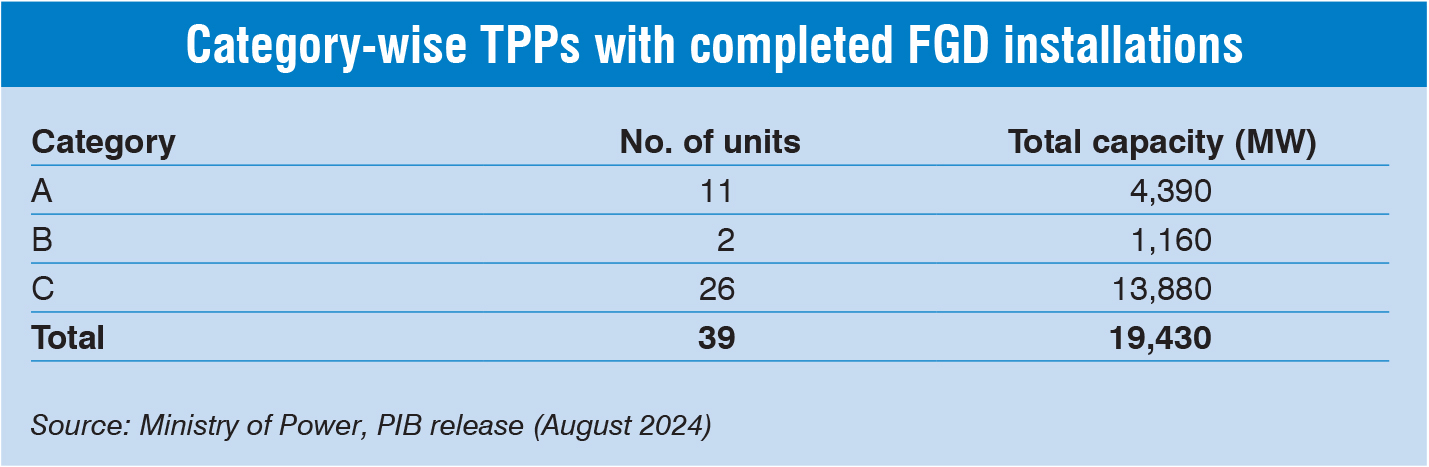
According to the Ministry of Power, FGD for SOx control is being installed in 537 units across coal-based TPPs as of August 2024. So far, FGD systems have been commissioned in 39 units with a capacity of 19,430 MW. The contracts have been awarded for 238 units with a cumulative capacity of 105,200 MW. Further, 139 units are at the tendering process, with a capacity of 42,847 MW.
 NOX control
By utilising techniques such as combustion modification processes, NOx outflows may be reduced to 300-600 mg per Nm3. However, improved control methods, such as selective catalytic reduction (SCR) and selective non-catalytic reduction (SNCR), are needed to further reduce emission levels by 100-300 mg per Nm3. According to the CEA, 62 units (21,339 MW) have completed combustion modification, seven units (750 MW) have planned combustion modification by December 2024 and six units (1,400 MW) have started feasibility studies.
At NTPC Limited, specifically, combustion modifications have been completed in 50 units, aggregating around 21 GW, including the units located in NCR – two units at Dadri and three units at Jhajjar. Overfire dampers have been installed, allowing precise regulation of the flow and direction of the secondary air injected into the furnace by the overfire air system.
While SCR and SNCR are established technologies for NOx emission reduction with respect to low ash coal, they have not yet been cleared for abrasive and high ash Indian coal. NTPC is conducting several pilot tests and studies to determine if SCR technology is appropriate for Indian coal.
PM control
Fly ash, a by-product of coal combustion, is a major contributor to PM, accounting for approximately 26 per cent of PM10 and PM2.5 emissions. At high temperatures, fly ash can become airborne, posing risks to air and water quality due to its content of heavy metals and other hazardous substances.
To mitigate PM emissions, TPPs typically use electrostatic precipitators (ESPs), which electrically charge ash particles in flue gas. ESPs are highly effective, capturing over 99.99 per cent of particles ranging from 0.01 to 100 micrometres. According to the CEA, 57 units (19,794 MW) have upgraded their ESPs, with upgrades planned for 12 additional units (1,690 MW) by December 2024. Another six units (2,005 MW) anticipate achieving PM compliance following FGD installation.
At NTPC, ESP retrofits have been completed for 40 units with a combined capacity exceeding 13 GW, achieving a control efficiency of over 99.8 per cent across all stations. Retrofitting efforts are ongoing for the remaining units, while renovation and modernisation of ESPs have been finalised for 14,220 MW of capacity. Further reductions in PM emissions are expected through the implementation of FGD systems.
Issues and the way forward
Utilities face considerable challenges in deploying FGD systems due to several factors, including limited access to concessional financing, high capital costs and constraints related to space and infrastructure. Delays in tariff adjustments further exacerbate the situation. Vendor capacity is another bottleneck, with current capabilities limited to supporting installations of 16-20 GW (33-39 units) annually, while approximately 20 per cent of FGD components still rely on imports. Additionally, design complexities stemming from site-specific requirements hinder standardisation and streamlined implementation. Frequent revisions to compliance deadlines have compounded these delays, creating ripple effects that impact both vendors
and suppliers.
Meanwhile, policy uncertainty also looms over the further course of installations. NITI Aayog has reportedly recommended the central environment and power ministries to direct coal-based power plants to stop placing fresh orders for FGDs.
To effectively address air pollution, a clear and consistent policy framework with well-defined timelines is crucial. This should be complemented by ongoing research, innovation and open dialogue among stakeholders. Technological advancements must focus on improving efficiency, reducing water usage and maximising by-product utilisation. Original equipment manufacturers need to develop cost-effective, adaptable systems that meet emission standards while ensuring the availability of high quality components and reliable after-sales support. Over time, the energy sector should shift its emphasis from merely achieving cleaner operations to embracing sustainable green energy solutions.
As per the Centre for Research on Energy and Clean Air, completing FGD installations across all 537 coal-fired power plant units in India could achieve an estimated 64 per cent reduction in SO2 emissions, bringing them down from 4,327 kilotonnes to approximately 1,547 kilotonnes. This substantial decrease underscores the critical environmental benefits of enforcing stringent emission control measures. To realise this potential, regulatory oversight must be bolstered, with stricter enforcement of compliance deadlines and more robust penalties for violations.