
Thermal power continues to play a pivotal role in the global power sector, despite the ongoing push for cleaner energy alternatives. With India’s commitments to reduce emissions under its Nationally Determined Contributions, there is a growing pressure to transition to cleaner energy and move from these high-carbon energy sources. The focus has, thus, shifted to supercritical and ultra-supercritical technologies, because of their ability to improve plant efficiency and reduce emissions at the same time. These technologies offer several benefits over subcritical units such as reduced coal consumption, per unit of electricity produced, increased flexibility in plant operations and a notable reduction in carbon dioxide (CO2) emissions.
Clean coal technologies
Research and development (R&D) in support of supercritical and ultra-supercritical technologies has allowed their deployment for new construction such that they are now considered mainstream for power generation. There is a growing base of high-efficiency supercritical coal-fired units in operation.
Ultra-supercritical and supercritical units are engineered to operate at significantly higher steam parameters, with ultra-supercritical units reaching 280 kg/cm² at 600/600°C and supercritical units achieving 247 kg/cm² at 565/593°C. These advanced steam conditions enable these units to deliver efficiency levels of approximately 9 per cent and 5 per cent higher, respectively, compared to conventional 500 MW subcritical units. By utilising these technologies, fuel consumption per unit of power generation is reduced by around 2 per cent, contributing to an 8 per cent reduction in emission intensity compared to traditional subcritical power plants. This makes ultra-supercritical and supercritical boilers a more sustainable and energy-efficient choice for modern power generation.
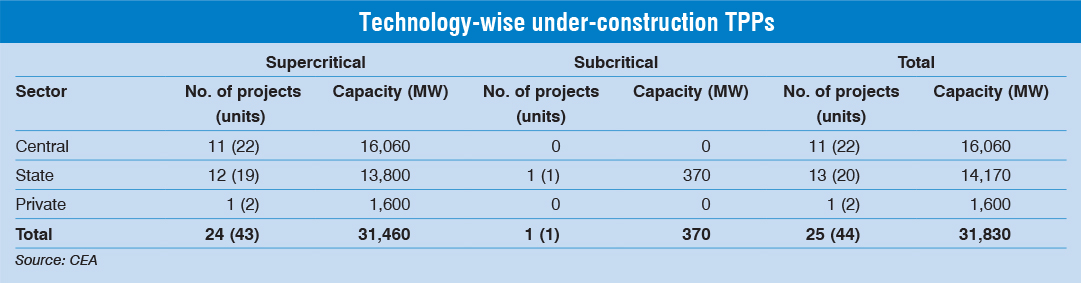
As per the Central Electricity Authority data, there are currently 43 supercritical units under construction in the country, aggregating 31,460 MW.
Meanwhile, a joint venture between NTPC and Bharat Heavy Electricals Limited (BHEL) will set up a full-scale 800 MW commercial plant, using advanced ultra-supercritical (AUSC) technology. While presenting the budget for 2024-25, the finance minister stated that the government will provide the required fiscal support. AUSC technology has been developed indigenously with joint R&D efforts from the Indira Gandhi Centre for Atomic Research, BHEL and NTPC. According to BHEL, AUSC technology provides a 10-15 per cent reduction in CO2 emission compared to subcritical technology. The first phase of the project, which focused on R&D, has been successfully completed. In the second phase, the 800 MW AUSC technology demonstration plant will be set up under the aegis of the Ministry of Power and NTPC. The demonstration plant will be part of NTPC’s existing plant at Sipat in Bilaspur district of Chhattisgarh.
Integrated gasification combined cycle (IGCC) technology is another key clean coal technology. This innovation allows coal to be converted into cleaner syngas, which can then be used to power gas turbines and generate electricity more efficiently. Since IGCC reduces emissions, it automatically becomes an important technology to balance coal reliance with sustainability goals. Commercial-scale facilities in the Netherlands, Spain and the US are operating successfully and providing operational experience with the technology. The advantages of gasification include the flexibility to handle a variety of feedstocks (e.g., coal, biomass, petcoke and oil tars), and also having the option to produce multiple products (e.g., electricity, chemicals, hydrogen, transport fuels and synthetic natural gas).
Digitalisation trends
Furthermore, many thermal power plants (TPPs) across the country have begun adopting digital technologies, thereby revolutionising the operations and maintenance of TPPs. The adoption of the latest digital technologies is helping TPPs improve performance by reducing the consumption of fuel, auxiliary power, consumables and greenhouse gas emissions.
Digital twin solutions are assisting in better operations and maintenance of applications such as boilers, gas turbines, flue gas desulphurisation systems, selective catalytic reduction systems and air preheaters. Advanced solutions such as artificial intelligence (AI), machine learning (ML) and internet of things (IoT) are now playing a pivotal role in optimising plant operations by analysing real-time data to forecast energy generation, minimise unscheduled outages, and eliminate unnecessary preventive maintenance, thereby improving overall plant availability and reliability. TPPs are also deploying drone-based monitoring to minimise human exposure to hazardous areas and improve staff safety during plant inspections and maintenance.
 CO2 capture
The need to tackle rising CO2 emissions to address climate change means that clean coal technologies now extend to include those for CO2 capture and storage. By capturing CO directly from the power plant, carbon capture utilisation and storage (CCUS) technologies mitigate the environmental impact of TPPs, helping them transition towards sustainability. These systems are particularly effective in ultra-supercritical and supercritical power plants, where higher efficiencies already contribute to reduced emissions. The integration of CCUS further amplifies this effect, enabling near-complete carbon capture. Once captured, CO₂ can be either stored in geological formations or utilised in industrial processes, such as enhanced oil recovery, or the production of high-value chemicals such as methanol and urea.
Currently, there are a number of R&D and pilot-scale projects that aim to address performance and scale-up issues. In a major step to highlight its potential, NTPC recently announced that it has achieved CO2-to-methanol synthesis at the Vindhyachal TPP in Madhya Pradesh. Conceived and conceptualised by NETRA (NTPC Energy Technology Research Alliance), the R&D arm of NTPC, this innovative plant captures CO2 directly from the flue gas emissions and converts it into methanol, a versatile and cleaner fuel, which can be further used for applications such as power generation and transportation. It is also undertaking an assessment of CO2 storage potential in select coalbed methane rich coalfields in India, including those available with NTPC. NETRA NTPC and the National Centre of Excellence in Carbon Capture & Utilisation (NCoE-CCU), IIT, Bombay, have launched the assessment for it.
Conclusion
Technological advancements, such as advanced ultra-supercritical systems, digital solutions powered by AI, ML and IoT, and flexibilisation strategies, are redefining the operational efficiency and sustainability of TPPs. While these advancements have significantly improved efficiency and flexibility, addressing emissions remains a pressing priority, especially with thermal power dominating India’s energy mix. The journey to widespread CCUS adoption remains to be a challenging one due to high upfront capital costs, and the need for robust policy frameworks. Despite these challenges, the prospects for CCUS in India are promising.