
With coal expected to dominate India’s energy mix for at least the next few years, renovation and modernisation (R&M) is critical for improving the efficiency of thermal power plants (TPPs). Ageing assets, environmental mandates and growing energy demands necessitate a focused approach to enhance the efficiency, reliability and sustainability of TPPs. R&M of ageing power plants stands as a financially viable approach to bolstering power generation. R&M initiatives typically require shorter implementation periods than the construction of new plants, and involve minimal rehabilitation and resettlement concerns. R&M seeks to enhance heat rate, diminish auxiliary consumption, decrease emissions and ensure optimal fuel utilisation. In contrast, life extension (LE) of old thermal power units is carried out with the aim of extending their useful life by 15 to 20 years beyond the original design’s economical life.
Experience so far
India’s thermal power fleet comprises a significant number of ageing units, particularly in the 200 MW/210 MW category, many of which are over 25 years old. These units often face declining efficiency, high maintenance costs and challenges in adhering to modern environmental standards. According to the Central Electricity Authority (CEA), over 90 GW of coal-based capacity in India is more than 25 years old and requires R&M or retirement in the near future.
The government has been actively promoting R&M and LE as part of its strategy to ensure energy security. Public sector units such as NTPC and state utilities are accessing loans from agencies such as the Power Finance Corporation and Rural Electrification Corporation for R&M projects.
During 2017-22, a total capacity of 1,197 MW underwent R&M/LE works in the state and central sectors (as of September 2024). These include Ukai TPS (Unit 4), Wanakbori TPS (Unit 3), Kathalguri CCGT (Unit 3), Kathalguri CCGT (Unit 6), Koradi TPS (Unit 6), Obra TPS (Unit 12), Obra TPS (Unit 13) and Barauni TPS (Unit 6).
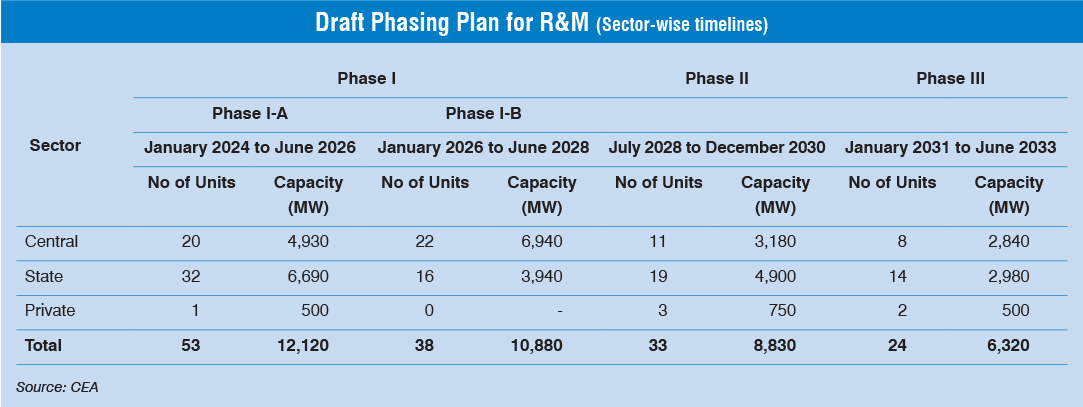
Going forward, for the 2024-33 period, the CEA has identified 148 units, with a total capacity of 38,150 MW, that are older than 20 years (as of December 2022) as potential candidates for R&M/LE works. This work has to be implemented in three phases to avoid any major energy demand-supply gap.
A draft phasing plan for 148 units and tentative timelines for the implementation of R&M/LE intervention have been prepared. As per Phase I-A of the plan, all units over 35 years of age are proposed to undergo R&M/LE works by June 2026, while under Phase I-B of the plan, all units between 30 and 35 years of age are proposed to undergo R&M/LE works by June 2028. In Phase II, thermal units between 25 and 30 years of age are to undergo R&M by December 2030, while units between 20 and 25 years of age are to complete the process by June 2033.
 Environmental mandates
TPPs also need to undertake retrofits for the installation of emission control equipment such as flue-gas desulphurisation (FGDs) technologies. As per a Ministry of Environment, Forest and Climate Change notification dated September 5, 2022, the time limits for implementation of the sulphur dioxide (SO2) emission norms by coal-fired TPPs in Categories A, B and C (based on the plant’s location) are December 2024, December 2025 and December 2026, respectively. These TPPs are required to comply with the SO2 emission norms within these stipulated timelines, failing which environmental compensation for non-compliance shall be imposed accordingly.
Among the various technology options, limestone-based wet FGD stands out as the top choice among desulphurisation technologies for Indian coal-based power plants. These systems effectively remove 90-99 per cent of sulphur oxide emissions, making them the preferred option. They are valued for their adaptability to units of different sizes, cost-effectiveness and the production of a marketable byproduct, gypsum. Dry/Semi-dry FGD technologies achieve removal efficiencies between 70-98 per cent. However, they have higher operational expenses despite the lower initial capital costs.
As of August 2024, FGD units have been installed in 39 units with a cumulative capacity of 19,430 MW, while contracts for 105,200 MW of capacity have been awarded and another 42,847 MW is under various stages of tendering. Several challenges persist in facilitating the seamless implementation of FGD systems, with space constraints and limited vendor availability being the primary concerns. On the technical front, older coal-based units face hurdles due to space limitations for FGD system installation. Additionally, the scarcity of quality limestone and the associated high transportation costs pose execution challenges. The management of unutilised gypsum, a byproduct of FGD plants, also presents a notable concern.
 Future outlook
As per the Central Electricity Regulatory Commission (CERC) regulations, thermal units become eligible for R&M after completion of 25 years of operation. As per regulations published by CERC in 2024, a special allowance of Rs 107.5 million per MW is envisaged for the 2024-29 period.
Net net, R&M and LE initiatives can defer the need for new capacity additions, reduce costs and ensure a smoother transition to a greener grid. As India navigates its energy transition, R&M and LE remain indispensable tools for maintaining grid reliability, improving plant efficiency and meeting environmental standards. With the right mix of policy, technology and financial support, India’s ageing thermal fleet can be revitalised to play a pivotal role in the country’s sustainable energy future.