
 Established in 2011, Kerala State Electricity Board Limited (KSEBL) was re-vested under the Kerala Electricity Second Transfer Scheme of 2013. It functions as a fully integrated electricity utility, overseeing the generation, transmission and distribution of electricity across nearly 99 per cent of the state’s consumers. From an initial installed capacity of 109 MW in 1957, KSEBL has expanded to an impressive 2,482.42 MW as of 2023-24. The utility has achieved one of the lowest aggregate technical and commercial (AT&C) losses in the country, consistently maintaining losses in single digits.
To meet the growing power demand, KSEBL aims to ensure 10,000 MW of power availability in the state by 2030. The utility is prioritising grid modernisation and renewable energy initiatives, with a focus on solar power, energy storage and innovative solutions such as pumped storage plants. It is also investing significantly in smart metering and distribution infrastructure improvements under the Revamped Distribution Sector Scheme (RDSS).
Generation mix
Kerala’s energy requirement has increased significantly. While the state’s internal generating capacity is around 3,819 MW, power demand in the state has increased to 5,301 MW in 2023-24.
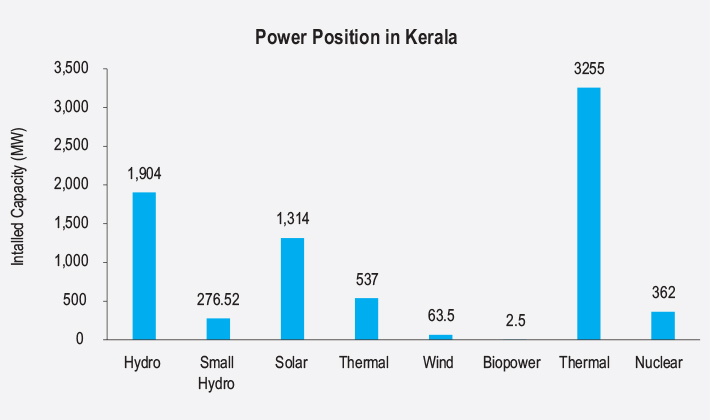
The state’s generation mix is dominated by renewable energy, with hydropower contributing 1,904 MW, followed by solar energy at 1,314 MW. Small-hydro projects account for 276.52 MW, while thermal power accounts for 537 MW. Wind energy and biopower contribute 63.5 MW and 2.5 MW respectively,
The annual power generation in the state has exhibited a fluctuating trend with significant growth over the years. After a dip to 5,723 MUs in 2019-20, generation surged to a peak of 9,742 MUs in 2021-22 before declining to 8,538 MUs in 2022-23.
During 2023-24, KSEBL added substantial renewable energy capacity. This included 244.34 MW of solar capacity, surpassing the state’s total solar capacity of 1 GW. Also, the 6 MW Peruvannamoozhi small hydroelectric project (HEP) was inaugurated. Under PM-KUSUM, installations aggregating 1.3 MW were completed at eight sites. In the ongoing financial year (2024-25), KSEBL recently commissioned the Thottiyar HEP (40 MW). The 60 MW Pallivasal extension scheme in Idukki is also nearing completion.
Transmission and distribution
During 2023-24, the state witnessed the commissioning of seven extra high tension (EHT) substations, including Kerala’s first 400 kV gas insulated substation at Kottayam, and the addition of 297 ckt km of transmission lines. The state’s import capacity increased by nearly 1,000 MW.
At a recent Power Line conference, Biju Prabhakar, Chairman and Managing Director, KSEBL, shared that the utility has one of the lowest AT&C losses in the country at 7.55 per cent in 2023-24. In 2021-22 and 2022-23, AT&C losses were reduced to 8.26 per cent and 7.55 per cent, respectively, compared to the trajectory targets of 13 per cent and 12.2 per cent.
He added that KSEBL has also consistently maintained low SAIFI and SAIDI values at 12.23 and 58.79 respectively for 2024, which reflects fewer and shorter power interruptions compared to other state-owned utilities. This can be attributed to effective grid management, regular maintenance and a quick response system.
The state’s power purchase quantum has grown at a CAGR of 4 per cent between 2016-17 and 2023-24, reflecting the steady rise in energy consumption. Despite surplus solar power during the day, supported by an average addition of 35 MW from rooftop solar to the grid, Kerala faces challenges with grid congestion and balancing supply effectively. To address shortfalls, the state often relies on gas-based power stations, driving power costs above Rs 10 per unit in critical times.
Kerala’s total consumer base stood at 13.2 million as of March 2024, with domestic consumers accounting for 76 per cent, followed by commercial category consumers at 19 per cent and industrial consumers at 12 per cent.
KSEBL’s total electricity sales were 27,675 MUs in 2023-24. The LT domestic consumer segment accounted for the highest share at 50 per cent, reflecting significant residential demand. The HT and EHT (high tension and extra high tension) category followed with 22 per cent of total energy sales. Commercial LT customers contributed 17 per cent, highlighting the commercial sector’s role in Kerala’s power consumption. Both industrial LT and other categories represented 5 per cent each, while agricultural LT accounted for a minimal share of 1 per cent. Interestingly, the export category recorded 0 per cent sales.
Financial performance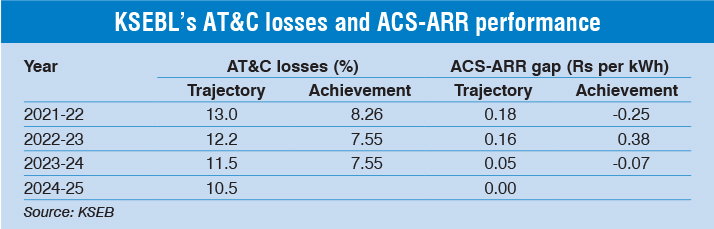
In terms of financial performance, KSEBL’s consolidated statement shows significant improvement for the year ended March 31, 2024. The total income increased to Rs 218.02 billion, up from Rs 189.38 billion in the previous year, reflecting a growth of 15.13 per cent. Notably, the company achieved a net profit of Rs 2.12 billion in 2024, a remarkable turnaround from the net loss of Rs 9.91 billion in 2023. This significant recovery can be attributed to improved operational efficiency and enhanced financial management during the year.
New initiatives
KSEBL is undertaking several key initiatives to improve infrastructure, promote sustainability and enhance customer services across Kerala. Under the Dyuthi project, KSEBL aims to elevate its distribution grid to international standards through a comprehensive five-year plan spanning 2022-23 to 2026-27. Despite the achievements of Dyuthi 1 (2018-22), KSEBL recognised the need to reach global standards of performance in several areas. Hence, its board approved the Dyuthi 2 project with a budget of Rs 40.16 billion. Dyuthi 2 integrates essential features and requirements from the Dyuthi 1 scheme and the RDSS, focusing on resilient and safe installations, ensuring uninterrupted supply during the plan period and seamless integration of renewable energy.
Another new initiative is Filament Free Kerala, completed in partnership with local self-governments. The initiative successfully replaced filament lamps with LED bulbs, reducing peak demand and mercury pollution by distributing 11.8 million LED bulbs to consumers. The NILAVU programme, also in collaboration with local self-governments, has replaced conventional street lights with LED alternatives, with installations reaching 366,980 as of March 31, 2024.
In the area of e-mobility, KSEBL has established 63 fast charging stations and 1,169 pole-mounted charging stations. It is promoting the “recharge and refresh” concept, enabling charging at malls and offices where vehicles are typically parked. It also plans to roll out fast charging infrastructure in the state.
Another key initiative is KEMapp, an app from KSEBL that contains information about charging stations for electric vehicles (EVs) and allows remote operation of these stations. Developed in collaboration with five vendors, KeMAPP addresses the challenges faced by EV users, particularly the fragmentation of mobile applications. To streamline operations and enhance user experience, KeMAPP was developed as a comprehensive software solution and mobile application.
Additionally, KSEBL is transitioning customer services to digital platforms to improve efficiency. Since December 1, 2024, all services have been made available online, with offline services being discouraged. KSEBL is also focused on implementing IT and digital solutions; introducing cloud telephony services that allow consumers to register complaints, request services and obtain billing information via IVR and WhatsApp; and reducing manual intervention and wait times.
Through the voluntary disclosure scheme, KSEBL is facilitating energy savings by allowing self-declaration for revising connected loads for LT consumers. It is also undertaking significant electrification efforts. These include the electrification of BPL households with a connected load of up to 1,000 W, funded by KSEBL’s own resources, and large-scale tribal colony electrification. So far, 29 colonies have been electrified.
KSEBL has also contributed to ensuring 4G network penetration across Kerala, strengthening connectivity in the state.
 Future plans
KSEBL has outlined several focus areas to enhance operational efficiency, promote green energy and adopt advanced technologies. KSEBL is targeting a total installed capacity of 10,000 MW by 2030. This includes 500 MW of solar, 530 MW of wind, 1,500 MW of hydro and 35 MW of monthly rooftop solar additions. Further, it plans to achieve 3,000 MWh of battery energy storage system (BESS) and 2,000 MW of pumped storage (six-hour discharge) capacity. It also plans to explore small modular reactors for setting up nuclear power in the state.
In the transmission segment, KSEBL is focused on developing green energy corridors, improving infrastructure through trans grid projects. TransGrid 2.0 aims to create intra-state high-capacity corridors for seamless power transfer, ensuring power availability at all load centres with minimal loss.
It is also implementing data centres for automatic energy logging and adopting innovative solutions to reduce interstate transmission losses, thus ensuring reliable and efficient energy distribution. In regions with significant vegetation causing outages, a zero-outage policy has been initiated.
KSEBL is also advancing GIS mapping of all its generation, transmission and distribution assets. Technical pilots are being undertaken for asset inspection using drones/UAV technology.
KSEBL is implementing the RDSS with an outlay of around Rs 28.80 billion. Of this, 60 per cent of budgetary support will come from the Ministry of Power and the remaining 40 per cent from KSEBL’s own resources to modernise and strengthen distribution infrastructure. Almost 77 per cent of the budget is allocated to distribution infrastructure improvements. Tenders for projects have been finalised. SCADA and internet of things initiatives will also be taken up in the state.
The discom plans to increase the share of HT lines in its network to improve the quality of power supply and reduce losses. In addition, it is adopting covered conductors to avoid interruptions and developing hotline maintenance solutions to improve reliability. It is also undertaking distribution transformer health monitoring and pilot asset inspections using drones and UAVs.
For addressing the current challenges in transformer supply chains, KSEBL is shifting gears to bolster in-house manufacturing capabilities, ensuring a more robust and self-sustaining system.
To improve demand-side management, KSEBL has engaged in resource adequacy plans and smart meter-driven demand management while piloting BESS in villages and encouraging public investment in solar batteries.
A key initiative is providing FIDIC training to ensure fair and competitive tenders. In addition, KSEBL is developing its own research and development wing.
Challenges and outlook
KSEBL faces several key challenges that impact its operations and infrastructure development. One major issue is difficulty in maintaining the supply chain for components/key equipment as rising demand leads to longer lead times and increased costs. This problem is further compounded by the lack of manufacturing facilities within the state and high freight charges due to Kerala’s locational disadvantage.
Another critical challenge is the scarcity of skilled contractors capable of undertaking high-value projects, which delays progress. KSEBL also faces resistance from its trade unions to technology transitions, such as smart meters. Also, the integration of existing meters adds complexity while the high costs of implementation call for financial assistance.
Despite these challenges, KSEB’s forward-looking strategy reflects its sustained commitment to building a robust and reliable power sector in Kerala. By adopting renewable energy, modernising infrastructure and partnering with village-level government bodies, KSEB is setting a strong example of how to address growing power demands effectively and sustainably.