

 Surinder Kumar Negi, CTO, Skipperseil Limited, and former MD, GETCO
Electricity has become a lifeline for human beings. Almost each and every activity is dependent on electricity and one cannot afford to have any interruptions. The same is true for the power industry, whose growth and sustainability are directly linked to availability of uninterrupted power supply. When such is the impact of electricity on our social life, the first and foremost expectation from utilities and the government would be to provide electricity at an “affordable price”.
The power sector in India has grown and matured enough to serve the nation 24×7 with quality power supply. The Electricity Act, 2003 triggered a paradigm shift in the administrative setup, commercial and regulatory mechanisms, system performance and operation, power industry growth and last but not the least, customer focus.
Thanks to the vision of policymakers, who very well anticipated and captured the future of the electricity sector while drafting the Electricity Act, today we are fully geared up to overcome administrative and commercial challenges.
On the generation front, we have put up a robust installed capacity of 462,065 MW as of December 2024, comprising 299,578 MW of conventional and 162,477 MW of renewable energy, which is good enough to serve the entire nation without shortages. India has the unique distinction of power system operation in one frequency for the entire nation. This is possible because of good transmission planning, technology adoption – 765 kV AC and 800 kV HVDC, adequate network with reliability criteria and 24×7 load despatch centres, etc.
In distribution, we continue to face challenges in serving agricultural, rural and urban consumers in spite of feeder bifurcation. Aggregate technical and commercial (AT&C) losses and transformer failures require further improvement, even though AT&C losses have been reduced from 27.8 per cent in 2009 to 15.37 per cent in 2023. It is a remarkable recovery, but discoms still have to go a long way.
 The surge in renewable energy from 46,000 MW in 2016 to 162,477 MW in 2024 has not only drastically changed the despatch schedule for conventional plants, but also grid operation methodology in order to maintain “one nation, one frequency” despite the intermittent nature of renewable energy. In Gujarat, 95 per cent of the agriculture load is now served during day time with renewable energy and the position in many states will be similar. Therefore, renewable energy infrastructure and sub-transmission systems have become valuable assets for a utility to maintain. The ambitious target set by the government of 500 GW renewable energy by 2030 will call for meticulous planning of despatches, along with grid monitoring and control remedial measures at the state, regional and national levels.
Going forward, we have to adopt a viable financial model, which includes network development, operations and maintenance (O&M) expenditure, administrative costs and invisible losses. One has to make a prudent investments plan with justifications and clear cost-benefit analysis regarding investment made in new projects, maintenance infrastructure tools and system improvement plans (renovation and modernisation). The latter is gaining prominence as aged and obsolete technology assets in the transmission and distribution (T&D) grid are the major cause of breakdown, poor maintenance and unsafe operation.
This is possible only when an integrated approach is adopted in the sector, and collaborative efforts by policymakers, regulators, technical institutes, utilities and the public act as catalysts in the implementation of this integrated approach.
It is good that we have a strong knowledge base in advanced control and monitoring devices, diagnostic equipment and tools, installation techniques, hotline maintenance tools, etc. Moreover, we have the information technology and communications (ICT) skills to use O&M data meaningfully.
An asset management system (AMS), which integrates assets, functions and stakeholders, O&M resources, state-of-the-art T&D technologies, grid operation, environment and safety, is the only way forward. ICT infrastructures would be the backbone to enable such decision-making tools.
The adoption of such an integrated AMS would result in the following gains for a utility:
- Uninterrupted 24×7 power supply and avoidance of industrial production loss and public inconvenience.
- Optimisation of transmission losses and maximisation of system availability through network development and reactive power management.
- Realisation of the full design life of equipment for its cost. Asset management can even facilitate an additional period of operation over its design life.
- Assurance of routine and preventive/predictive maintenance within budget.
- Prevention of breakdown maintenance (reactive), which often results in untoward incidents, collateral damages, power interruption, threat to human life and avoidable costs.
- Facilitation of financial gain through predictive techniques that can help prevent premature failure of capital equipment
- Centralised monitoring of equipment/system performance via routine diagnostics/test result analysis through a health index portal
- Automation in system operation to save manpower costs, allowing utilisation of manpower in system improvement, development of analytics, health index, etc., enabling capacity building
- Enabling of strategic decisions according to localised weather and environment conditions for maintenance and capex deployment
- Support for R&M plans and substitution of obsolete technologies
- Catalysis of design improvement and introduction of new technologies, which are smart IT-enabled, maintenance-free and secured from system parameter variations in grid operation
- Establishment of optimal spare and inventory levels
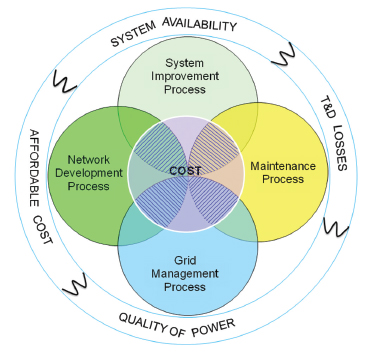
Ownership of such AMS has to be structured in the organisation under the four pillar processes:
- Maintenance process
- Grid management process
- System improvement process
- Network development process
These processes are cost-centric, but they can influence decisions regarding the expenditure plan through close interfacing and correlation, leading to the best results in fulfilling the key performance indicators (KPIs) of the utility in this manner:
Maintenance process – ERP software to ensure adherence to schedule, offline and online diagnostic monitoring and testing, health index tool to determine health status, accurate predictive maintenance, coordination with network development for outages, reactive power management for power quality and losses, spares and inventory management to handle disaster management, identification of aged and obsolete technology.
Grid management process – Merit order despatch, monitoring of tripping and outages, adherence to frequency and voltage parameters, levy of penalty for grid code violation, renewable energy forecasting and generation load balancing from conventional plants, contingency plan, advice on network planning for redundancy, annual maintenance plan for power plant.
System improvement process – Identification of frequent breakdowns in aged and obsolete technology equipment, identification of poor power factor pockets and low voltage pockets for reactive power requirement, renovation of earthing system and hotline maintenance tools.
Network development process – System study for new lines and transformers to cater to loads as per N-I criteria, voltage regulation, reactive power from STATCOM in peak and off-peak times, short-circuit levels for equipment and system security, renewable energy integration at main and sub-transmission levels.
There is no doubt that high investments will be required in the initial stages, but the adoption of AMS processes will be cost-effective and economical in the long run. It is, therefore, necessary to ensure that our decision to invest in any of the above processes is very thorough and doable.
The utility has to be in a proactive mode and vary these cost inputs wisely at regular intervals within the ambit of the utility KPIs and performance reviews. All the processes are interlinked and investment in a particular process has a visible impact on improvement in other process. The performance review of each process as per the matrix of integrated AMS must look at such visible impacts. Corrective and/or preventive ensure must be taken accordingly to have a balanced investment in all four processes.
The KPIs are measurable performance indicators developed out of business processes to gauge a company’s performance as a whole. Integrated asset management links these business processes and the final outcome is measured through KPIs, which fulfil the commitment given to the regulators and stakeholders. Simultaneously, business processes are changed/modified through internal and external inputs, such as shareholders’ suggestions, financial numbers, employees’ expectations, customer pressure to minimise rates, government policies and regulations to achieve better KPIs.
Going forward with integrated AMS
Step 1: Perform asset mapping.
Step 2: Deploy ERP software to manage assets and coordinate data flows from various operation sites to a centralised/cloud server for preventive (proactive) action, according to test data
entered at a remote location through in built analytics.
Step 3: Establish an apex body comprising the four process heads to provide inputs for asset management objectives.
A reasonably good maturity level on part of the utility in terms of knowledge, skills and ownership is the primary requirement to ensure seamless integration of the four processes to sustain AMS in the long run. It is high time that utilities gear up in right earnest to adopt and implement integrated AMS.