

In an extremely densely populated and rapidly developing country like India, ensuring that rail electrical infrastructure keeps pace with the changing needs and increasing number of trains is undoubtedly a complex task. To address this, Indian Railways has structured a national programme, the National Rail Plan 2030, to upgrade existing infrastructure.
The plan involves improving various routes in stages, starting from high-density network routes, followed by the Golden Quadrilateral and Golden Diagonal routes. In the first phase, Indian Railways has already initiated upgrades on one of the priority sections – the Delhi-Mumbai route.
The upgrade will improve power reliability, enhance load-carrying capacity and increase speeds by up to 160 kilometres per hour (kmph), 20 per cent faster than the current maximum speed of 130 kmph. This initiative will support rapid urbanisation and the growing demand for mobility in the country by providing faster, efficient and reliable rail transportation. By significantly reducing the carbon emissions of the railway system, this initiative will contribute to Indian Railways’ mission of achieving net-zero status.
Electrification upgrade on the Delhi-Mumbai route
To start the implementation of the project, Indian Railways needed to find the right partner to develop and execute the required 220 kV and 132 kV traction substations. The substations would power the 2×27.5 kV catenary systems with Scott-connected transformers for the Mumbai-Ratlam and Vadodara-Ahmedabad sections.
The work was awarded to a leading local engineering, procurement and construction (EPC) company, and the transformer supply was assigned to Hitachi Energy.
Hitachi Energy’s scope includes designing and delivering 12×100 MVA 132 kV Scott-connected transformers. These are the first Scott transformers produced at Hitachi Energy in India (at its Maneja factory in Gujarat) and are the largest among all India Railways systems.
Since these transformer ratings were new, the first unit of each had to undergo a dynamic short-circuit test before delivery, which was completed at the Central Power Research Institute in Bengaluru.
The dynamic short-circuit test ensures that transformers can withstand extreme conditions, such as sudden faults or short circuits, without any damage. It helps verify the integrity of the design and confirms the transformer’s ability to perform safely during real-world electrical disturbances.
Hitachi Energy is the first company to deliver India’s largest power-rated Scott transformers, featuring multiple 100 MVA units at 132 kV.
In addition to Scott-connected transformers, Hitachi Energy also secured a contract from an EPC company to supply 132 kV and 220 kV, 63 MVA V-connected transformers for the Eastern Railway Section. Hitachi Energy has successfully completed a short-circuit test for both 132 kV and 220 kV V-connected transformers.
Hitachi Energy’s Scott-connected and V-connected specialty transformers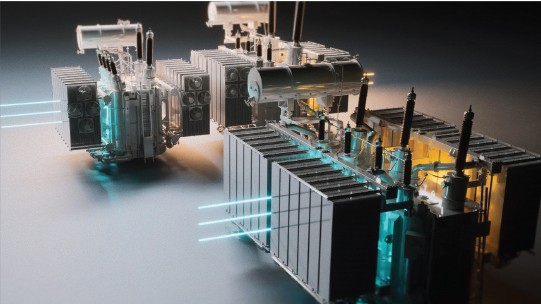
Indian Railways, with their extensive network, face hurdles in keeping pace with the nation’s rapid development. The traditional single-phase 27.5 kV power supply system, while adequate for earlier railway needs, is now a bottleneck against further development, as increasing train speeds and higher traffic density necessitate substantial increases in power delivery.
The challenge was to raise the power rating of single-phase transformers while maintaining the 27.5 kV voltage level, which would cause a higher voltage imbalance, leading to significant voltage drops. Power delivery at this voltage level would also lead to higher power losses, reduced efficiency and infrastructure limitations.
Thus, the limitations of the existing system posed clear challenges to the railway network’s ability to meet the rising expectations of passengers and freight operators. To address the growing challenges and unlock the full potential of India’s railway network, Indian Railways adopted the innovative approach of directly supplying power to two separate 27.5 kV railway lines. By doubling the voltage, the 2×27.5 kV system can deliver significantly higher power levels to trains, enabling increased speeds and capacities without the drawbacks of increasing current in a single-phase system.
To implement this 2×27.5 kV system, Indian Railways relied on Hitachi Energy’s expertise in specialised rail infrastructure power transformers. Together, they developed Scott-connected and V-connected specialty transformers.
These specialty transformers (Scott and V-connected) meet the higher power requirements (for increased train speeds) while offering benefits such as better voltage regulation and reduced voltage imbalances in the network compared to conventional single-phase rail infrastructure power transformers with similar power capacity. In addition, these transformers enable greater spacing between traction substations.
The improved power quality and efficiency offered by the development of these new transformers will result in lower energy losses and reduced environmental impact. In fact, adopting Hitachi Energy’s Scott-connected and V-connected transformers can lead to a 30 per cent reduction in CO2 emissions. As India strives to achieve its sustainability goals, Hitachi Energy’s technology will play a crucial role in building a greener and cleaner rail network.
By enabling higher power delivery, these technologies will support increased train speeds, reduced journey times and enhanced passenger capacity. Furthermore, their special connection and ability to deliver more power allow for increased spacing between railway substations that supply power to the train lines. This optimisation of rail electrical infrastructure reduces maintenance costs and improves the overall system reliability.
Conclusion
Railway electrification and upgrades have been key priorities for Indian Railways to reduce emissions, lower dependence on imported diesel, and reduce operations and maintenance costs of electric locomotives. So far, over 95 per cent (around 62,000 route km) of the broad-gauge network has been electrified, with 100 per cent electrification of the network expected to be achieved in the following years.
The recent upgrade of the rail electrical system underscores the commitment of Indian Railways to enhance the speed, reliability and efficiency of the rail network, and achieve its target of net zero emissions by 2030.
With this project, Hitachi Energy has proven itself as a technology leader and reliable partner in co-creating solutions to meet the unique needs of each customer and national system, and supporting them in their sustainability journeys.
