
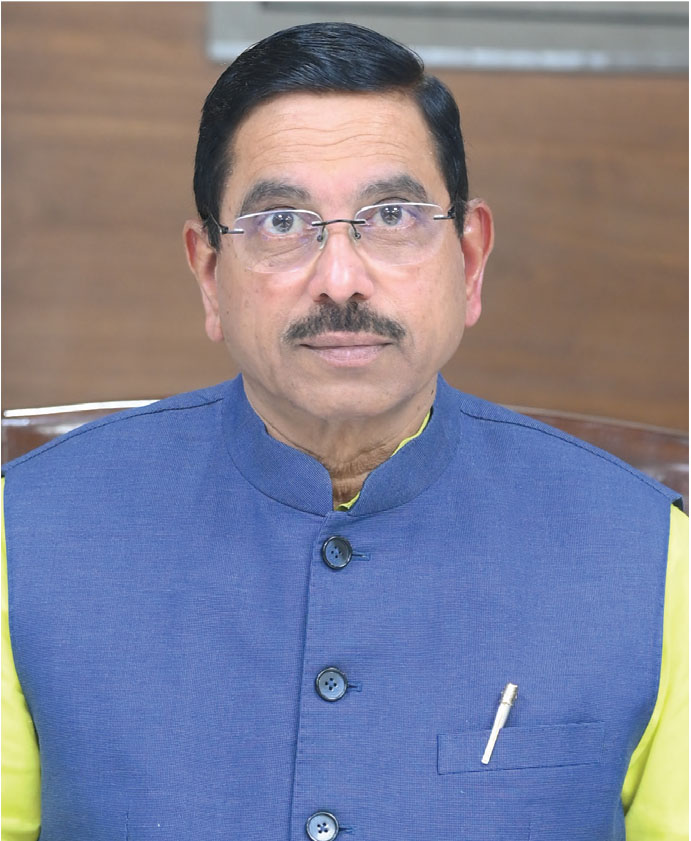
 In an interview with Power Line, Pralhad Joshi, Union Minister for New and Renewable Energy and Consumer Affairs, Food and Public Distribution, spoke about his key priorities, the achievements of the Indian renewable energy sector, and the progress in the residential rooftop solar, offshore wind and domestic manufacturing segments. He also talked about solutions to decarbonise the coal, food and public distribution sectors. Edited excerpts…
What have been the key recent achievements in the renewable energy sector?
In line with the prime minister’s announcement at COP26, the Ministry of New and Renewable Energy (MNRE) is working towards achieving 500 GW of non-fossil fuel-based installed power capacity by 2030. India has remained steadfast in its transition towards clean energy, achieving the fastest pace of renewable capacity addition among all major economies. As of December 31, 2024, 217.62 GW of non-fossil fuel capacity has been installed in the country. This includes 162.47 GW of renewable energy, 46.97 GW of large hydro and 8.18 GW of nuclear power. This accounts for a 47.24 per cent share of the total installed capacity of 460.68 GW as of December 31, 2024. Further, India ranks fourth globally in installed renewable energy capacity, fourth in wind power capacity and fifth in solar capacity (as per IRENA’s Renewable Energy Statistics 2024, with data as of December 2023). During the past 10 years, the installed renewable capacity has increased from 76.37 GW in March 2014 to 209.44 GW in December 2024, an increase of around 2.74 times. Installed solar energy capacity has increased from 2.82 GW in March 2014 to 97.86 GW in December 2024, an increase of over 35 times, while wind capacity has increased from 21.04 GW in March 2014 to 48.16 GW in December 2024, an increase of around 2.3 times. Renewable energy generation has increased from 190.96 BUs in 2014-15 to 359.88 BUs in 2023-24. Solar power tariffs have reduced significantly, from Rs 10.95 per unit in 2010-11 to Rs 6.17 per unit in 2014-15 to around Rs 2.60 per unit in 2023-24. Moreover, wind turbine manufacturing capacity has increased from 10 GW in 2014 to 18 GW in 2024, and solar module manufacturing capacity has increased from 2.3 GW in 2014 to 80 GW in 2024.
What are your priority areas as union renewable energy minister?
My topmost priority is to achieve the Panchamrit target of 500 GW of non-fossil fuel-based installed capacity by 2030. So far, 218 GW of non-fossil fuel-based capacity has been installed and several measures are being taken to achieve the remaining target of 282 GW. These include inviting bids for 50 GW annually and ensuring transmission connectivity. Further, the PM Surya Ghar: Muft Bijli Yojana aims to install rooftop solar systems covering 10 million households by 2026-27. Under the National Green Hydrogen Mission, efforts are being made to establish robust hydrogen infrastructure to achieve the target of 5 million metric tonnes per annum of production capacity by 2030. The MNRE is also working towards the development of offshore wind projects and the promotion of energy storage systems.
What progress has been made so far in the implementation of the PM Surya Ghar: Muft Bijli Yojana?
The government launched the PM Surya Ghar: Muft Bijli Yojana in February 2024 with the aim of increasing the share of rooftop solar capacity and empowering residential households to generate their own electricity. The scheme targets to achieve rooftop solar installations across 10 million households by 2026-27, with an outlay of Rs 750.21 billion. So far, 16.4 million consumers have registered under the scheme, 3,939,000 applications have been received and 806,600 household installations have been completed. Subsidy has been released for 498,000 consumers. The scheme also provides for easy, collateral-free loans from public sector banks at a 7 per cent rate of interest, which can be accessed seamlessly through the PM Surya Ghar portal. Currently, 187,459 loan applications have been received under the scheme, of which 90,215 applications have been sanctioned and 70,585 have been disbursed.
India has a huge offshore wind potential along its coastline. What steps is the government taking to tap this resource?
India is blessed with a coastline of about 11,098 km as was revised recently, surrounded by water on three sides with significant potential for offshore wind energy generation. To tap this potential, the government has taken several steps, including:
Notification of the Offshore Wind Energy Policy in October 2015 to provide a facilitative framework for offshore wind development.
As per the preliminary mesoscale study, the National Institute of Wind Energy (NIWE) has identified eight zones each off the coasts of Gujarat and Tamil Nadu, estimating 70 GW of offshore wind potential. Light detection and ranging (LiDAR) technology installed off the coast of Gujarat in November 2017 collected two years of wind data. In addition, the NIWE has conducted geophysical, geotechnical, rapid environmental impact assessment, and oceanographic (wave and tide current) studies off the Gujarat coast for 1 GW capacity in Zone B and obtained in-principle clearances for the same. LiDAR was also installed off the Tamil Nadu coast in October 2024 and wind resource measurements are under way.
The MNRE has devised a strategy for establishing offshore wind energy projects, with a bidding trajectory of 37 GW by 2030, as well as various business models for project development (revision issued on September 26, 2023). The Offshore Wind Energy Lease Rules, 2023 have been notified to regulate the grant of lease of offshore areas for offshore wind
development.
Central Transmission Utility of India Limited has completed the planning of the transmission and evacuation network for an initial 10 GW of offshore capacity (5 GW each off the coasts of Gujarat and Tamil Nadu). Further, the governments of Gujarat and Tamil Nadu have agreed for power offtake at Rs 4.50 per unit and Rs 4 per unit respectively from initial offshore wind energy projects on their respective coasts.
The MNRE, through the Solar Energy Corporation of India (SECI), has issued the first tender for “Leasing out Seabed for Development of 4 GW of Offshore Wind Power Projects”. Based on the pre-bid meeting, the tender has been revised and published.
On June 19, 2024, the union cabinet approved the viability gap funding (VGF) scheme for offshore wind energy projects, with a total outlay of Rs 74.53 billion. The scheme envisages the installation of 1 GW of offshore wind energy projects (500 MW each off the coasts of Gujarat and Tamil Nadu), and grants for the upgradation of two ports to meet logistics requirements.
The guidelines for the VGF scheme for offshore wind energy projects have been issued. SECI issued a tender for 500 MW of offshore wind energy capacity off the Gujarat coast under the scheme on September 13, 2024. The pre-bid meeting for the same was convened on December 6, 2024.
What clean energy initiatives can be undertaken to decarbonise the food and public distribution sector, as you are also leading the Ministry of Consumer Affairs, Food and Public Distribution?
Solar thermal systems can be deployed for heating and drying activities in warehouses and grain storage facilities, and renewable energy-powered cold storage units can be installed. Warehouses and grain collection centres can install rooftop solar plants and in cases where rooftop space is limited, clean power can be purchased from renewable energy plants across the country. Further, agricultural residue such as rice husk and bagasse from sugarcane are being used for electricity generation and pelletisation to replace coal.
As a former minister of coal, what, in your view, can be done to decarbonise the coal sector? What is the outlook for biomass co-firing in TPPs?
The MNRE provides subsidies for biomass pellet and briquette manufacturing, and for compressed biogas and non-bagasse-based cogeneration projects that utilise agro residue under the National Bio Energy Programme. Co-firing biomass pellets with coal in thermal power plants (TPPs) helps reduce coal consumption, promoting a cleaner and more sustainable energy transition.
Under this programme, a total of 56 pellet/briquette manufacturing projects have been sanctioned with a capacity of 4,208 tonnes per day. To further promote this sector, the MNRE increased subsidies for pellet manufacturing in July 2024 from Rs 900,000 per tonne per hour (tph) to Rs 2,100,000 per tph.
The SAMARTH initiative aims to produce clean energy via 5 per cent co-firing of biomass pellets with coal. Under this mission, a total of 66 power plants are co-firing biomass pellets with coal, with 15 LMT of biomass pellets co-fired to date. The highest adoption of co-firing has been observed in the National Capital Region, where 11 TPPs have cumulatively used 10 LMT of biomass pellets to mitigate pollution and prevent crop burning.
At a rate of 5 per cent, approximately 50-60 million tonnes of agricultural residue will be consumed annually, generating wealth from waste for farmers and reducing air pollution.
Through these efforts, our “Annadata” (farmer) is also becoming an “Urjadata” (energy producer), contributing significantly to achieving India’s Nationally Determined Contribution Targets.
How can India leverage the “China Plus One” strategy in the renewable energy manufacturing space? What steps are being taken by the Indian government in this space?
Incentivising domestic solar manufacturing is a key focus area of the government. Several measures have been taken by the government to promote domestic solar PV manufacturing. The government’s efforts span financial, fiscal and policy measures aimed at bolstering domestic production. Financial incentives include the production-linked incentive (PLI) scheme for setting up fully or partially integrated manufacturing units for solar PV modules and upstream components. Fiscal incentives include concessional customs duties on inputs required for domestic manufacturing, waivers on import duties for specific capital goods needed for solar PV cell and module production, and imposition of basic customs duties on imports of solar PV modules and cells.
Since 2014, India’s installed solar PV module manufacturing capacity has grown by around 35 times, from 2.3 GW to about 80 GW. This increase makes India capable of meeting domestic demand while also catering to exports. Solar PV cell manufacturing capacity has also increased by around 13 times over the past 10 years, from 1.2 GW in 2014 to about 15 GW in 2024.
Furthermore, over 48 GW of fully or partially integrated solar PV module manufacturing projects are currently under implementation under the solar PLI scheme, and some segments of the awarded projects have even started production. Including the additional capacities established by the PLI beneficiaries beyond the capacities awarded under the PLI scheme, as of December 31, 2024, the operational capacities include around 15 GW of solar PV module manufacturing, 4 GW of solar PV cell manufacturing and 2 GW of ingot wafer manufacturing.
Once the projects under the solar PLI scheme are completed, they will attract an investment of approximately Rs 1.1 trillion and create direct employment for around 45,000 people. The solar PLI scheme will also bring cutting-edge solar PV module manufacturing technology to India, reducing the country’s dependence on imports.
Further, wind turbine generator technology has evolved in India over the past three decades and state-of-the-art manufacturing technologies are now available in the country. Approximately 70-80 per cent indigenisation has been achieved, with a total manufacturing capacity of about 18 GW per annum. The MNRE has established a procedure to enlist type- and quality-certified wind turbines under the Revised List of Models and Manufacturers (RLMM), which also mandates that hub and nacelle assembly/manufacturing facilities must be located in India. Wind turbines of individual capacities ranging from 225 kW to 5.2 MW are being manufactured in the country and enlisted in the RLMM, including 31 different models manufactured by 14 companies. The Indian wind turbine manufacturing industry is mature, with the presence of major global players such as Vestas, Siemens Gamesa, GE, Senvion, Nordex and Envision, along with domestic players such as Suzlon, Inox and Pioneer Wincon.
How does the government plan to secure the supply of critical minerals that are needed for the energy transition?
This subject relates to the Ministry of Mines (MoM). However, the government is actively working to secure a steady supply of critical minerals essential for its energy transition goals, particularly to achieve the target of 500 GW of installed capacity from non-fossil-fuel sources, to promote electric vehicles and other advanced technologies.
There have been several policy changes that focus on enhancing domestic mineral exploration and mining. First, the MoM has conducted four tranches of auctions for critical mineral blocks from November 2023 to June 2024. Second, Khanij Bidesh India Limited has made several efforts to collaborate on critical mineral projects with governments in Australia, Argentina and Chile.
In addition, Union Budget 2024 covered key initiatives being implemented by the MoM, including the auction of offshore mineral blocks; the Critical Minerals Mission; the elimination of customs duties on 25 critical minerals and reduction of basic customs duties on two critical minerals; and the elimination of customs duty on blister copper.
The elimination of import duties on critical minerals will reduce costs for industries reliant on these minerals, attract investments in processing and refining, and support the growth of downstream industries, shielding India from elevated levels of import reliance and supply risks from geopolitical turbulence.
Moreover, the government is promoting policies for recycling materials such as lithium-ion batteries to reduce dependence on virgin mineral imports. In this regard, the Ministry of Environment, Forest and Climate Change has notified the E-Waste (Management) Rules, 2022, and the Battery Waste Management Rules, 2022. These rules promote environmentally efficient management of e-waste generated from electrical and electronic equipment, including solar PV modules or cells.
What are the key challenges and opportunities in achieving India’s renewable energy goals, and how does your ministry plan to address them?
Currently, 218 GW of non-fossil fuel-based capacity has been installed, with 174 GW capacity under implementation and 86 GW capacity at the tendering stage. In order to achieve the target of 500 GW of non-fossil fuel-based installed power capacity by 2030, an investment of Rs 30 trillion-
Rs 32 trillion will be required in the renewables sector, presenting significant opportunities for the green energy transition. Being a fast growing sector, India’s renewable energy sector faces challenges on a day-to-day basis, which are being addressed regularly by the MNRE and the Ministry of Power. The major challenges highlighted by developers include compliance with the renewable purchase obligation and delays in transmission connectivity, both of which are being addressed.