
The world’s energy landscape is undergoing rapid transformation with increasing decarbonisation, decentralisation and digitalisation. Facing these challenges, smart grid development has become a priority for most utilities around the world. What makes a power grid “smart” and how can this smartness be measured?
Singapore’s SP Group has created a global benchmarking framework to guide smart grid development. Known as the Smart Grid Index (SGI), it is a simple and quantifiable framework that evaluates the “smartness” of power grids worldwide across seven key dimensions. The 2024 SGI benchmarks a total of 92 utilities across 36 countries/markets. The survey covers the Asia-Pacific region, Europe and the Americas. The latest rankings were officially announced in early February.
The SGI draws on publicly available data to analyse seven dimensions of a smart grid, namely, monitoring and control, data analytics, supply reliability, distributed energy resource integration, green energy, security, and customer empowerment and satisfaction.
Notably, in the 2024 rankings, India’s Tata Power Delhi Distribution Limited (Tata Power-DDL) achieved an impressive score of 83.9 per cent. The company performed exceptionally well on four key parameters – monitoring and control, green energy, security, and customer empowerment and satisfaction–making it the only Indian discom ranked among the top 10 globally.
A closer look at the rankings and insights from the smart grid trends being adopted globally…
 Global trends
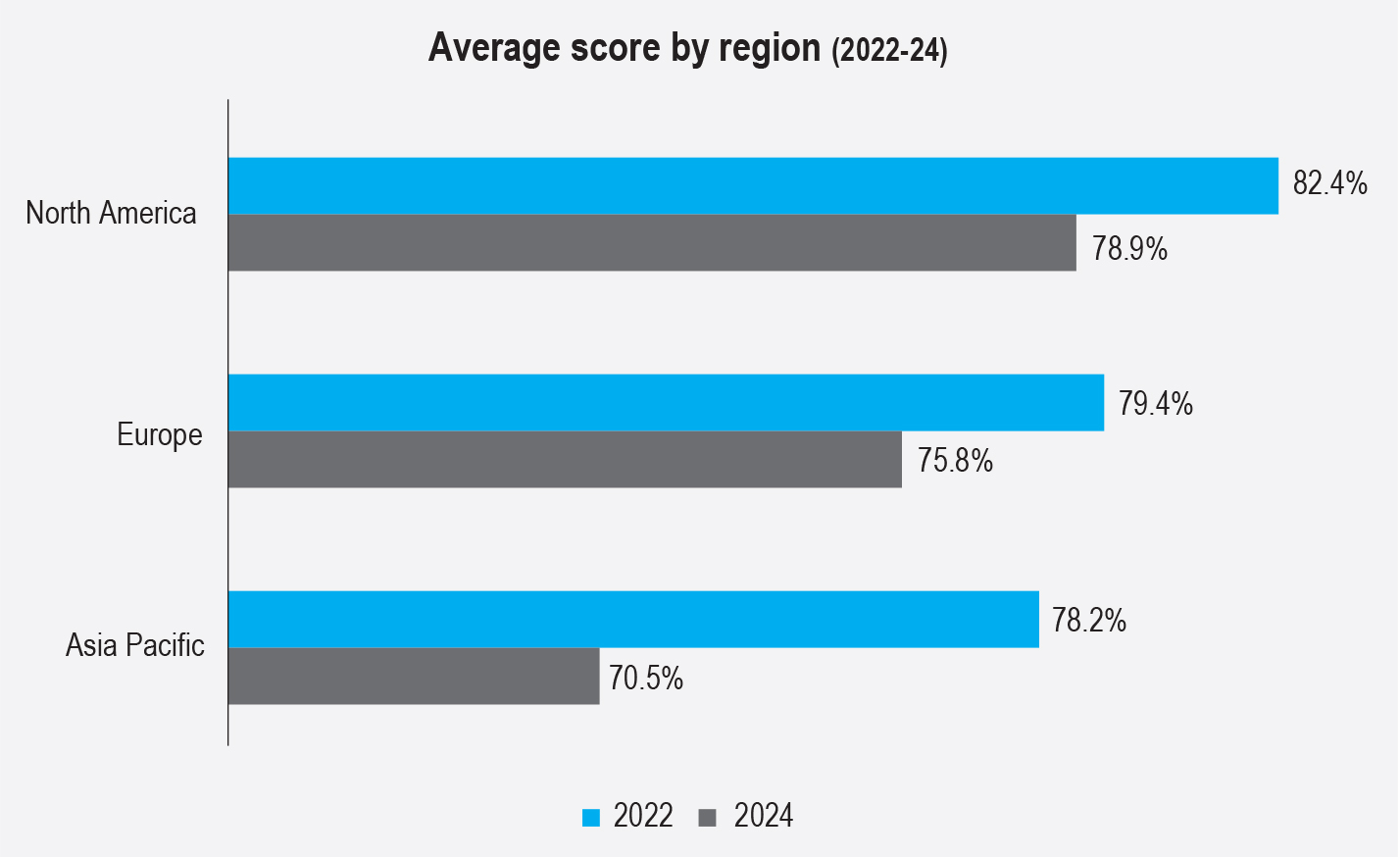
As per the SGI 2024, average scores improved across all regions during 2022-2024. North America led with the highest score of 82.4 per cent, marking a 3.5 per cent increase from the previous study. Europe followed with a score of 79.4 per cent, showing comparable growth, while Asia Pacific demonstrated the most significant relative growth of 7.7 per cent, closing the gap with a score of 78.2 per cent.
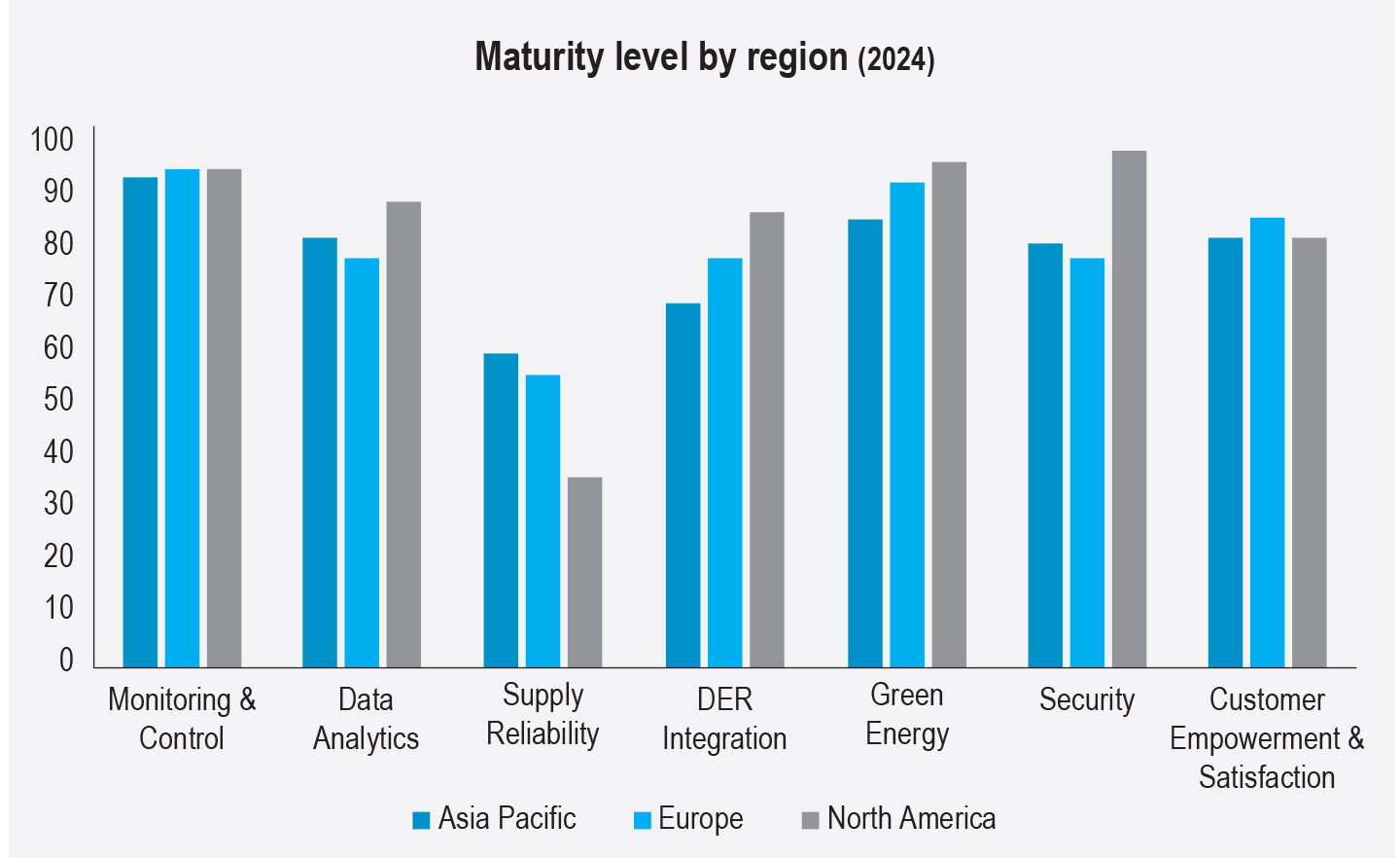
North America led maturity levels in 2024, excelling in categories such as data analytics, DER integration, green energy and security. Europe demonstrated balanced performance across all categories, maintaining competitiveness. Asia Pacific showed notable strength in supply reliability, narrowing gaps in other areas.
The report notes that there was a steady rise in the average score for energy storage deployment by utilities globally and in North America during 2019-24. North America consistently surpassed the global average, with a notable growth of 27.8 per cent, increasing from 58.3 per cent in 2019 to 86.1 per cent in 2024. The global average also experienced a significant growth of 30.2 per cent, rising from 37.2 per cent to 67.4 per cent, highlighting the growing global emphasis on energy storage solutions.
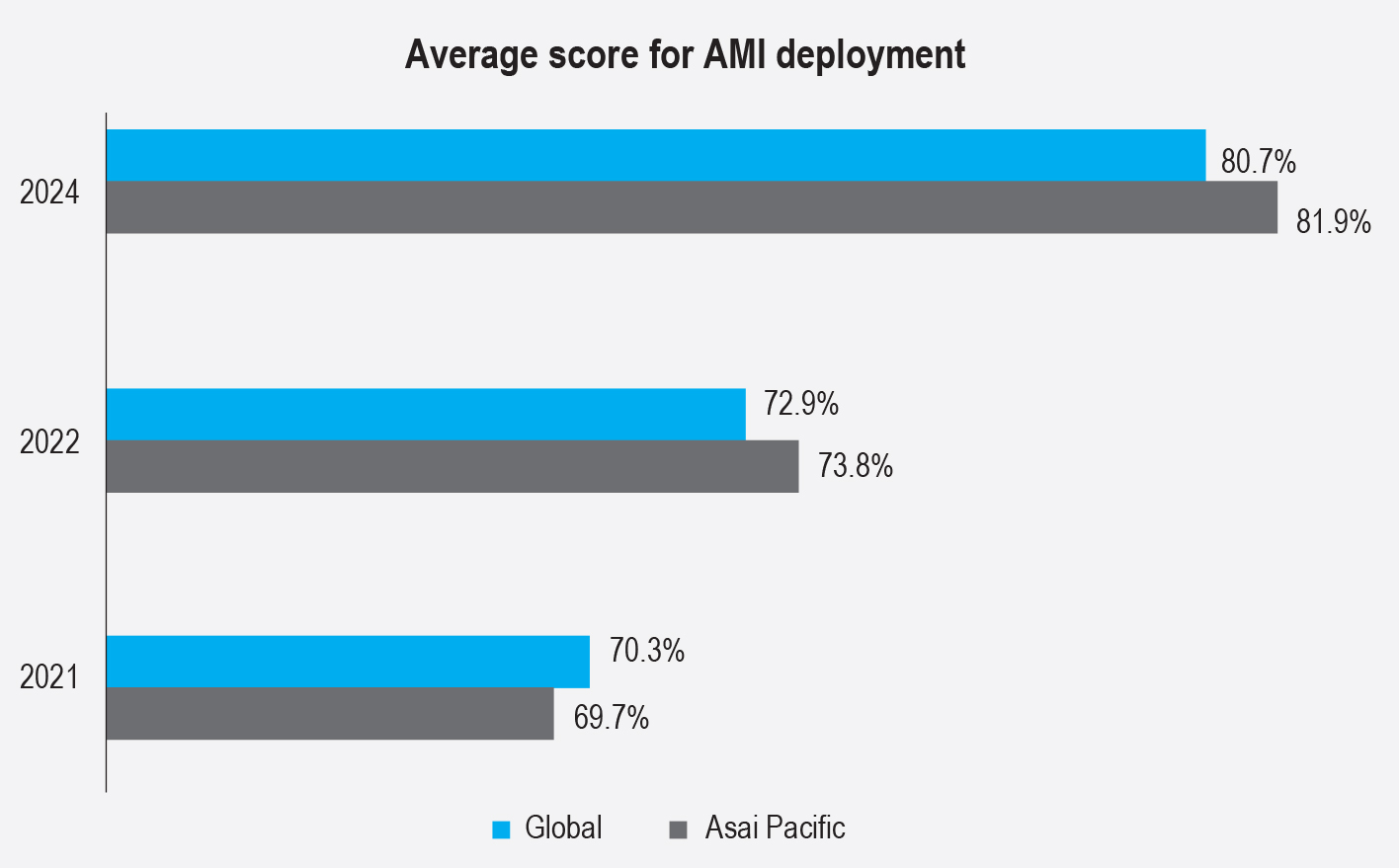
There were steady improvements in average scores for advanced metering infrastructure (AMI) deployment globally and in the Asia Pacific during 2021-2024. The Asia-Pacific region consistently outpaced the global average, reaching 81.9 per cent in 2024 compared to the global average of 80.7 per cent. Both metrics showed strong growth over time, with Asia Pacific leading the global adoption of AMI technologies.
Further, there was steady progress in renewables and Electric Vehicle (EV) initiatives during 2022-24 across regions. North America led with a 4.2 per cent increase, reaching 95.1 per cent in 2024 from 90.9 per cent in 2022, followed by Europe, which improved by 3.3 per cent to 91.8 per cent. Asia Pacific demonstrated the most significant relative growth of 7.3 per cent, rising from 77.1 per cent to 84.4 per cent, though it still trailed behind the other regions.
 Utility rankings
French DSO Enedis Distribution, a subsidiary of Électricité de France, topped the benchmarking index for the third time in a row with a total score of 98.2 per cent. It was found to exhibit best practices in six of the seven dimensions.
In second place were TaiPower from Taiwan and UK Power Networks, followed closely by the similarly tied CitiPower and Powercor from Australia, Dubai Electricity and Water Authority, and State Grid Shanghai.
 Also in the top 10 list were New York’s Con Edison, State Grid Beijing and the two Great Britain network operators SP Energy Networks and WPD (now part of National Grid).
Tata Power Delhi Distribution Limited (Tata Power-DDL) which supplies electricity to a populace of around 9 million in the north and northwest parts of Delhi, was also among the top 10 power utilities globally in the Smart Grid Index 2024. Tata Power-DDL has been a frontrunner in implementing power distribution reforms and is acknowledged for its consumer-friendly practices. Since privatisation, the aggregate technical and commercial (AT&C) losses in Tata Power-DDL areas have shown a record decline. Today, AT&C losses stand at 5.9 per cent, which is an unprecedented reduction from the opening loss level of 53 per cent in July 2002.
 Summary
By examining the shifts in electricity landscapes and the smart grid functionalities needed to address these changes, the report serves as a valuable resource for global stock-take and perspectives. Initiatives highlighted by top performing utilities can be used as a mirror to explore what actions will be necessary to facilitate smart grid adoption.