

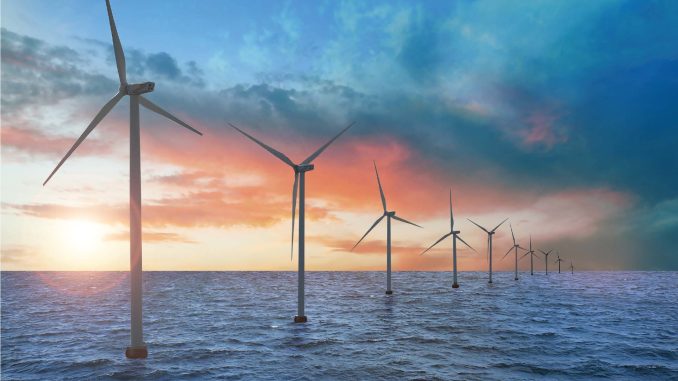
One of the priority areas for India’s transmission grid is to connect offshore wind power. The global energy transition is accelerating, with wind power playing a central role in decarbonising electricity generation. While onshore wind has been the dominant source of wind energy, offshore wind is rapidly emerging as a critical and complementary solution.
Given the rising energy demand, land constraints and the benefits that offshore wind power offers, it no longer remains an alternative. For instance, wind speeds over waterbodies are not only higher but also more consistent, tackling the issue of intermittency that onshore wind power faces. As a result, offshore wind farms can potentially generate more electricity per installed capacity. A major challenge that renewable energy developers face is the issue of land availability. Offshore wind addresses these problems since it utilises open seas and allows larger turbines, and hence, gives hgher energy output without requiring agricultural or residential land.
Offshore wind landscape
With a long coastline of over 7,600 km, India is a good candidate for offshore wind energy generation. In 2015, the Ministry of New and Renewable Energy (MNRE) notified the National Offshore Wind Energy Policy and designated it as the nodal agency. Later, in 2023, the MNRE launched a strategic road map that introduced three primary business models and set an ambitious target of 37 GW capacity to be auctioned in various tranches by 2030. Three models were outlined for project development. Model A applies to sites where studies/surveys have been or will be conducted by the National Institute of Wind Energy/government entities, with the MNRE procuring offshore wind capacity through bidding and providing viability gap funding (VGF) to ensure a uniform power tariff. Model B covers sites where developers conduct their own studies with seabed exclusivity, allowing project development through bilateral agreements, captive consumption or power exchange, with potential power procurement bids for discoms after two years but without central financial assistance (CFA). Model C allows developers to identify offshore wind sites within the exclusive economic zone (excluding Model A and B sites), conduct studies/surveys, and participate in site-specific bidding, with the original surveyor having the first right of refusal, but without CFA support.
With an estimated offshore wind potential of 71 GW, the Facilitating Offshore Wind in India (FOWIND) project and the First Offshore Wind Project in India (FOWPI) led to a 1 GW tender plan in Gujarat and Tamil Nadu. This was followed by an offshore wind bidding trajectory and the waiver of interstate transmission charges for offshore wind projects.
The sector received a major boost in 2024 when the government approved a VGF of Rs 74.53 billion. This included an outlay of Rs 68.53 billion for installing and commissioning 1 GW of offshore energy projects and a grant of Rs 6 billion to upgrade ports for meeting the logistical requirements for these projects. The VGF has been a major step towards the implementation of the National Offshore Wind Energy Policy. This support is likely to reduce the cost of power. Further, an additional surcharge will not be applicable for offshore wind projects commissioned up to December 2032, provided that power from such projects is supplied to open access consumers.
Transmission infrastructure requirements
As per the Global Offshore Report 2024 by the Global Wind Energy Council, offshore grid delivery usually involves several steps such as marine spatial planning, site investigation, grid planning, geophysical surveys, environmental studies and permitting, tendering, financing, procurement, and operations and maintenance. Unlike onshore wind, offshore wind farms require transmission networks that can transport power over long distances. For this, high voltage direct current (HDVC) transmission has become the preferred choice for large offshore projects due to its ability to minimise energy losses over extended distances.
HVDC cables have transformed offshore wind transmission by offering significantly lower energy losses compared to traditional alternating current cables. HVDC is particularly advantageous for projects located far from shore, where AC transmission faces reactive power losses. Recent advancements in HVDC cable technology have increased their efficiency and reliability.
Additionally, HVDC converter stations are critical components in offshore wind transmission, converting the electricity generated by wind turbines from AC to DC for efficient long-distance transport and then back to AC for integration into onshore grids.
The transmission system for integrating offshore wind power involves the establishment of offshore pooling stations, submarine power cables for integrating offshore pooling stations with onshore pooling stations, and transmission systems beyond onshore pooling stations. Central Transmission Utility of India Limited has identified the transmission system for Phase I of offshore wind power evacuation for Gujarat and Tamil Nadu.
Offshore wind transmission also involves several critical components, including array cables connecting individual turbines, offshore substations, export power cables and onshore substations. For the upcoming 500 MW project off Gujarat’s coast, a 66 kV array cable will connect turbines to a 220 kV offshore substation. This infrastructure is necessary to stabilise transmission from offshore turbines to onshore stations.
Challenges
Although transmission infrastructure for offshore wind power generation is evolving, several challenges still require attention. Environmental and logistical concerns are particularly pronounced in offshore wind projects. For instance, cable installation must navigate sea-floor mapping, cable burial and environmental impact on marine ecosystems. Moreover, offshore wind projects being set up in India require specialised technology to withstand the country’s relatively low wind speeds. While Tamil Nadu benefits from a more favourable wind profile, Gujarat’s offshore sites may struggle with lower wind availability, necessitating further adaptations in turbine design. It is important to develop a robust local supply chain to minimise dependence on imported components. An indigenous supply chain would reduce project costs and increase the sector’s resilience against global price fluctuations.
Subsea cabling also presents another challenge as these cables must endure extreme underwater conditions, potential damage from marine activities and the risk of faults, which can be costly and time-consuming to repair. Additionally, integrating large offshore wind capacities into the national grid or state-level grid requires careful planning to maintain stability. Overcoming these challenges will require continuous technological advancements and policy support.
Outlook
Offshore wind energy presents a promising opportunity for India’s energy transition and the diversification of wind energy. By harnessing high and consistent wind speeds over the sea, offshore wind can contribute significantly to the country’s renewable energy targets. However, the sector still faces hurdles, particularly in terms of cost competitiveness, infrastructure readiness and private developer confidence. While Tamil Nadu and Gujarat have been identified as the initial target states for offshore wind development, projected tariffs remain high, in the range of Rs 5.50-Rs 6 per kWh compared to onshore wind tariffs. The government has introduced VGF to address the cost gap and stabilise tariffs.
Further, the government aims to support grid connectivity up to offshore substations, a significant cost-saving measure that could cover nearly 25 per cent of the capex. Ensuring seamless grid connectivity and coastal security will be essential for long-term sector growth. Despite the challenges, offshore wind energy has the potential to play a transformative role in India’s clean energy future.