
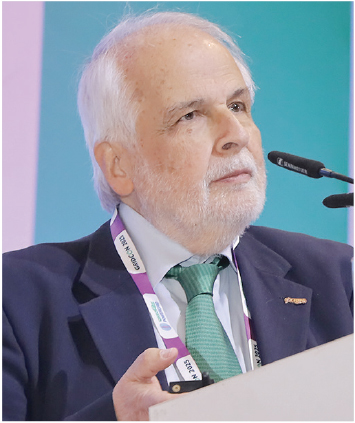
 On the sidelines of Power Grid Corporation of India Limited’s GRIDCON 2025 event, Power Line interviewed Dr Konstantin O. Papailiou, President, CIGRE, about the role of transmission grids in the global energy transition scenario, key challenges facing the grid today, challenges related to grid expansion and outlook for the power sector, among other things. Excerpts…
What is your perspective on transmission grids and their role in today’s energy transition?
There is no transition without transmission. We must transition in order to save the planet, and to do so, the only way is through renewables. The majority of these new power plants will be based on wind and solar energy. However, renewable energy sources are often located in remote areas, far from demand centres. To deliver this power to consumers, expanding the transmission network is crucial. The energy transition will require the addition of 1.5-2.5 million km of new transmission lines, mainly high voltage lines, including around 300,000-500,000 km of high voltage direct current (HVDC) lines. Approximately 40-60 per cent of the existing lines, equivalent to roughly 3-6 million km, will need to be replaced or refurbished by 2050. This means that the total requirement for high voltage overhead transmission lines by 2050 is around 4.5-8.5 million km. To achieve this, several challenges must be addressed, though not primarily technical, as we have the necessary expertise. For example, many organisations, including CIGRE, address various issues in transmission. The greater challenge lies in proactively communicating to the public and convincing them of the necessity of new transmission lines. Governments and industry leaders must emphasise the urgency of grid expansion and renewable energy adoption, as the energy transition is not optional but essential.
What are the challenges facing the grid today?
The first challenge is obtaining permission to build a grid, which is a significant hurdle. All stakeholders must work together to address this. The second challenge is the shortage of skilled manpower globally. Even in a large country like India, there is a shortfall, as people prefer office jobs over field work, despite the latter being more interesting. The third challenge is the lack of materials. Manufacturers worldwide are struggling to meet the growing demand. Therefore, in addition to convincing the public of the need for new transmission lines, we must also ensure the availability of manpower and equipment.
How can right-of-way challenges be minimised for transmission lines? What are the specific challenges of building HVDC systems?
Since we live in a democratic country, we cannot impose transmission lines on the public. We have to convince them of their necessity. Hence, methods must be developed to engage with communities affected by new transmission lines and assure them that the infrastructure poses no danger. Aesthetic designs can also help ease concerns. We make aesthetic towers, like pieces of art. For instance, I once designed a tower shaped like a tennis racket to appeal to a tennis enthusiast. These creative approaches help build acceptance, as we cannot impose such infrastructure on people. India has made good progress in HVDC technology, emerging as a leader in this space. The challenge lies in ensuring the availability of adequate manpower and equipment. These are not technical issues, since those are more or less solved.
To achieve the “One Sun, One World, One Grid” initiative, what are the next steps?
Many interconnections are under way, with a significant portion involving submarine cables. Greece is being connected to Cyprus, and then to Egypt or Israel. Italy is also developing submarine cables. There are also plans to connect India with the Middle East and then to Europe. A unified grid is not a dream, it is a necessity. The more interconnected the grid, the more secure and reliable it becomes, enabling better compensation for variations in renewable energy. Wind and solar power are unpredictable, but interconnecting regions allow excess power from one region to be transferred to another where power is needed. These interconnections are crucial for advancing the energy transition.
What is your perspective on the power sector’s outlook in India over the next decade or so?
The power sector is more than just an industry – it is a mission. The sector must lead the transition to full electrification with zero emissions. In particular, the youth should be encouraged to be a part of it. There is no work more meaningful than ensuring a sustainable future through involvement in the power sector. CIGRE, with over 20,000 members worldwide, is a global community dedicated to advancing power system expertise. Its mission as a non-governmental, non-profit organisation is to raise voice, point out the problems, attract and educate young people, utilise better human capital and support research initiatives related to energy transition. Establishing specialised academic programmes will help train the next generation of energy professionals. Strengthening human capital and supporting research in clean energy technologies will be key to achieving a sustainable, electrified future.