
North Eastern Electric Power Corporation Limited (NEEPCO) was established in 1976. It has built a large portfolio of renewables and thermal assets of over 2 GW over the years. It has been a key player in the north-eastern region’s power sector development, having completed several key projects in the remote and toughest of terrains. Of the region’s total installed power generation capacity of more than 5 GW, NEEPCO currently contributes over 40.5 per cent. Its projects hold a steady operating performance track record. NEEPCO is a 100 per cent subsidiary of power major NTPC Limited.
To harness the north-eastern region’s immense hydropower potential, NEEPCO is currently working on a long-term capacity addition plan of achieving 14,000 MW of hydro capacity by 2037. Of the planned capacity, around 8,000 MW is expected to be added through pumped storage plants (PSPs). The majority of these plants are expected to be set up in a joint venture with Arunachal Pradesh, which has significant untapped hydro potential.
Current portfolio
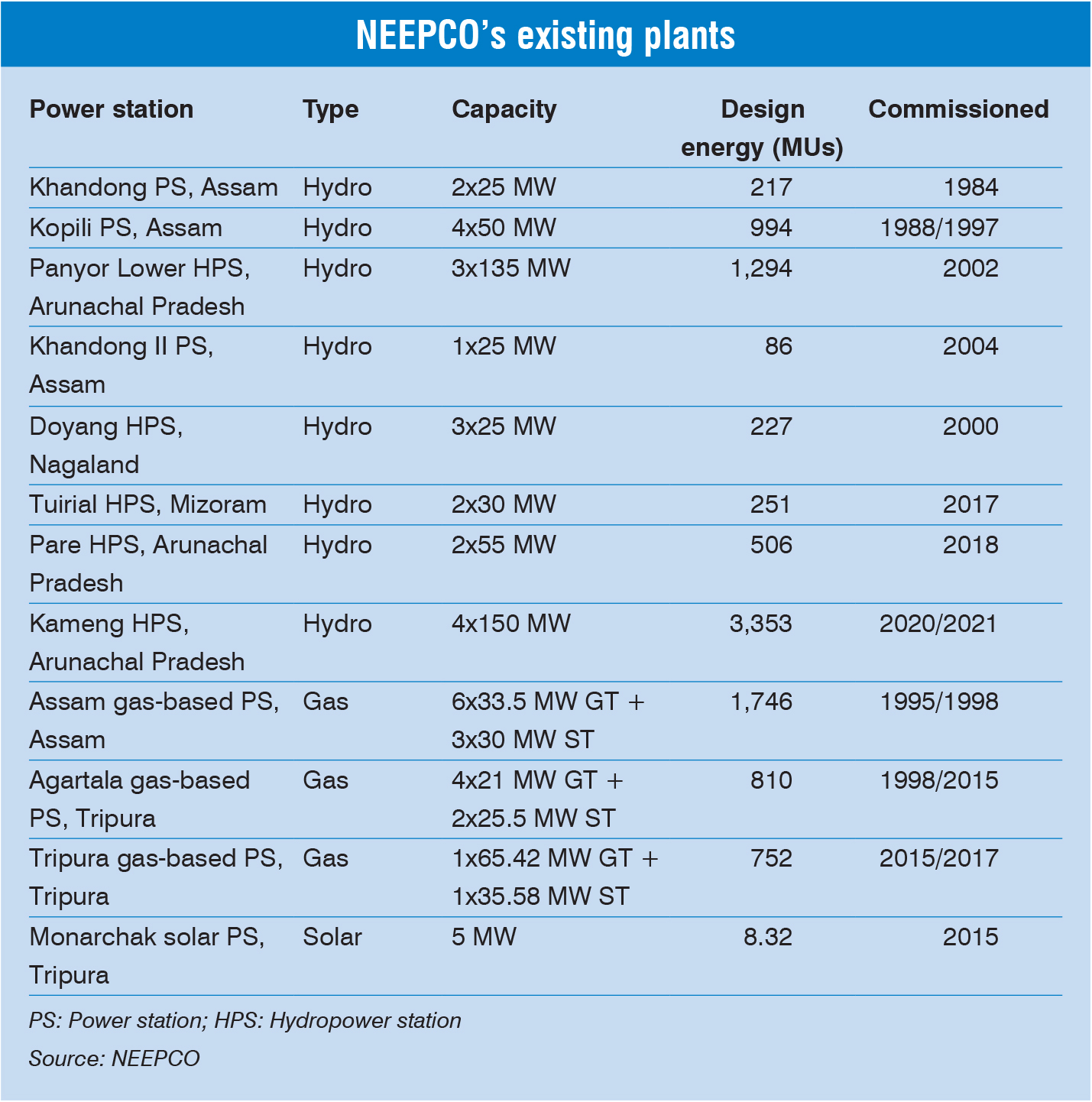
NEEPCO’s portfolio comprises seven hydropower plants with a total capacity of 1,525 MW, three gas-based plants totalling 527 MW and one solar project of 5 MW, bringing the total installed capacity to 2,057 MW.
The hydropower stations under NEEPCO have a total installed capacity of 1,525 MW. These include the oldest plant, the 2×25 MW Khandong PS in Assam, commissioned in 1984 with a design energy of 217 MUs. The unit is currently under renovation and modernisation. It also owns the 4×50 MW Kopili PS and the 1×25 MW Khandong Stage II PS, both in Assam. In Nagaland, the 3×25 MW Doyang HPS, commissioned in 2000, has a design energy of 227 MUs. The most recent plant of the company is the 4×150 MW Kameng HPS in Arunachal Pradesh, which was commissioned in phases in June and July 2020, and January and February 2021, with a substantial design energy of 3,353 MUs. In the renewables segment, its Monarchak Solar PS in Tripura has an installed capacity of 5 MW. It produces 8.32 MUs of annual energy and was commissioned in 2015.
Power offtake from these plants is tied up with all the seven states in the Northeast.
Financial performance
In 2023-24, NEEPCO reported a total income of Rs 42,642 million, a decrease from Rs 45,706 million in the previous year. However, the company had a strong profit after tax of Rs 5,481 million. Capex incurred also increased to Rs 11,337 million from Rs 8,494 million during the same period.
Recent initiatives
In line with the national policy targets of achieving 500 GW of non-fossil fuel capacity by 2030 and attaining net zero emissions by 2070, NEEPCO’s plans are aligned to support and contribute towards these goals.
From a regional perspective, the Northeast holds an estimated hydropower potential of 56,000 MW, which constitutes about 42 per cent of the country’s total potential. Within this, Arunachal Pradesh alone possesses a potential of around 50,000 MW. So far, 1,115 MW has been developed, and projects amounting to 4,880 MW are currently underway.
NEEPCO’s long-term capacity addition plan envisions 14,000 MW of hydro capacity by 2037, with 8,000 MW from PSPs.
In August 2023, NEEPCO signed a memorandum of agreement with the Arunachal Pradesh government for five hydro projects with a combined capacity of 2,620 MW, all located within a 50 km radius. Of these, investment clearances for two projects, Tato-I hydroelectric Project (HEP) and Heo HEP, were obtained in December 2024, and all necessary statutory clearances are now in place. The final award for one of the projects is currently awaited, with main construction activities set to commence by October 2026.
 The 240 MW Heo HEP will be developed at a cost of Rs 19.39 billion and is expected to be completed in 50 months. It will be implemented through a joint venture between NEEPCO and the Arunachal Pradesh government. The central government will provide Rs 1.27 billion for enabling infrastructure such as roads and transmission lines, and Rs 1.3 billion as financial support for the state’s equity share. Arunachal Pradesh will receive 12 per cent free power and 1 per cent will be allocated to the Local Area Development Fund (LADF), promoting local development.
Meanwhile, the Cabinet Committee on Economic Affairs approved the 186 MW Tato-I HEP at a cost of Rs 17.5 billion. It will generate 802 MUs of electricity annually and will also be completed in 50 months. The central government will provide Rs 773.7 million for enabling infrastructure and Rs 1.2 billion towards the state’s equity. The state will also benefit from 12 per cent free power and 1 per cent towards the LADF.
Earlier, on October 2, 2024, NEEPCO signed an MoU with the Indian Renewable Energy Development Agency (IREDA) to support its expansion plans. IREDA will offer techno-financial expertise for project development, fundraising and due diligence on renewable energy and energy efficiency projects. It will also help NEEPCO prepare a five-year action plan for acquiring clean energy assets and ensure compliance with international environmental and social standards.
NEEPCO is planning to leverage advanced technology to enhance the efficiency and accuracy of its operations. It has adopted light detection and ranging technology and drone-based surveys for precise topographical mapping, significantly improving data collection methods. A major initiative includes the establishment of 50 automatic weather stations across the Northeast, equipped with multiple telemetry systems to ensure continuous and real-time data monitoring without human intervention. Additionally, the Indian Meteorological Department has been engaged for a dedicated research and development project aimed at studying the impact of climate change on hydro projects. This initiative also involves the development of appropriate mitigation measures to address the emerging challenges posed by a changing climate.
 Challenges and outlook
The hydropower sector in the Northeast, particularly in Arunachal Pradesh, faces several challenges that hinder project development. A major concern is the high capital cost, which is driven by expensive land in the region and resulting tariff implications. The land acquisition process itself is extremely cumbersome and prone to delays, compounded by a complex and time-consuming forest clearance process. The application of GST further adds to project costs. These logistical and environmental hurdles are compounded by a shortage of capable contractors and quality design consultants. Additionally, there is a notable reluctance among engineers to work in these isolated locations, leading to high attrition rates of up to 60-65 per cent. Insurance-related challenges and reluctance to finance hydro projects in Arunachal Pradesh further complicate matters, posing significant barriers to the sector’s growth and sustainability.
However, enabling policy measures are expected to address these concerns, including extension of project life from 35 to 40 years, increased loan repayment tenore to 18 years, and revision of tariff structures with a 2 per cent annual escalation. Central financial assistance for up to 24 per cent of state governments’ equity in viable projects has also been made available. State governments are also offering support through measures like state GST (SGST) waivers and support on law-and-order issues. Arunachal Pradesh has approved SGST waivers for two projects – Tato II (NEEPCO) and Kamala (NHPC Limited) – which are expected to reduce project costs by 6-7 per cent.
These challenges notwithstanding, NEEPCO is strategically positioned to benefit from the significant untapped hydropower potential in India’s north-eastern region. By leveraging its regional presence and expertise, NEEPCO is well positioned to drive capacity additions in the coming years and contribute meaningfully to India’s energy transition goals.