
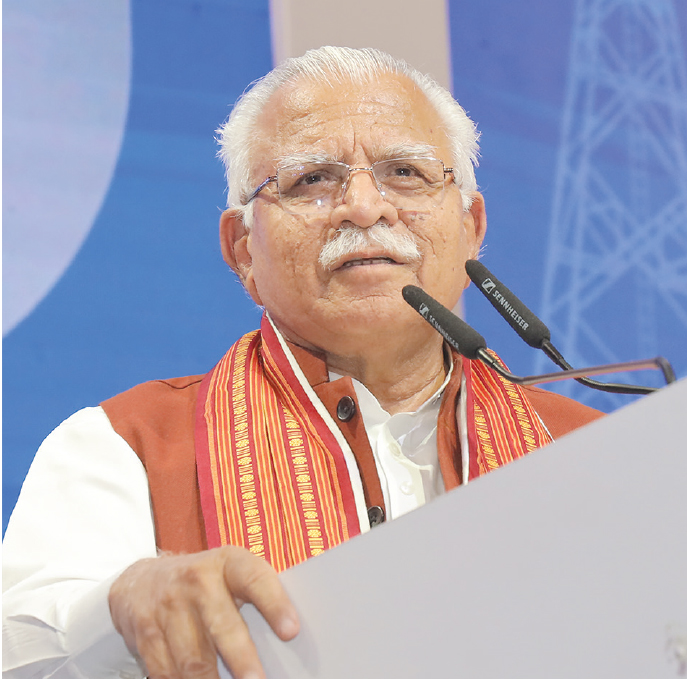
 Manohar Lal, Union Minister of Power, inaugurated GRIDCON 2025. In his address, he called upon all stakeholders to accelerate the pace of project implementation in order to expedite transmission line construction. Excerpts from his address…
India’s power sector has made remarkable progress, from humble beginnings to its current prominence on the global stage.
In 1967, many villages first experienced the glow of an electric bulb. Despite initial scepticism about the limited impact of such a small step, this marked a huge transition from studying under clay lamps to using modern electricity. Today, collective efforts have contributed to the power sector’s growth and electrification. This has been made possible through effective policymaking, along with the dedicated involvement of various stakeholders, business leaders and discoms.
The power sector plays a pivotal role in economic growth, facilitating industrial expansion and driving national development. The power sector will play a huge role in achieving India’s vision of becoming a developed nation by 2047, and so it must expand significantly. To link the power generation segment to the power distribution segment, the transmission segment plays an extremely important role. Transmission lines are akin to the arteries system in the human body, essential for delivering power where it is needed. Coordinated efforts between power generation companies, transmission companies and discoms will help ensure seamless energy delivery.
Hence, there is a critical need for rapid expansion in the transmission segment to keep pace with the increasing generation capacity. To address this challenge effectively, Power Grid Corporation of India Limited and private transmission companies must not only expedite their efforts but also foster greater collaboration among themselves. This will be essential in ensuring that the transmission infrastructure can match the gestation periods of various upcoming hydro, solar, wind and other renewable energy projects, and adequately support the growing energy demand.
The country has ambitious plans for grid expansion, including a proposed undersea transmission line to Sri Lanka. Efforts are also being made to set up a project for interconnection with the UAE, which is expected to involve a transmission line with a significant investment of almost Rs 400 billion, as per initial estimates. These initiatives aim to unify and strengthen power connectivity across regions. In order to realise the vision of “One Sun, One Grid, One Frequency”, it is imperative that we accelerate our efforts.
Further, we must establish a robust transmission network at both the national and state levels to overcome key challenges such as right of way. This involves not only the adoption of new technologies in the sector but also addressing critical issues such as land acquisition. Land acquisition must be achieved through consensus rather than compulsion, ensuring satisfaction among stakeholders. Achieving this will be key to ensuring smooth progress and the long-term success of the initiative. Additionally, we need to promote domestic manufacturing to reduce import dependency for transformers, HVDC equipment and insulators. This will reinforce the Make in India concept.
India has shown impressive economic growth, rising from being the 10th largest global economy a decade ago to the fifth position today, with aspirations to soon become the third largest economy. The power sector is a key driver of this economic growth. We need to expand and diversify into various power generation sources. There is already a growing shift from traditional thermal power to cleaner sources such as solar, wind and nuclear energy. India has committed to achieving net zero carbon emissions by 2070. It has been taking proactive steps to meet climate targets, making it one of the fastest achievers among the G20 countries.
India has an ambitious goal of achieving 500 GW of renewable energy capacity by 2030. This translates into an addition of 60 GW of renewables annually. Various stakeholders are already working towards accelerating the pace of addition.
I must commend the significant growth in India’s transmission network, which has increased from 296,000 ckt km in 2014 to an estimated 475,000 ckt km in 2025. The power transmission segment needs a capex of almost Rs 9.6 trillion by 2032. This provides a significant opportunity for private investors to participate in the sector. All stakeholders need to persist in advancing India’s energy infrastructure for sustained economic growth and environmental sustainability.