

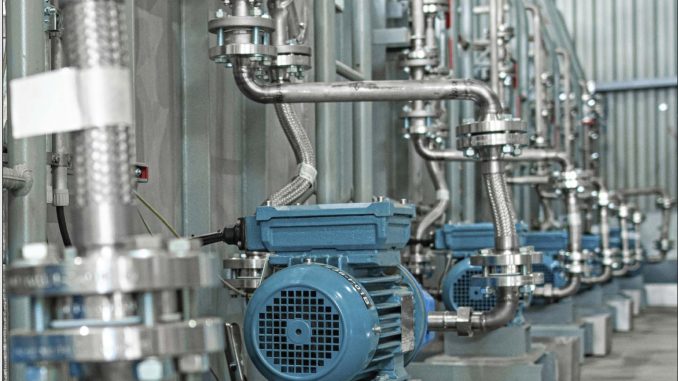
Indian industry is increasingly focusing on energy efficiency by adopting efficient motors and drives, with several companies expanding production, leading to market growth. As India’s industrial sector expands, the need for efficient motors and drives is rising to minimise energy consumption and reduce operational costs. The government is also emphasising energy efficiency to reduce carbon emissions, while energy service companies (ESCOs) are playing a key role in leveraging the country’s untapped energy efficiency potential. However, despite the Indian energy efficiency market being valued at Rs 1,500 billion, ESCOs have only tapped into a small percentage of this potential.
Energy-efficient motors
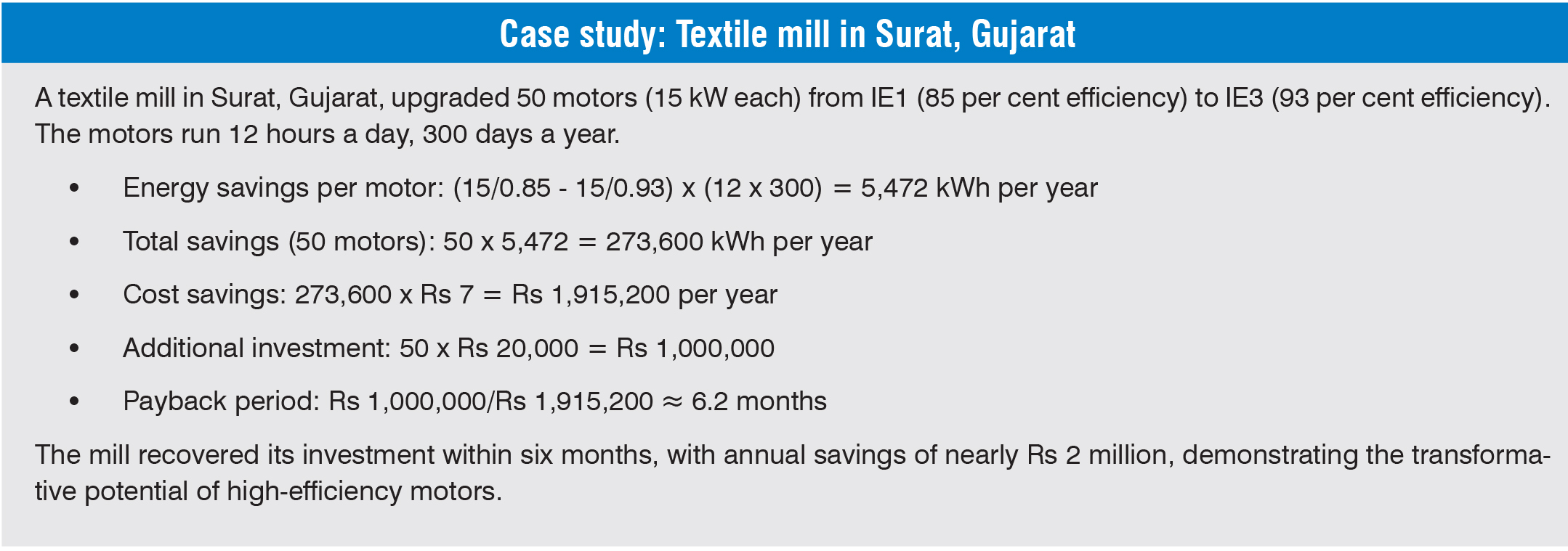
Energy-efficient motors (EEMs) offer significant benefits by reducing energy consumption and operational costs compared to standard motors. EEMs are designed to produce the same shaft output power (HP) but use less input power (kW) than standard-efficiency motors. They often incorporate design improvements to reduce intrinsic motor losses, such as using higher quality materials and thinner steel laminations in the stator. Motors are classified into efficiency classes – IE1 (standard efficiency), IE2 (high efficiency), IE3 (premium efficiency) and IE4 (super premium efficiency), with IE4 being the most efficient.
In India, EEMs, particularly those adhering to IE3 and IE4 standards, are gaining traction for their lower energy consumption, reduced operational costs, smaller carbon footprint, longer lifespan, and minimal maintenance requirements. This is because EEMs utilise lower-loss silicon steel, thicker wires and thinner laminations, while copper windings in induction motors help reduce electrical resistance and minimise energy losses. These motors find a wide area of applications such as pumps, fans, blowers, and air compressors. Various industries, including metals, chemicals, cement, mining, food and beverages, also use these motors. EEMs often have higher insulation, longer service factors, longer bearing lives, less vibration, and lower power waste heat output. By reducing energy costs, companies can gain a competitive advantage in the market.
As per the India Electric Motor Market Outlook to 2028 by Ken Research, the country’s electric motor market is valued at Rs 118 billion and is projected to grow at a compound annual growth rate (CAGR) of 9.79 per cent during 2025-33. AC motors dominated the market in 2023 due to their extensive use in industrial applications and electric vehicles (EVs). Low voltage (LV) motors held the largest share in 2023, driven by their widespread application in home appliances, appliances, high voltage alternating current (HVAC) systems, and smaller industrial machines.
Technological advancements
- Innovations in motor design, variable frequency drives (VFDs) and permanent magnet motors are contributing to energy savings and operational cost reductions.
- EEMs such as IE3 motors are being adopted by major industries to reduce energy consumption and emissions.
- The installation of variable speed drives (VSDs) in motors is another energy-efficient technique to increase motor efficiency by adjusting the speed of an electric motor based on application requirements. VSDs are used in critical national infrastructure projects such as ventilation systems for tunnels, and in pharma units for Covid-19 vaccination manufacturing.
- Synchronous motors can achieve near-perfect conversion of electrical and mechanical energy, reaching efficiency rates of up to 99 per cent.
Other electric motor innovations include:
- Smart motors: Integration of IoT for real-time monitoring and predictive maintenance.
- Permanent magnet motors: Higher efficiency and reduced size.
- Brushless DC motors: Increased lifespan and lower maintenance requirements.
- Hybrid motors: Combination of different motor types for enhanced performance.
The India AC drives market is also poised for robust growth, with an estimated CAGR of 8.93 per cent during 2025-34, as per Expert Market Research. AC drives, also known as VFDs, are critical components in industrial and commercial settings, optimising motor speed and power consumption to enhance energy efficiency and operational flexibility, and reduce the carbon footprint.
LV AC drives dominate the market, widely used in HVAC, fans, pumps and conveyor systems. However, medium-voltage AC drives are also gaining traction in industries such as oil and gas, power generation and mining owing to their ability to handle high-power applications, mostly industrial and commercial, along with automotive and residential.
The market growth is driven by increasing industrial automation, energy efficiency initiatives and the rising demand for advanced motor control systems in various sectors. With the Indian government’s focus on reducing energy consumption and promoting sustainable practices, industries are adopting advanced AC drives to meet these goals and reduce costs.
India’s manufacturing and processing industries are witnessing a paradigm shift towards automation. Automated systems demand precise motor control, which is facilitated by AC drives. Increasing automation in assembly lines and the adoption of EVs are driving the demand for AC drives. In addition, rapid urbanisation and infrastructure development in India are fuelling demand in HVAC systems, elevators and escalators. The upcoming smart, green buildings and cities require energy-efficient solutions. In the agricultural sector, AC drives are used in irrigation systems and agricultural processing machinery, enhancing efficiency and productivity.
Finally, as India progresses towards renewable energy integration, AC drives play a crucial role in managing power generation and distribution, and enhancing the reliability and stability of renewable energy grids.
Challenges ahead
As with all technology and initiatives, certain challenges need to be addressed. While AC drives lead to long-term savings, the high initial investment can deter SMEs from adopting them. In addition, the price volatility of raw materials such as semiconductors impacts the production cost of AC drives, influencing their market price and demand. The effective utilisation and maintenance of AC drives require skilled professionals, but there is a shortage of trained personnel in India, which hinders widespread adoption.
The electric motor industry also faces fluctuations in raw material costs, particularly for copper and steel. In 2023, copper prices surged by 15 per cent, impacting manufacturing expenses and leading to price hikes that have affected profitability across the sector, complicating cost management.
Finally, though India’s electric motor market is expanding, it lags in advanced technologies compared to India standards. Currently, only 20 per cent of Indian manufacturers have adopted smart and sensor-integrated motors, highlighting a technological gap that hinders innovation and reduces the sector’s competitive edge.
Competitive landscape
The India AC drives market is characterised by intense competition among both domestic and international players. These companies have been focusing on innovation, partnerships and expansion of their product portfolios to cater to the diverse needs of Indian industries.
Northern India is a major contributor to market growth, driven by demand for AC drives in agriculture and manufacturing across major industrial hubs in states such as Haryana, Punjab and Uttar Pradesh. With its thriving IT, automotive and electronics industries, southern India is also a key market for AC drives. Cities like Bengaluru, Chennai and Hyderabad are leading the demand. In western India, the industrial and commercial growth in Maharashtra and Gujarat is accelerating the adoption of AC drives. These states are also leaders in renewable energy initiatives. The western region led the electric motor market in 2023, driven by its high industrial activity, rapid urbanisation and adoption of renewable energy sources. Cities such as Mumbai, Pune and Ahmedabad have witnessed a surge in the use of electric motors across industries, ranging from automotive to heavy machinery manufacturing. Although smaller in market size compared to other regions, eastern India’s developing infrastructure and mining sector present growth opportunities for AC drives.
Choosing the right motor
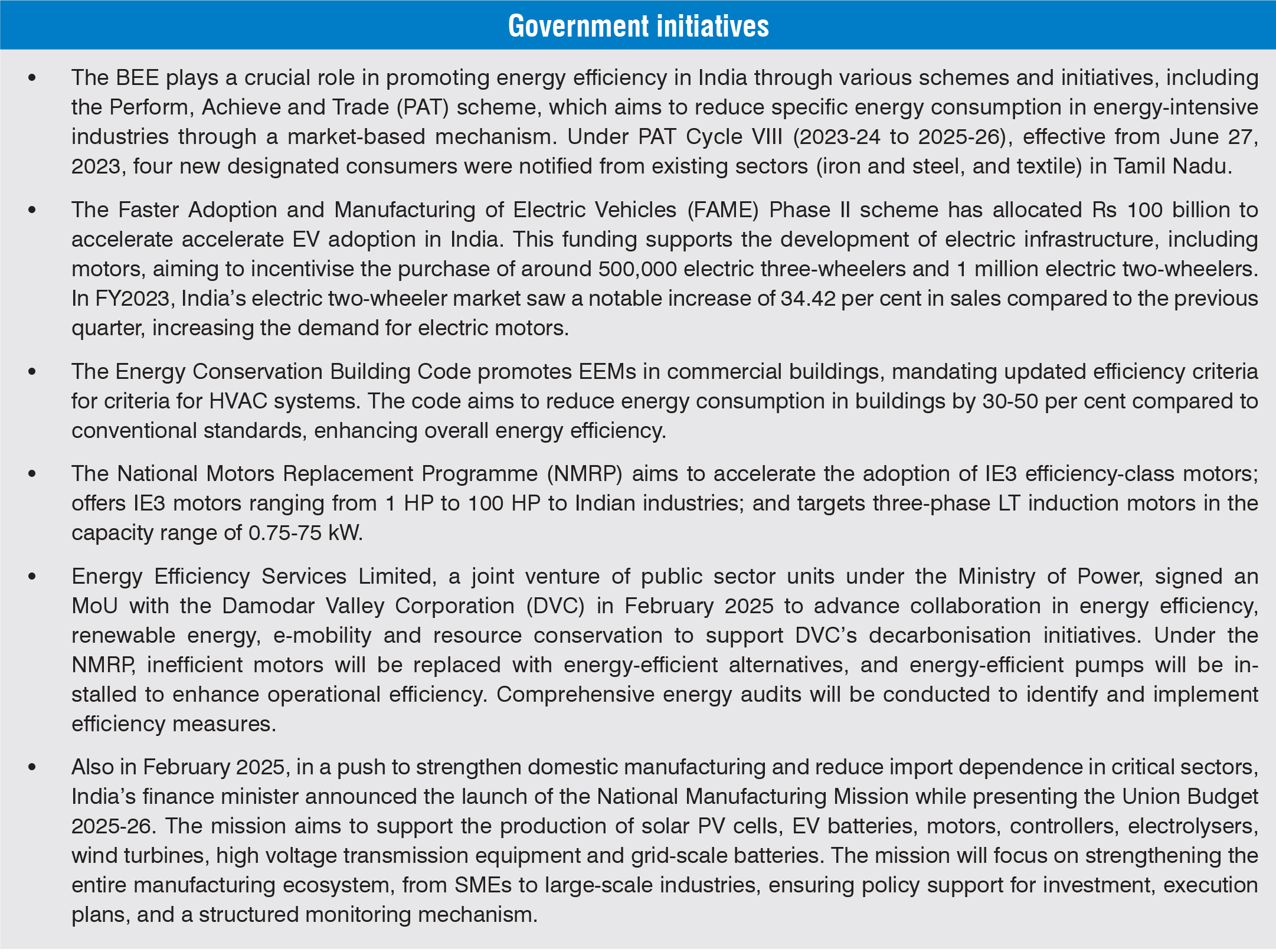
While EEMs have a higher initial cost than standard motors, their long-term cost savings often justify the investment. Choosing the right motor for a specific application is crucial to ensure optimal efficiency and performance. Meanwhile, proper maintenance of EEMs ensures continued efficiency and longevity. The following are the key considerations while selecting EEMs:
- Application: Matching the motor’s torque and speed to the specific equipment needs.
- Environment: Choosing motors with suitable IP ratings for dust, heat or moisture.
- Total cost of ownership: Focusing on long-term savings, not just the purchase price.
- Supplier: Choosing trusted brands with strong after-sales support.
- Standards: Ensuring compliance with BEE and IEC guidelines.
 Emerging market trends
The adoption of brushless DC motors is set to rise substantially due to their higher efficiency and lower maintenance requirements. In the coming years, these motors will become the preferred choice for applications in EVs and consumer electronics, enhancing performance and reliability.
Smart motors equipped with sensors will gain traction in industries where predictive maintenance is becoming essential. In the coming years, IoT-enabled motors will be increasingly integrated into industrial automation and energy management systems, facilitating real-time monitoring and optimising operational efficiency. The integration of digital technologies such as IoT, AI and machine learning in AC drives is also increasing. Smart AC drives enable remote monitoring, predictive maintenance and real-time data analytics, enhancing operational efficiency and reducing downtime. Manufacturers are increasingly offering customised AC drives tailored to specific industrial requirements, improving customer satisfaction and strengthening market presence.
Government programmes such as Make in India and the Smart Cities Mission support the adoption of advanced technologies, including AC drives. Also, India aims to install 500 GW of non-fossil-fuel-based energy capacity by 2030. This growing sector, particularly solar and wind, requires electric motors to convert energy into usable power, contributing to the overall growth of the electric motor market.
India’s manufacturing sector is rapidly adopting Industry 4.0, with a dedicated policy allocating Rs 5 billion to promote green mobility and EV manufacturing. Electric motors are also essential for automation across applications such as robotics and conveyor systems.
 Future outlook
India’s motors and drives market in India is set to achieve significant milestones in the future, driven by the ongoing industrial revolution, technological advancements and a strong focus on energy efficiency. Efforts to reduce initial costs and increase awareness among SMEs will further expand the market’s reach. Continuous research and development will lead to more efficient, compact and user-friendly solutions. In addition, with its strong manufacturing base, India has the potential to become a global exporter of AC drives, further strengthening its market presence.
Anita Khuller