
Over the past decade, India has made significant advancements, emerging as the fourth largest electricity consumer and the third largest renewable energy producer in the world. Between 2013-14 and 2023-24, India’s peak electricity demand has surged by 79 per cent. In May 2024, India recorded an all-time high peak electricity demand of 250 GW.
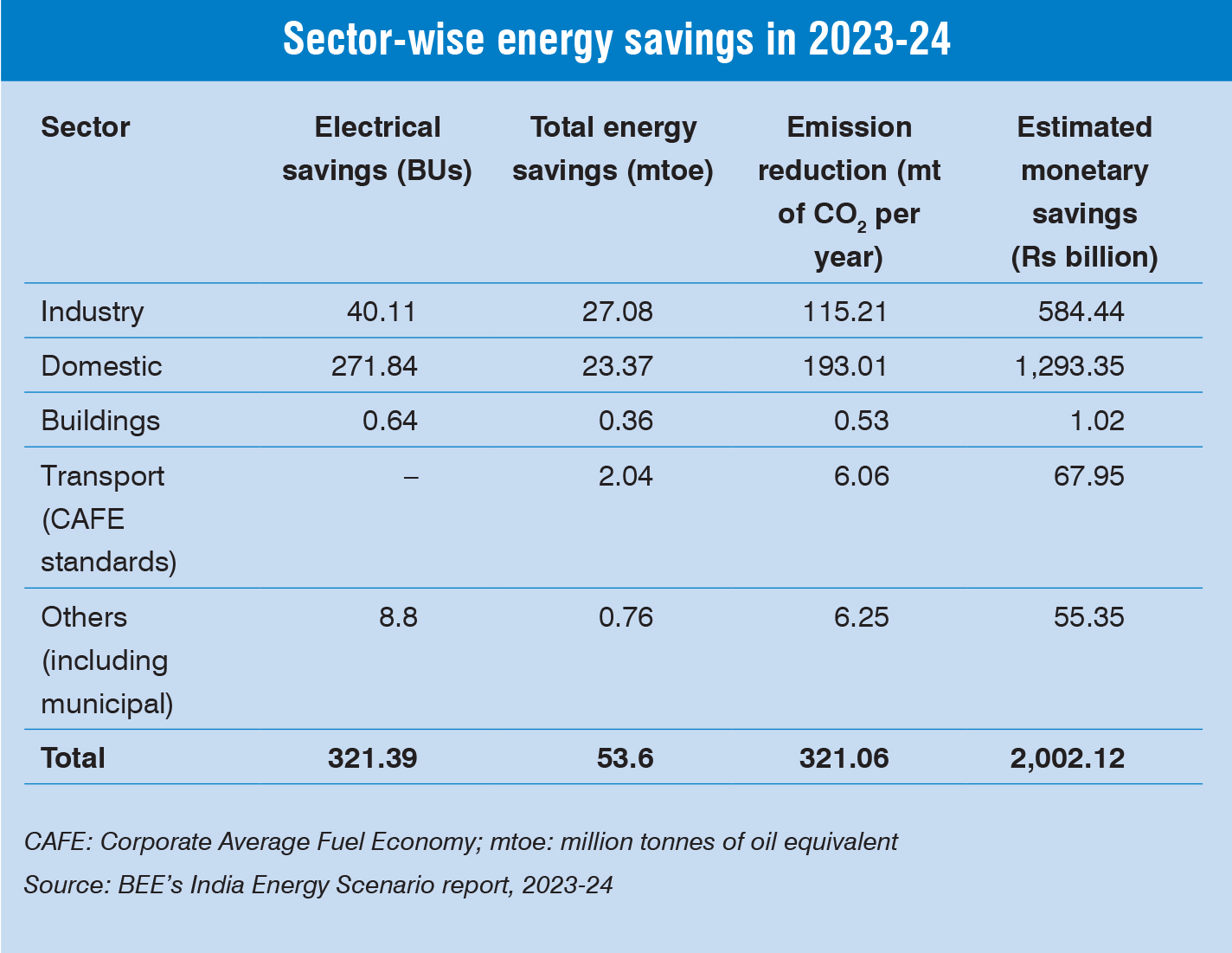
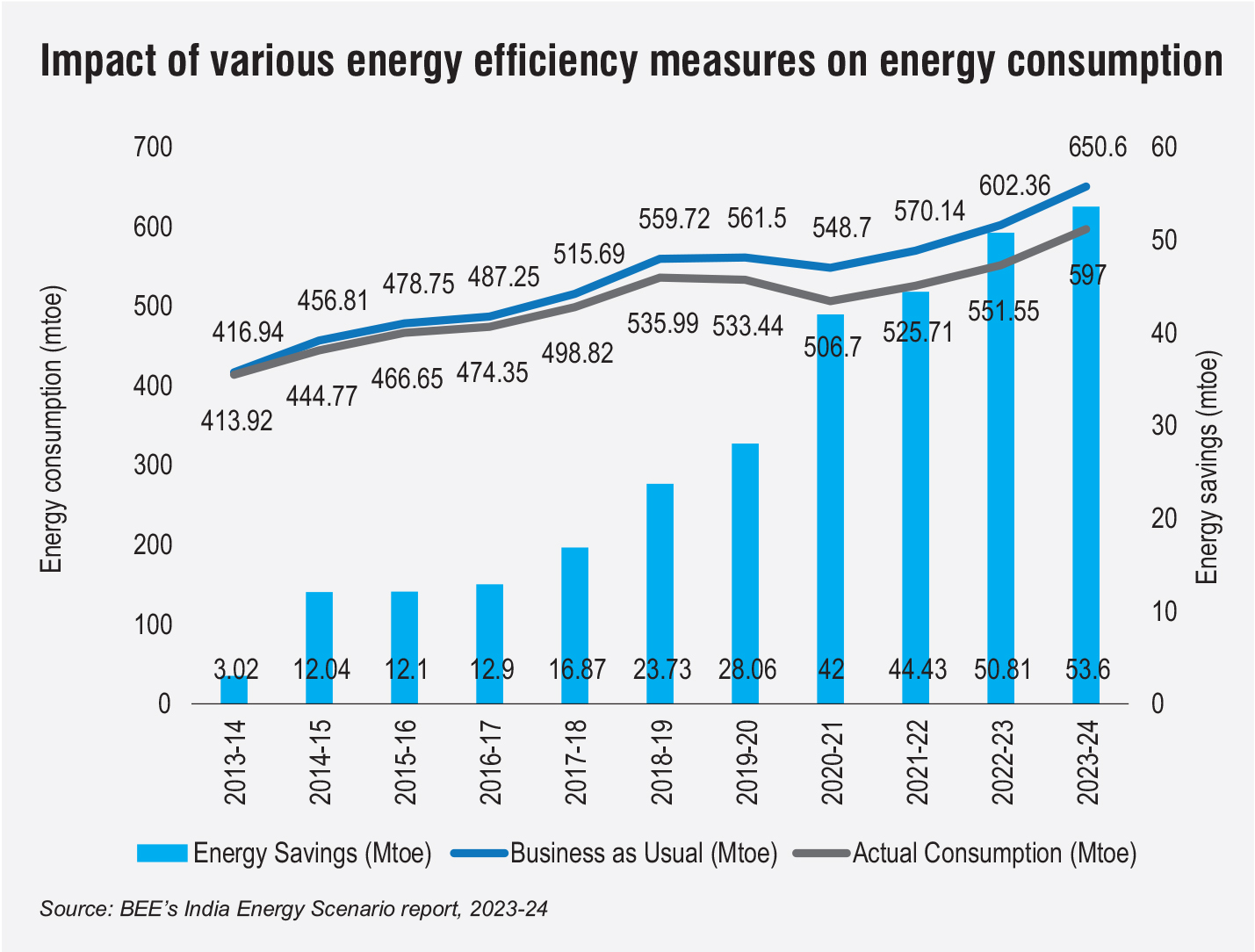
The Bureau of Energy Efficiency’s (BEE) recent report titled “India Energy Scenario 2023-24” highlights India’s shift towards cleaner energy sources, changes in industrial energy consumption and the role of energy efficiency initiatives like the Perform, Achieve and Trade (PAT) scheme. Further, it highlights sector-wise energy consumption trends and the significant savings achieved through efficiency measures.
Energy supply
Coal
Coal remains a key part of India’s energy needs. In 2023-24, the country consumed about 1,277 million tonnes (mt) of coal and lignite. Of this, approximately 80 per cent was mined domestically, while the rest was imported from countries such as Australia, Indonesia and Russia. Coal production in India stood at 998 mt during this period, nearly reaching the Ministry of Coal’s target of 1,000 mt. Coal India Limited continues to dominate coal production, contributing over 70 per cent to the coal production, with the rest coming from other public and private players.
Oil and petroleum products
India consumed 233 million metric tonnes (mmt) of oil in 2023-24, making it the third largest oil consumer after China and the US. To meet its energy needs for transport, industry and homes, India relies heavily on imported crude oil.
In 2023-24, the country’s domestic oil production stood at 29.4 mmt. Oil and Natural Gas Corporation Limited and Oil India Limited were the major producers, contributing about 65 per cent and 11 per cent, respectively. The remaining 24 per cent came from fields under production sharing contracts and revenue sharing contracts. As of April 1, 2024, India had a refining capacity of 256.8 mmt per annum, making it the third largest refiner in Asia and the fourth largest in the world, after the US, China and Russia.
Natural gas
In 2023-24, natural gas made up 7 per cent of India’s primary energy mix. The government aims to raise this to 15 per cent by 2030 through initiatives like expanding pipelines, city gas networks and liquid natural gas (LNG) terminals. Industries consume the most natural gas (38 per cent), followed by households, transport, power and refineries. India meets its gas needs through domestic production from areas like the Krishna-Godavari basin and Mumbai High Field, along with imports. As of April 1, 2024, recoverable gas reserves stood at 1,094.2 billion cubic metres. Despite several efforts, India continues to import a significant amount of natural gas through LNG terminals, making it the fourth largest importer globally.
Renewable energy
With strong government support and policies, India’s renewable energy supply is set to keep growing. Having set a target of achieving 500 GW of installed renewable capacity by 2030, some of the key initiatives include setting up large solar parks, implementing production-linked incentive (PLI) schemes and rooftop solar programmes such as the PM Surya Ghar: Muft Bijli Yojana, and mandating renewable purchase obligations. According to studies by the National Solar Institute of India and the National Wind Institute of India, the country’s solar potential is estimated at 748 GW, while its wind potential is at 1,164 GW. Other renewable sources include 133 GW from large hydro, 42 GW from biomass and 21 GW from small-hydro. To manage renewable integration, the government is also promoting energy storage, especially pumped storage projects, with an estimated 176 GW potential.
 Electricity generation
India’s electricity generation grew by about 5 per cent each year over the past seven years, reaching 1,734 TWh in 2023-24. Coal remains the primary source, contributing 74.7 per cent, followed by renewables (including large hydro) at 20.8 per cent, nuclear at 2.8 per cent, and oil and gas at 1.8 per cent. Renewable energy generation has grown strongly, rising from 204 TWh in 2016-17 to 360 TWh in 2023-24, at an annual growth of 8 per cent.
Energy demand: Trends and analysis
India is actively working to meet its rising energy needs while staying committed to sustainable development. In addition to expanding renewable energy and green hydrogen on the supply side, the government is also promoting energy efficiency initiatives on the demand side.
Industry
In India, industries are classified into energy-intensive and non-energy-intensive sectors. Over the past decade, the industrial sector has shown a gradual transition towards cleaner fuels, with the share of coal in the total industrial energy consumption declining from 70 per cent in 2013-14 to 63 per cent in 2023-24.
The industrial sector’s savings include those from the PAT scheme, excluding those from discoms, buildings and railways, as well as savings from micro, small and medium enterprises. BEE is set to broaden the scope of the PAT scheme by including ten additional energy-intensive sectors in the upcoming cycles. These sectors are automobile, ceramic, chemicals, copper, dairy, glass, port trusts, tyre manufacturing, zinc and mining.
Against the backdrop of rising energy demand, BEE’s India Energy Scenario report highlighted eight energy-intensive industries targeted by the PAT scheme. The scheme mandates specific energy consumption reduction targets for eligible units based on each energy consumption threshold. Since the introduction of the scheme, BEE has launched over eight PAT cycles, covering over 1,333 industries, including energy-intensive industries, thermal power plants, refineries, railways, discoms and buildings. These industries cover eight major sectors – iron and steel, cement, fertilisers, aluminium, pulp and paper, textile, petrochemicals and chlor-alkali.
The iron and steel sector primarily relies on coal, lignite and oil as major energy sources. Coal consumption in this sector rose from 302 mt in 2016-17 to 366 mt in 2023-24, at a compound annual growth rate (CAGR) of 3 per cent. Additionally, under the PAT scheme, the iron and steel industry has been classified as an energy-intensive sector, with 204 designated consumers identified up to PAT Cycle VII (2021-22 to 2024-25).
Similarly, the aluminium industry is highly energy-intensive, with production involving three stages – bauxite mining, alumina refining and alumina smelting – to produce aluminium. The refining and smelting phases also require substantial amounts of electrical energy.
The aluminium sector, due to its substantial energy consumption, has also been classified as energy-intensive under the PAT scheme, with BEE notifying 14 designated consumers from the sector up to PAT Cycle VII (2021-22 to 2024-25). The cement sector is also one of the eight energy-intensive sectors under the PAT scheme, with 175 designated consumers notified up to PAT Cycle VII, surpassing energy-saving targets by 81.6 per cent and 48 per cent in PAT Cycles I and II, respectively. The petrochemicals industry, which is another major consumer of energy and a significant contributor to greenhouse gas emissions, is also under focus as emissions are projected to increase with sectoral growth. In 2019, the chemicals segment accounted for 0.5 per cent of the emissions from the manufacturing and construction sectors. The petrochemicals sector’s heavy reliance on imported crude oil, particularly naphtha, further contributes to its energy-intensive nature.
 Buildings
As part of its efforts to advance energy efficiency in the building sector, India took a significant policy step in 2024 with the roll-out of two updated building codes. The Energy Conservation and Sustainable Building Code (ECSBC) is targeted towards commercial buildings, while the Eco-Niwas Samhita (ENS) code for residential buildings. These codes are applicable to large commercial structures and multi-storey residential complexes with a connected electricity load of 100 kW or more. They are expected to play a key role in reducing energy consumption and improving overall building performance.
Initiatives like Saubhagya scheme and the Deen Dayal Upadhyaya Gram Jyoti Yojana focus on providing electricity to all households, with 99 per cent electrified under Saubhagya (as per the Ministry of Power, 2024). The Unnat Jyoti by Affordable LEDs for All scheme supports the use of affordable, energy-efficient appliances such as LED bulbs, tube lights and fans. The key focus areas for improving energy efficiency in hotels include upgrading to energy-efficient lighting systems like LEDs, optimising HVAC systems with intelligent controls, and enhancing hot water systems using solar heaters or heat pumps. The use of building management systems helps monitor and control overall energy usage more effectively. Additionally, the integration of renewable energy sources such as solar panels is gaining traction, further helping hotels meet sustainability goals and reduce their carbon footprint.
Transport
India’s demand for transport has increased nearly eightfold since 1980, making it one of the highest among Asian countries. The sector continues to rise steadily due to factors such as the expansion of e-commerce and the post-pandemic surge in tourism. This growing demand has been accompanied by efforts to curb emissions through the implementation of stricter norms like Bharat Stage-IV (BS-IV) and BS-VI, which have accelerated the adoption of cleaner vehicle technologies. Additionally, in 2017, the Indian government introduced corporate average fuel efficiency norms to promote fuel-efficient vehicles in order to reduce fuel consumption, lower CO₂ emissions, and decrease oil dependency and air pollution. Since 2021, electric vehicle (EV) registrations in India have more than doubled each year, growing at a CAGR of 129 per cent, led primarily by the two- and three-wheeler segments. This rapid growth can largely be attributed to supportive central and state government policies. Uttar Pradesh recorded the highest EV registrations in 2023-24, followed by Maharashtra, Karnataka and Tamil Nadu.
As a result, the electricity consumption by public EV charging stations has seen a significant rise with the increasing uptake of EVs. In 2023-24, public EV charging stations recorded electricity consumption of 465.85 MUs, more than doubling from 204.84 MUs in 2022-23. Supportive policies include the Faster Adoption and Manufacturing of Hybrid and Electric Vehicles scheme to facilitate the adoption of EVs. In addition to demand-side measures, the central government has rolled out supply-driven initiatives like the PLI scheme and the Advanced Chemistry Cell programme to stimulate the domestic manufacturing of EVs.
Agriculture
Ensuring energy efficiency and reducing energy usage in the agricultural sector offers multiple benefits, such as lowering emissions, improving agricultural productivity, and reducing the financial burden on discoms and state governments by cutting energy
subsidy costs.
Several initiatives have been introduced to promote energy efficiency in agriculture. Pradhan Mantri Krishi Sinchayee Yojana includes programmes such as “Per Drop More Crop” and the “Micro Irrigation Fund”, both aimed at enhancing water use efficiency. Additionally, the Pradhan Mantri Kisan Urja Suraksha Evam Utthaan Mahabhiyan scheme focuses on replacing diesel-powered pump sets with cleaner alternatives, thereby promoting energy efficiency.
Recommendations for energy efficiency
To drive improvements in energy efficiency across sectors, it is essential to establish a streamlined energy data ecosystem. This begins with strengthening the capacity of existing agencies like the Ministry of Statistics and Programme Implementation and creating a central agency to manage energy data at the state level in order to ensure better coordination across departments. Enhancing data collection methods by updating surveys and leveraging advanced technologies such as database management systems, internet of things and smart meters enables more accurate and real-time monitoring of energy use. Furthermore, integrating application programming interfaces into existing platforms like the India Climate and Energy Dashboard and the National Data and Analytics Platform can facilitate seamless access to energy data. Adopting global best practices in data standardisation and management will further support evidence-based policymaking and targeted interventions, ultimately leading to more effective energy efficiency strategies.
Conclusion
As India advances on its energy transition, coordinated efforts across various ministries, departments, and sub-national entities are driving innovative and impactful solutions that are increasingly data-informed. As highlighted above, strengthening data systems through improved coordination and the integration of best practices will play a pivotal role in enhancing these efforts. With this in place, India will be better positioned to scale up its initiatives, bridge existing gaps, and achieve its ambitious energy and development goals.