

In recent years, hydropower has gained traction due to its low-cost energy generation. The importance of renovation and modernisation (R&M) in preserving and enhancing this value cannot be understated. Hydropower projects, unlike most generation technologies, have considerably longer lifespans. However, to maintain plant performance, R&M activities are required every 30-35 years. Timely renovation, modernisation, uprating and life extension (RMU&LE) can increase the lifespan of a hydropower plant by 20-25 years, bringing improved reliability and availability. As utilities face financial constraints that limit investment in new capacity, R&M programmes offer a cost-effective option for capacity addition in old power plants. With much lower gestation periods, these programmes yield potential benefits in about three to four years, in contrast to the installation period of six to seven years for new hydro generating capacity.
Progress and plans
Significant progress has been made through the RMU&LE of hydropower plants. During the 2017-22 period, R&M works were completed at 118 plants, including 26 in the central sector and 92 in the state sector, totalling an installed capacity of 22,634.7 MW. Through these initiatives, a total benefit of 4,139.56 MW was achieved during this period.
For the 2022-27 period, RMU&LE works are under way for a total of 49 hydroelectric projects (HEPs), with an aggregate installed capacity of 8,765.90 MW. Of this, 2,228.8 MW will be achieved through R&M at 14 HEPs, 5,294.1 MW through life extension at 26 HEPs, and 1,243 MW through life extension and uprating at nine HEPs. The revised capacity upon completion of work at these projects is expected to reach 8,923.40 MW. As of December 2024, of the 49 projects, 11 have already been completed, aggregating an installed capacity of 2,590.8 MW. This includes 1,301 MW through life extension and 90 MW through uprating. Looking ahead, RMU&LE works at 32 other HEPs with an aggregate capacity of 5,161.20 MW, which are scheduled for completion by 2027-32.
Need for RMU&LE
In regions such as the Himalayan belt, where hydropower plants operate in silt-laden waters containing quartz, operational challenges are fairly common due to continuous operation under abrasive conditions. In such regions, plants often face erosion and mechanical wear, recurring outages, decline in machine health, frequent strainer clogging, cooler tube blockages, punctures and shaft seal damage, and issues with drainage and dewatering pumps. Given these challenges, it is necessary to undertake technological upgrades and R&M activities as frequently as every three years.
To avoid performance deterioration and premature retirement of assets, it is necessary to timely identify units for RMU. This process should begin well in advance to allow sufficient time for meeting technical, logistical and regulatory prerequisites. Moreover, to identify units for RMU, a thorough evaluation of key parameters is required. These include frequency of breakdowns, declining generation efficiency, reduced availability, increased operating temperatures, abnormal vibrations, escalating maintenance costs and obsolescence of key equipment. Accordingly, plants exhibiting any of these symptoms are strong candidates for RMU&LE intervention. Initially, the performance of all projects should be reviewed every 10 years, and subsequently, every five years post the 20th year of operation to timely detect performance degradation.
 Approach to R&M
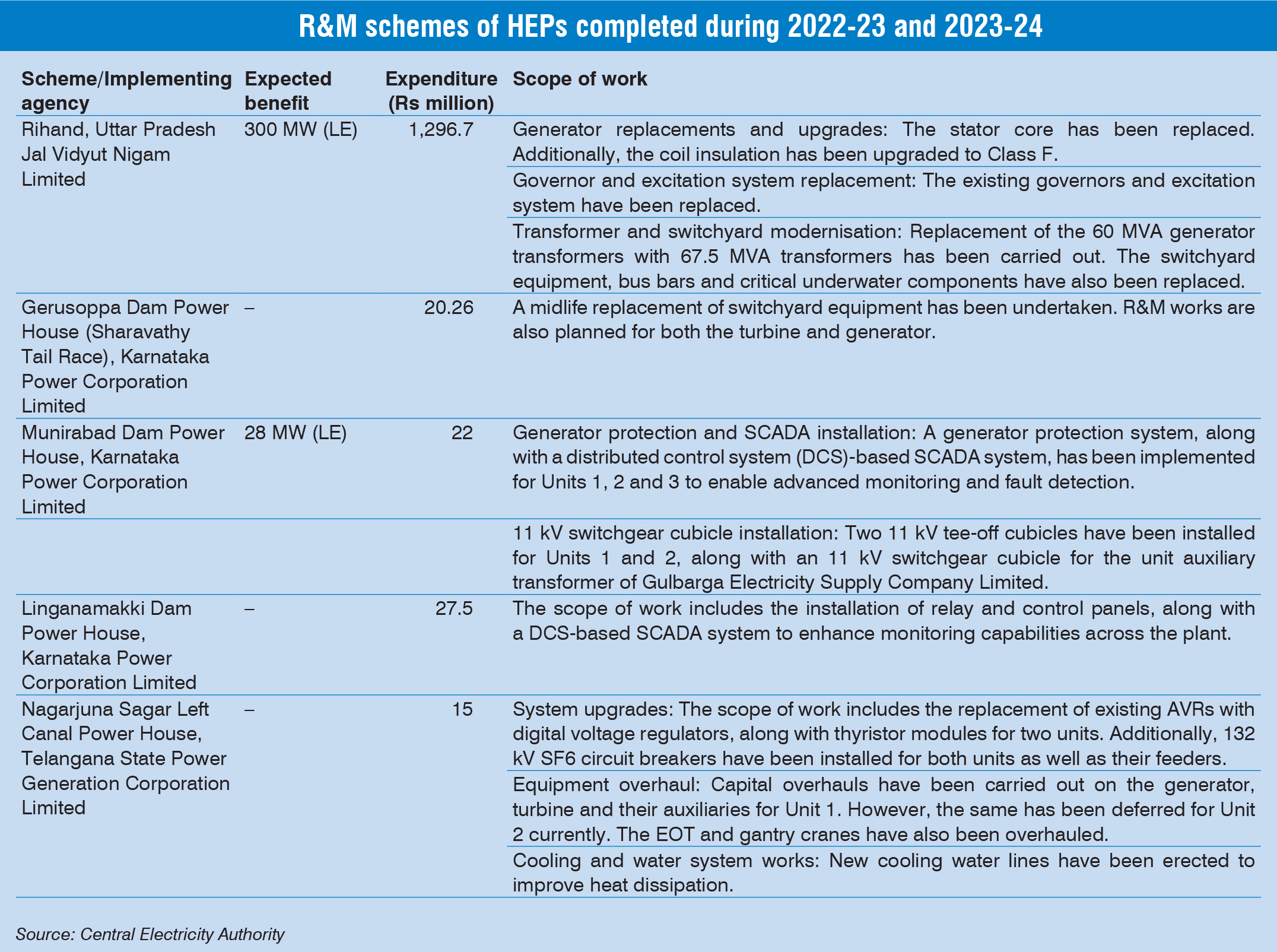
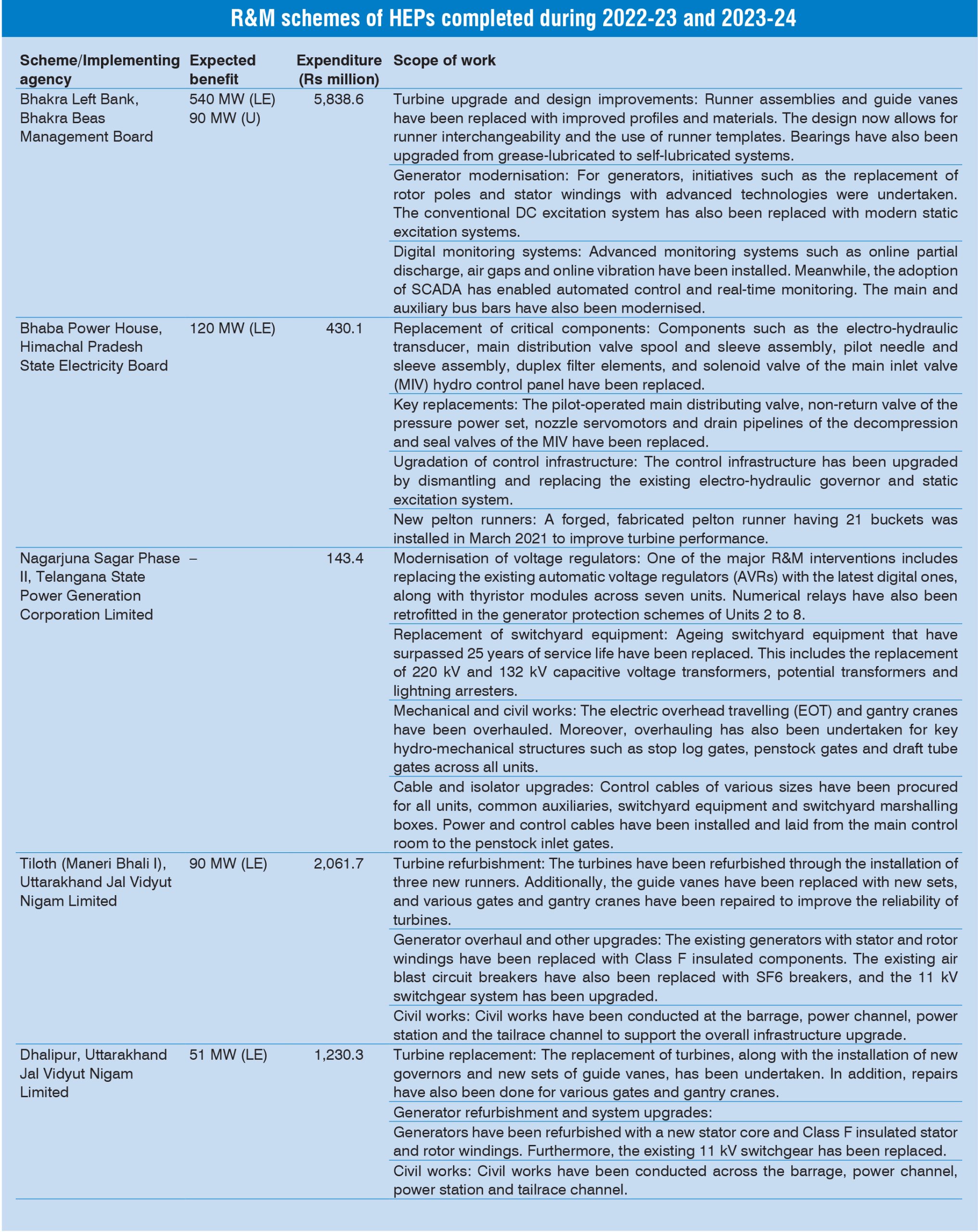
As the first step of any R&M intervention, a detailed assessment of the plant’s condition must be carried out. This involves evaluation of historical performance data, breakdowns and efficiency losses. Hydraulic and electrical parameters, including water availability, silt levels and sediment load, also must be studied in depth. Moreover, wherever uprating is considered, hydraulic data and structural drawings should be shared with manufacturers to ensure design compatibility.
Key equipment and control systems that are typically the first to become obsolete should be prioritised for modernisation. By replacing outdated materials with modern alternatives, plant performance can be significantly increased. For example, bitumen-based generator insulation can be replaced with epoxy systems, or conventional switchgear systems with SF6 switchgear. Additionally, many older plants still operate with electromechanical or analog control systems, which should be upgraded to digital ones. These upgrades can incorporate microprocessor-based governors, static excitation systems, numerical relays, optical instruments for monitoring vibration and silt content in water, and supervisory control and data acquisition (SCADA) for real-time monitoring and remote diagnostics. By adopting these technologies, the operations of ageing plants can improve considerably.
For plants operating in silt-prone regions, protective measures include installation of silt measuring instruments, online monitoring and radiographic equipment for video display of damage, and cyclone separators to filter fine silt from cooling water. Additionally, thermal spray coatings such as plasma, high velocity oxygen-fuel or high velocity air-fuel can also be used on underwater components. Upgrading turbines by reprofiling runners and flow passages, and replacing admiralty brass with cupro-nickel tubes in coolers can further lead to higher resilience against silting and minimise erosion.
Importantly, while undertaking mechanical and electrical upgrades, consideration should be given to lifecycle costs and ease of maintenance. For example, replacing metallic bearings with self-lubricating non-metallic ones can reduce recurring maintenance costs. Similarly, advanced diagnostic tools like radiographic probes allow for condition assessments without disassembly, and should be part of the modernisation toolkit. Additionally, where feasible, hydraulic conditions should be improved by modifying blade geometry or replacing runners entirely to suit present-day load and flow variations.
 Challenges
Despite significant progress made with respect to RMU activities, a host of challenges persist, hindering the timely and effective implementation of these activities. First, the absence of robust policies and guidelines often results in utilities neglecting RMU or undertaking it in a fragmented manner. Second, poorly prepared detailed project reports (DPRs) also exacerbate problems and create issues during the bidding process, leading to prolonged delays in executing R&M activities. Third, utilities frequently delay R&M projects until the plant nears the end of its useful life, which is typically around 30-35 years. However, experts recommend conducting interventions much earlier, especially in silt-prone Himalayan regions where erosion-induced forced outages can significantly reduce plant availability. Lastly, there is a shortage of skilled personnel equipped to conduct residual life assessment studies for power plants, leading to delays in the formulation of accurate DPRs and defining the scope of work.
Conclusion
As India aims for the large-scale integration of renewable energy sources into its grid, hydropower is well-positioned to support overall system reliability in the coming years. However, the implementation of R&M activities is crucial for ensuring the long-term viability and efficiency of this sector. The R&M of HEPs presents a cost-effective and time-efficient approach to revitalising ageing infrastructure and mitigating challenges such as declining output, silt erosion and outdated technology. Moving forward, the timely identification of critical units, regulatory support, and continued research and development in advanced technologies will be key to realising the full potential of R&M activities.