
Operations and maintenance (O&M) is a critical function in the life cycle of hydropower plants, directly impacting plant reliability, efficiency and performance. Structured and technology-driven O&M strategies are essential to minimise downtime, manage costs and ensure regulatory compliance. With hydropower playing a growing role in balancing the grid amid rising renewable integration, the importance of predictive and condition-based maintenance is increasing. Challenges such as ageing infrastructure, sedimentation and inflexible grid operations require continuous upgrades in O&M practices. The emergence of pumped storage projects (PSPs) adds further complexity due to their distinct operational demands. Utilities are increasingly adopting digital tools, remote monitoring systems and standardised asset management frameworks to manage their hydropower portfolios more efficiently.
Power Line explores the best practices, technological advancements and future trends in O&M and asset management in the hydropower sector.
Best practices in O&M
Hydropower O&M practices are increasingly aligned with real-time operational data. Performance indicators such as inflow patterns, reservoir levels, water utilisation efficiency and spillage are closely tracked to inform maintenance planning and reduce unplanned outages. Compliance with the Indian Electricity Grid Code is ensured by maintaining optimal MVAR levels based on generator capability curves and dynamic grid requirements. Automatic generation control commands issued by the National Load Despatch Centre are not only executed in real time but also analysed periodically to evaluate response efficiency, identify gaps and fine-tune system frequency control strategies. These measures support predictive maintenance and enable more effective scheduling of shutdowns and inspections.
In regions with high sediment load during the monsoon season, robust erosion management measures are adopted to protect critical underwater components. High-velocity oxyfuel coating is commonly applied to runners, guide vanes and cheek plates to counteract silt-related wear. In many cases, asset owners prioritise the replacement of major components over repairs to reduce maintenance time and sustain plant availability.
Operational consistency is further reinforced through the implementation of site-specific standard operating procedures covering activities such as start-up and shutdown sequences, reservoir drawdown and emergency response. Routine inspections are conducted using daily and weekly checklists, while detailed reservoir operation plans are prepared to optimise water use for power generation, irrigation and flood control. These plans incorporate run-off forecasting and coordination with upstream and downstream plants to reduce spillage. To support grid resilience, utilities routinely conduct black start mock drills and maintain comprehensive logs of tripping incidents and equipment failures. Root cause analyses are undertaken to implement corrective measures, enabling faster system restoration. Centralised O&M teams provide technical and logistical support during forced outages, which helps minimise unplanned downtime through timely intervention and coordinated resource deployment.
The structural integrity of civil infrastructure, including dams, tunnels and penstocks, is maintained through systematic health monitoring. This includes visual inspections, seepage measurement and deformation surveys, with preventive maintenance aligned with risk assessments.
PSPs, due to their cyclic operation between pumping and generating modes, require specialised O&M strategies. Focus areas include real-time monitoring of reservoir levels, optimised scheduling for peak load balancing and regular upkeep of reversible turbine-generator units. PSPs also require robust control systems and effective grid coordination to ensure reliable performance during frequent mode transitions.
 Emerging technologies
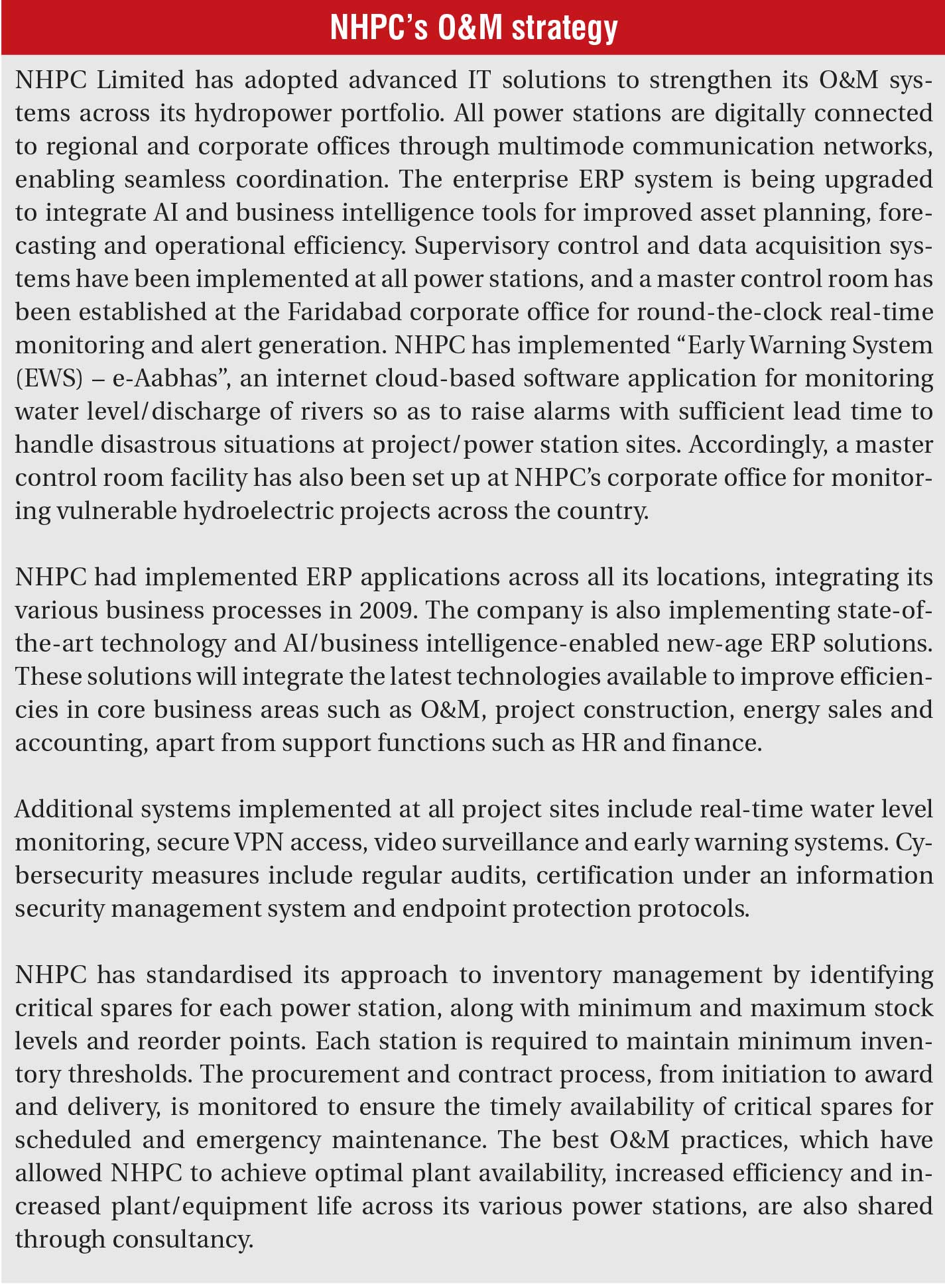
Modern technology is playing a critical role in advancing hydropower O&M practices by enabling a shift from reactive to predictive and condition-based strategies. Remote monitoring systems, including sensors, edge computing and cloud platforms, allow the continuous tracking of key parameters such as vibration, temperature, pressure, oil condition and water quality. These tools enhance operational visibility, support regulatory compliance and enable faster, data-driven decision-making. Sensor-based predictive frameworks that not only anticipate equipment failure but also integrate generation scheduling for optimal fleet performance.
Artificial intelligence (AI) and machine learning are improving predictive maintenance by analysing historical and real-time data to anticipate equipment failures, reduce false alarms, streamline inspections and enhance fault detection accuracy. Given the high mechanical stress from frequent mode shifts in PSPs, predictive maintenance is critical to minimising wear and extending equipment life. Digital twins are being used to create virtual models of critical assets, allowing operators to simulate performance and test operational scenarios without affecting plant operations. Remote inspection technologies, including drones and submersible robots, facilitate safe and cost-effective inspections of inaccessible infrastructure such as dams and underwater structures. Advanced diagnostic tools, such as torsional vibration analysis, air-gap monitoring and partial discharge detection, further support early fault identification and help extend the life of assets through timely interventions. An increasing number of asset owners are moving towards intelligent maintenance systems that bring together predictive analytics, enterprise resource planning (ERP) systems and real-time dashboards to support end-to-end e-maintenance of workflows.
Challenges and the way forward
The O&M of hydropower plants faces several operational and technical challenges. Ageing infrastructure, particularly in older plants, increases the risk of equipment failure and demands frequent maintenance or upgrades. High sediment load during monsoon seasons accelerates wear of underwater components, impacting efficiency and increasing maintenance costs. Remote locations of many plants complicate logistics, skilled manpower availability and timely access to spare parts. Grid integration requires plants to operate flexibly, placing additional stress on mechanical systems. In PSPs, frequent start-stop cycles and rapid mode switching between pumping and generation create high mechanical and thermal stresses, increasing wear of critical components such as pump turbines and motor generators. Cybersecurity is an emerging concern, with increased digitalisation exposing critical control systems to potential threats, requiring continuous monitoring, regular audits and robust protection measures.
Looking ahead, with the increasing deployment of PSPs and hybrid renewable systems, the standardisation of O&M practices across varied technologies will be essential to ensure consistency, efficiency and scalability. Utilities are expected to adopt advanced, data-driven platforms that enable the centralised monitoring and control of operations across diverse geographies and operating conditions. Real-time performance tracking, predictive diagnostics and fleet-wide benchmarking will become central to operational strategies, especially as regulatory bodies push for greater transparency, accountability and environmental compliance.
The use of unified digital platforms will support end-to-end visibility, automated audit trails and seamless reporting, significantly reducing manual intervention and streamlining regulatory compliance. These platforms will also enable better planning of maintenance schedules, spare part inventories and outage management. A strong focus on internal capacity building is anticipated, with utilities investing in upskilling their workforce in digital tools, AI-based analytics and automation technologies. Training programmes will be tailored to help staff manage new systems, interpret complex data and support informed decision-making.
Aastha Sharma


