
What is a district cooling system?
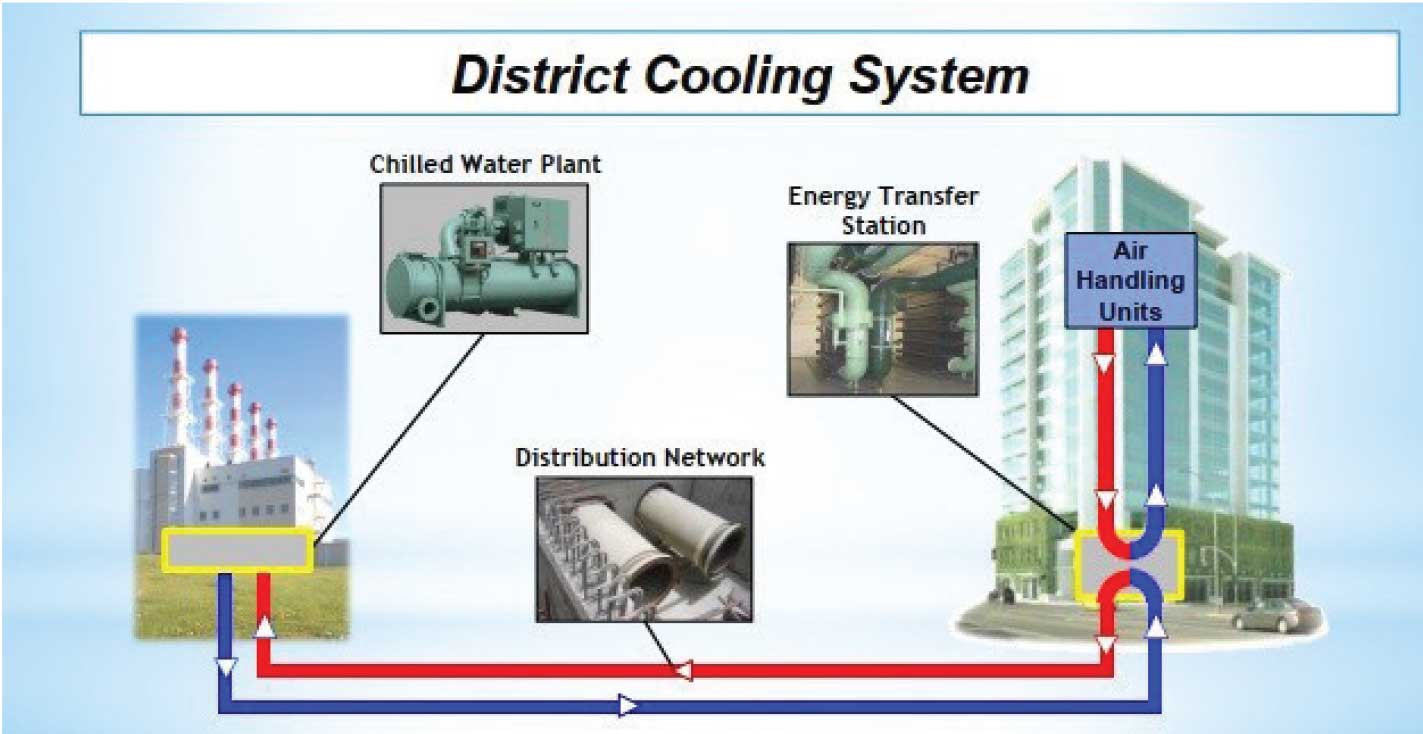
A district cooling system (DCS) is a centralised infrastructure that supplies chilled water from a central plant to multiple buildings through an underground network. This system replaces individual air conditioning units, offering a more efficient, cost-effective, and environmentally friendly solution for urban cooling.
Why district cooling?
As cities expand and temperatures rise, district cooling systems DCS can provide a smart and sustainable alternative to conventional cooling methods. Some of the key benefits are:
- Energy efficiency: Up to 50 per cent reduction in electricity consumption;
- Lower emissions: Centralised cooling systems emit fewer greenhouse gases;
- Cost savings: Reduced operational and maintenance expenses;
- Space optimisation: Frees up valuable building space.
Market opportunity
India’s cooling market is significantly underpenetrated, with per capita cooling energy consumption standing at ~147 kWh in 2023, as against the global average of 1,539 kWh, and AC ownership at 8 per cent vs 60 per cent to 90 per cent in other developing countries. This is despite India having the highest person cooling degree days (CDDs) at above 4,200 billion, driven by large population and consistently high ambient temperature in large swathes of the country.
The country’s rapid urbanisation and smart city initiatives present a strong growth opportunity for DCS. Cities such as GIFT City, Amaravati and Hyderabad are already exploring or implementing DCS projects. With the global district cooling market expected to exceed $72 billion by 2035, India is well positioned to lead in Asia, especially as DCS aligns with the National Cooling Action Plan (NCAP) and energy efficiency goals.
The country’s rapid urbanisation and climate trends present a compelling case for the expansion of DCS. With over 40 per cent of the population projected to reside in urban areas by 2030, the demand for efficient and sustainable cooling solutions is expected to surge, especially in commercial districts, IT parks, hospitals and residential complexes.
 India experiences a high number of CDDs, particularly in cities such as Ahmedabad, Delhi and Hyderabad, where summer temperatures frequently exceed 45 °C. This intensifies the need for large-scale, energy-efficient cooling infrastructure.
Despite this demand, the penetration of DCS remains low, with most buildings still relying on conventional, decentralised air conditioning systems. This gap presents a significant opportunity for growth, especially as the country moves towards net zero emissions and energy-efficient urban planning.
The district cooling market in India is expected to grow steadily, supported by:
- Government incentives for clean energy and sustainable infrastructure;
- Smart city initiatives integrating DCS into master plans;
- Private sector investments in centralised cooling technologies;
- Climate resilience strategies aimed at mitigating urban heat island effects.
DCS and sustainability
As per industry experts, the demand for cooling in India is expected to increase drastically, potentially rising eightfold over the next decade. This surge is likely to result in a fourfold increase in power demand, posing a huge challenge to the nation’s power generation, transmission and distribution infrastructure as well as sustainable and renewable energy. This additional cooling demand is equivalent to additional 120 GW of power generation and a corresponding increase in the transmission and distribution (T&D) network.
District cooling supports India’s climate and energy goals by:
- Reducing peak electricity demand and improving grid stability;
- Enabling integration with renewable energy and thermal energy storage;
- Mitigating urban heat island effects;
- Supporting green building certifications and sustainable urban development.
Policy asks
To accelerate DCS adoption across India, the following policy measures are recommended:
- Urban planning integration: Mandate DCS in new urban developments and smart cities.
- Financial incentives: Provide green financing, viability gap funding and tax benefits.
- Regulatory clarity: Establish clear licensing, tariff and service norms.
- Public-private partnerships (PPPs): Promote PPP models for infrastructure development.
- Awareness and training: Build capacity among urban planners, developers and utilities.
Special industrial tariff in Maharashtra
A notable policy development has emerged in Maharashtra, where the Maharashtra Electricity Regulatory Commission (MERC) has taken a progressive step to support DCS.
In a recent hearing, the MERC acknowledged the importance of encouraging energy-efficient systems like DCS, especially in light of India’s energy conservation goals.
To improve the financial viability of DCS projects, the MERC has decided to classify such systems under the industrial tariff category. This classification is specific to Maharashtra and reflects the commission’s view that electricity costs significantly impact the feasibility of DCS. The move is expected to boost adoption and serve as a model for other states.
Other states could also undertake similar policy interventions to encourage higher adoption of DCS.
Expanding the vision nationwide
Building on Maharashtra’s leadership, stakeholders now intend to propose similar industrial tariff classifications in other states. Aligning DCS with industrial tariffs nationwide will:
- Enhance the economic viability of DCS projects;
- Encourage private sector investment;
- Support India’s broader energy efficiency and climate goals.
- Inclusion in the National Building Code
To further institutionalise DCS adoption, stakeholders have formally requested the inclusion of DCS in the National Building Code (NBC), which is currently at the draft stage. The proposal recommends:
- Mandatory viability assessment of DCS for large-scale developments;
- Prioritisation of DCS over conventional air conditioning systems wherever feasible.
- This step aims to ensure that DCS becomes a standard consideration in urban planning and building design, reinforcing its role in India’s sustainable development strategy.
DCS in India
DCS has been popular in West Asian markets like the UAE, Oman, Bahrain, Saudi Arabia, etc. for decades. In India, it is still at a nascent stage; the market is highly fragmented with an established player having national reach and offering a full bouquet of services.
Adani Energy Solutions Limited (AESL), a key player in India’s energy infrastructure space, has announced a strategic expansion into centralised cooling solutions, offering end-to-end, scalable, and sustainable cooling infrastructure. AESL’s DCSs offer cooling-as-a-service (CaaS) under the design- build- finance- own-operate DBFOO model, where the entire capex is borne by it, with the user paying as per use. This approach not only frees up capital but also conserves valuable real estate for developers, as the land footprint of DCS is lower than individual cooling units.
AESL is in the process of setting up India’s largest district cooling facility in Mundra, located in Kutch district of Gujarat, with a capacity of 45,000 (TR) tonnes of refrigeration, aimed at serving industrial clusters in the region. In all, the company is executing projects with a cumulative capacity of 52,000 TR and is actively pursuing a robust pipeline of cooling projects totalling 0.25 million TR across various geographies and sectors.
Tata Power has also announced its intention to enter this space.
(The author of this article is an independent expert who wishes to remain anonymous.)