

In a landmark judgment, the Supreme Court has directed electricity regulatory commissions across India to strictly limit the creation of regulatory assets and ensure their time-bound liquidation. In line with the amended electricity rules, the court has directed that regulatory assets be capped at 3 per cent of the annual revenue requirement (ARR) and mandated their clearance within three to four years. The judgment is expected to reshape tariff-setting, improve financial discipline among discoms and enhance financial transparency in the sector.
A regulatory asset is an intangible accounting entry created by electricity regulatory commissions when a discom is unable to recover its full costs in a given year through tariffs. Instead of passing the entire cost to consumers immediately (which could cause tariff shocks), the commission allows part of the revenue gap to be deferred for recovery in future years. While designed as a cushion against tariff shocks, these deferred costs have now grown to alarming levels, straining discom finances. Industry experts estimate accumulated national regulatory assets of close to Rs 1.7 trillion.
For discoms, regulatory assets provide temporary relief by deferring costs, but over time, the accumulation creates financial stress. Large unrecovered amounts weaken the balance sheet, constrain cash flows, and result in delayed payments to power generation and transmission companies.
Background and key highlights of the Supreme Court Order
The Supreme Court order was issued in response to civil appeals and writ petitions, wherein Delhi’s three discoms – BSES Rajdhani Power Limited (BRPL), BSES Yamuna Power Limited (BYPL) and Tata Power Delhi Distribution Limited (Tata Power-DDL) – challenged the manner in which the Delhi Electricity Regulatory Commission set retail supply tariffs, leading to the creation and continuation of regulatory assets. As of March 31, 2024, the regulatory assets (including carrying costs) stood at Rs 129.93 billion for BRPL, Rs 84.19 billion for BYPL and Rs 57.88 billion for Tata Power-DDL, aggregating to Rs 272 billion. The problem of regulatory asset build-up is not new and has reached alarming levels over time. Rajasthan has reported regulatory assets of Rs 471 billion as of FY 2025, Kerala reported Rs 71.23 billion as of FY 2023 and Chhattisgarh reported a cumulative deficit of Rs 29 billion as of FY 2024, among others.
Notably, the laws to check regulatory asset build-up have been embedded in the Electricity Act, 2003. The National Tariff Policy, 2006 first codified that regulatory assets may only be created in exceptional cases (for instance, force majeure) and must be liquidated within three years. The National Tariff Policy, 2016 extended the permissible liquidation period to seven years, while reaffirming that regulatory assets cannot be routine instruments of tariff suppression. The most recent policy direction regarding regulatory assets was issued in January 2024, where the central government notified the Electricity (Amendment) Rules, 2024, inserting Rule 23 into the Electricity Rules, 2005. Rule 23 lays down that tariffs must be cost-reflective, with no gap between the ARR and revenue from the approved tariff, except in cases of natural calamity. It caps regulatory assets at 3 per cent of ARR, requires liquidation of new regulatory assets within three years and existing ones within seven, and applies carrying costs.
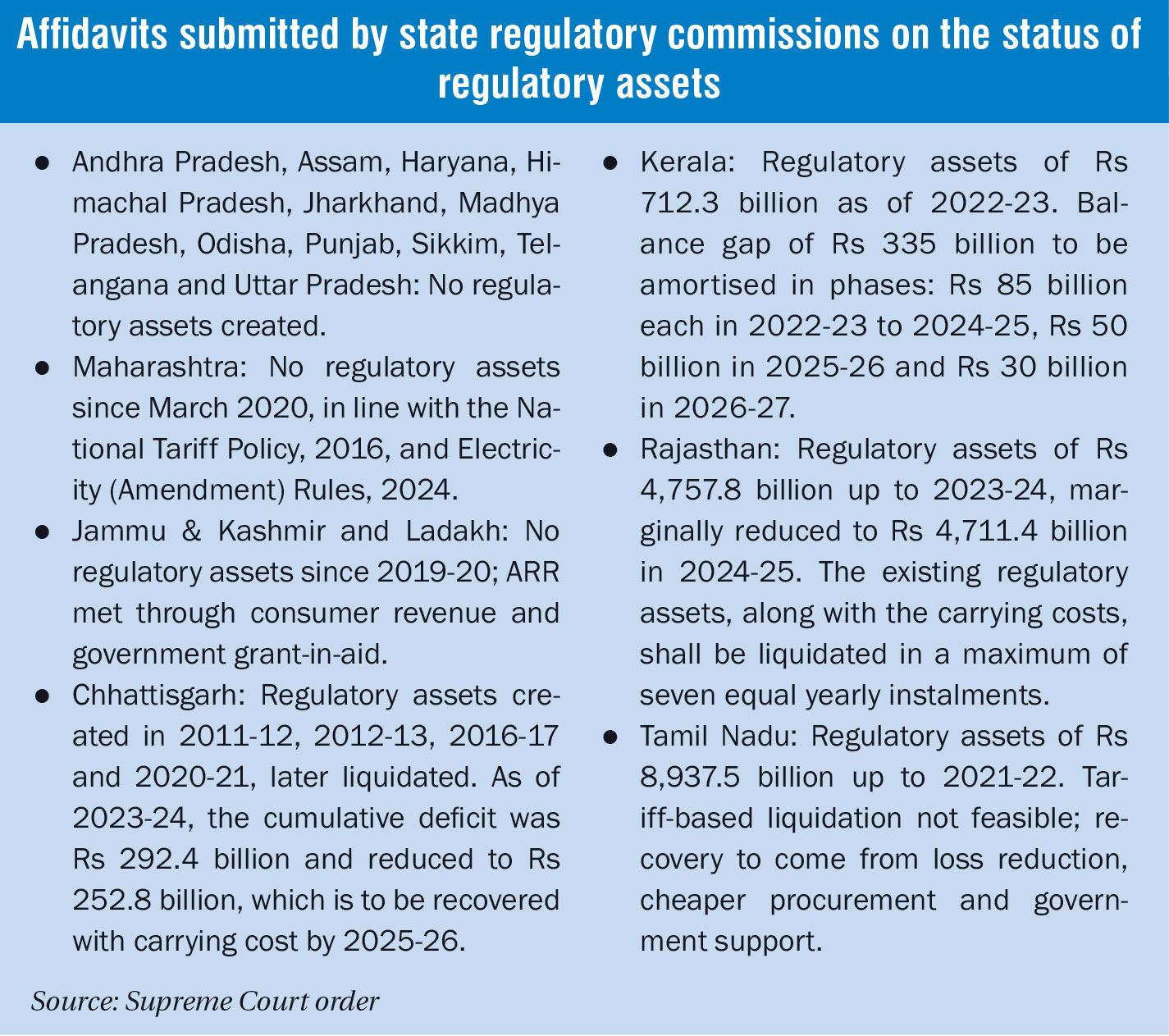 Building on this framework, the Supreme Court has emphasised that tariffs are to be cost-reflective and that any revenue gap between the approved ARR and revenue from the approved tariff should arise only under exceptional circumstances. Regulatory assets are not to exceed the 3 per cent cap under Rule 23. Where a regulatory asset is created, it is to be liquidated within three years, while existing assets are to be liquidated within a maximum of four years starting from April 1, 2024. Regulatory commissions are to lay down a clear trajectory for liquidation, including provisions for carrying costs, and carry out strict audits of the circumstances under which discoms continued without recovering the regulatory assets. The Supreme Court has directed the Appellate Tribunal for Electricity (APTEL) to exercise its powers under Section 121 of the Electricity Act, 2003 to issue necessary orders and monitor compliance.
While passing the present judgment, the Supreme Court underlined a set of critical points. Electricity, being a public good, is regulated under the Electricity Act, 2003, which entrusts tariff determination exclusively to independent regulatory commissions. These commissions must balance social justice with efficiency, ensuring affordable access to electricity while keeping tariffs cost-reflective. Delays in tariff filings, weak truing-up, subsidy lapses and indecisive regulations have led to ballooning assets – an indicator of regulatory failure. The Supreme Court has stressed on enhancing accountability and has directed the regulatory commissions to follow the act, policies and APTEL’s directions, with their decisions subject to appeal. APTEL has wide powers, including under Section 121, to issue binding directives, enforce discipline and monitor compliance to prevent the recurrence of such regulatory failures.
The way forward
The Supreme Court order is critical for the country’s power distribution segment, as it addresses the issue of cost deferral and encourages the alignment of tariffs with actual expenditure. By directing all states and union territories to liquidate the accumulated regulatory assets within four years, the Supreme Court has paved the way for a phased rationalisation of tariffs across consumer categories. For discoms, the order provides much-needed revenue certainty. On the regulatory side, the judgment reinforces the importance of ensuring timely cost recovery and adherence to tariff discipline. State governments are also expected to now face pressure to release subsidies on time, given the increased focus on timely cost recovery. While consumers may experience progressive adjustments in tariffs, the enforcement of cost discipline and liquidation of past arrears are expected to improve sector stability.
Priyanka Kwatra


