The European Union (EU) and many European governments have set ambitious targets for offshore renewable electricity generation, as it is one of the most promising resources to ensure Europe’s energy security, while transitioning to a net zero economy by 2050.
In a bid to identify possible regulatory gaps in the extant regulatory framework and to develop strategies and work plans that ensure a functioning regulatory framework for the development of more complex offshore infrastructure, the European Network of Transmission System Operators for Electricity (ENTSO-E) recently launched its offshore road map.
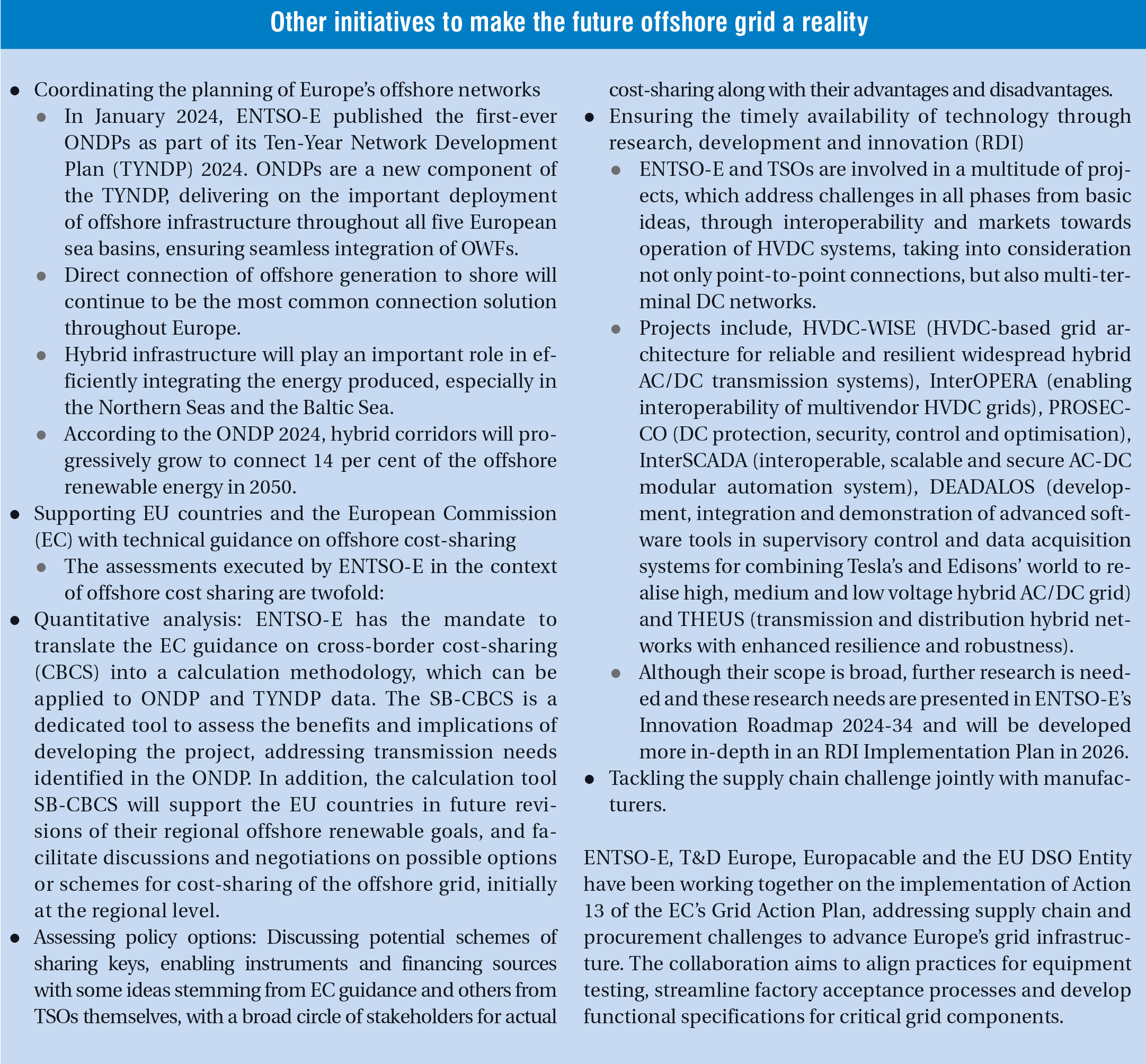
In December 2024, the EU countries agreed to increase their efforts to integrate up to 365 GW of offshore renewable capacities by 2050 in the European energy systems, a number that increased from 354 GW agreed to earlier in January 2023. Developed through extensive engagement with stakeholders, including workshops in 2024 and 2025, the road map marks a key step in aligning technical and regulatory readiness with Europe’s climate and energy ambitions. It outlines ENTSO-E’s work to adapt Europe’s electricity market rules, system operations and system development frameworks for more complex offshore infrastructure. Additionally, the document provides an overview of most of the other offshore-related activities of ENTSO-E – grid planning (offshore network development plans – ONDPs), technical work on cost sharing, research and development, and supply chains.
Power Line presents the key highlights of the ENTSO-E’s offshore road map…
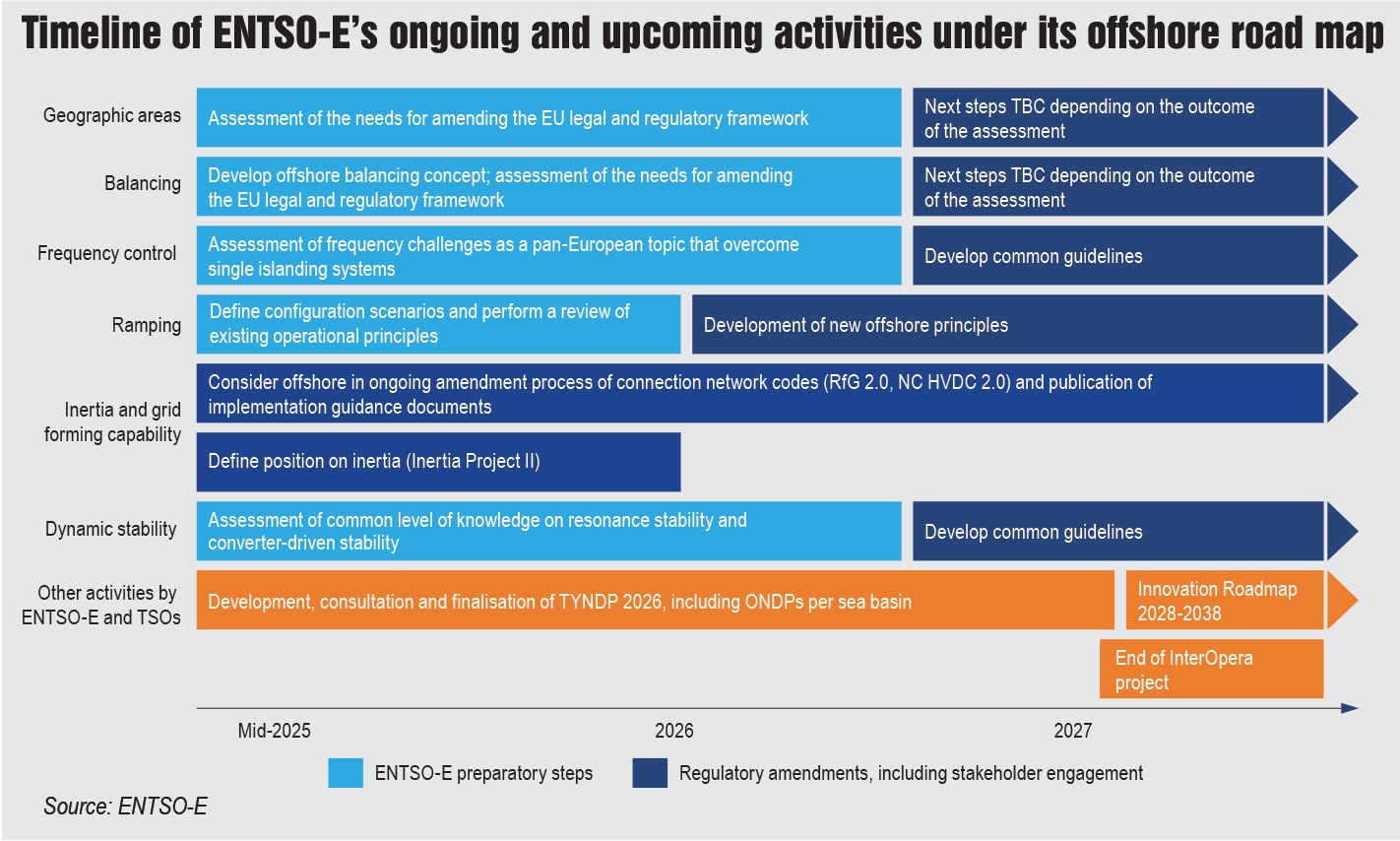
ENTSO-E has identified several regulatory challenges related to efficient integration of offshore and onshore electricity grids and has selected six priority areas for further legal and regulatory investigation and discussion. These priority areas are – defining geographic areas and offshore bidding zones (OBZs) to enable market-based coordination; developing a robust offshore balancing concept to ensure secure and efficient system operations; addressing frequency control in low-inertia offshore environments; harmonising ramping requirements for high voltage direct current (HVDC) links and wind farms; enabling inertia provision and grid-forming capabilities to maintain system resilience; and ensuring dynamic stability in offshore grids dominated by power electronics.
Development of geographic areas and OBZs
Larger and more interconnected offshore systems will have to be integrated efficiently into the existing framework for system operations and markets. The installation of multiple HVDC grid components will create new system characteristics. Currently, the operational rules, in the form of the System Operation Guideline, are largely based on synchronous areas, but offshore systems will also cover non-synchronous areas. An examination is needed to assess the need for improvement in the existing framework.
On the system operations side, a clear process has to be designed to assign offshore systems to load frequency control (LFC) blocks, LFC areas, monitoring areas, scheduling areas and system operation regions and to ensure smooth coordination between onshore and offshore systems. On the market side, OBZs have to be assigned to capacity calculation regions, imbalance regions and imbalance price regions through a clear process.
The OBZ model is the target framework for integrating hybrid interconnections which serve both as offshore wind farm (OWF) connections to onshore systems and as cross-border interconnectors into European electricity markets and allows for efficient coordination of cross-zonal electricity flows and wind injection from OWFs. Some of the first OBZs would include hybrid interconnections such as LionLink (the UK-Netherlands), Bornholm Energy Island (Denmark-Germany), Princess Elisabeth Island (Belgium-UK/Denmark).
 Additionally, simultaneous cross-border exchanges and wind injection are limited by the maximum thermal capacity of the offshore infrastructure. OBZs will be integrated into the European electricity markets via market coupling across all time frames.
To address these challenges, market frameworks must be in place to ensure the safe and secure operation of both offshore and onshore grids, while minimising the risk of unplanned infrastructure outages. Clarity on the set-up of operational and market areas can also provide inputs on how new grid assets and generation assets of offshore should be designed to ensure resilience, interoperability and automated communication. Overall, ENTSO-E’s objective is to establish and develop a viable operational framework that meets the technical and operational requirements of OBZs, while ensuring system security.
While enhancing overall market efficiency and managing congestion, the introduction of OBZs with flow-based market coupling or advanced hybrid coupling could affect the future revenues of OWFs and their ability to hedge risks, such as increased price and volume volatility, as OSW is put in direct competition with import and export from neighbouring bidding zones for the interconnector capacity.
Offshore balancing
ENTSO-E is working on an offshore balancing concept that is aligned with the European regulations and allows for the integration of OBZs (with only generation and no or limited demand) and OWFs in the European balancing markets.
The first OBZs are expected to primarily connect OSW and have no or very limited amounts of demand and hence, no or minimal inertia. How offshore power imbalances are dealt with, therefore, needs to be considered. Most likely that imbalances from OBZs need to be transported immediately, for example, by the respective HVDC systems to the neighbouring onshore areas.
The key challenges that need to be investigated and addressed here include management of instantaneous imbalances via the HVDC system; integration of OBZs into the EU balancing platforms; creating an adequate imbalance price; potential impact on dimensioning and sharing of reserves for offshore imbalances; and cost allocation for procurement and activation of reserves.
 Frequency control
ENTSO-E considers frequency control to be a pan-European topic, mainly organised at the level of synchronous areas of Continental Europe, the Nordics and Ireland/Northern Ireland. Increased interdependencies between synchronous areas are expected, both as a result of increased interconnectivity through HVDC systems and the cross-synchronous area impact of generation losses such as those resulting from weather-related phenomena.
The current concepts for frequency control, including criteria of reference incidents, should be reassessed, considering all the complex elements of the future grids. New emerging technologies and systems will help manage frequency stability better in the future. These include wide area monitoring systems, energy storage systems (ESSs), grid forming capabilities, and advanced functionalities on OWFs such as grid forming or synchronous condensers with additional flywheels.
Ramping rates for DC links and wind farms
The ramping rate describes the rate of change of active power by a power generating module, a demand facility or an HVDC system. Offshore generation is expected to have forecast errors similar to existing renewable energy generation. However, the size of OWFs can be much larger, causing larger uncertainties. These uncertainties are delivered at a single point onshore, also creating challenges for transmission system operators (TSOs) onshore, as this can lead to steep changes in active and reactive power.
Currently, there is no common TSO assessment on the impact of significant offshore renewable energy source feeding into the onshore system.
Inertia provision and grid forming capability
To deal with incidents and imbalances in the European transmission system, largely dominated by inverter-connected generation and HVDC systems, grid forming capabilities of power generating modules and HVDC systems will be essential. To manage imbalances and incidents, an ensemble of grid forming solutions needs to be implemented in the EU power system. Grid forming capabilities can be embedded through synchronous condensers; static synchronous compensators (statcoms); power park modules and ESSs, all with grid forming capabilities.
The grid connection regulations for generators in the Requirements for Grid Connection (RfG) 2.0 and the HVDC 2.0 are currently being finalised for publication and will further support the integration of offshore generation, with the implementation of new technical requirements related to grid forming and inertia provision. However, these requirements will, by default, not be effective immediately, due to the lag in the implementation of the EU connection network codes in the national regulations (which are expected by 2029 across Europe). ENTSO-E recommends accelerating the implementation period on a national level grid forming requirement, with the support of regulators and member states.
Under ENTSO-E’s Project Inertia Phase II, the resilience of the system in case of a split with the Continental Europe synchronous area is being assessed. This is done to draw conclusions on the need to address declining system resilience and propose necessary solutions and mitigation measures in a step-by-step, no-regret approach, in order to ensure secure and efficient operation for a future-ready decarbonised system.
Dynamic stability
There is a growing need for common stability assessment methodologies for offshore grids with a high penetration of power electronics. While existing practices for onshore grid stability assessment rely on well-established models, offshore meshed HVDC networks require new approaches that account for dynamic interactions among multiple converters, their control systems and their interactions with onshore AC grids.
For effective system strength management, new coordinated approaches must be developed. These include harmonised system strength requirements for offshore and onshore grid access and operation; and the definition of minimum grid forming capabilities for offshore converters, ensuring sufficient inertia-like response and robust voltage control and advanced testing and validation procedures to evaluate the resonance risk and converter-driven stability across different vendors and grid configurations.
Conclusion
As offshore projects increasingly extend across borders, ENTSO-E emphasises the need for coordinated regulation, system design and stakeholder cooperation. The road map also highlights efforts to guide offshore cost-sharing, support innovation and address supply chain constraints. ENTSO-E will continue to update the road map as technologies and policies evolve, ensuring that OSW can be connected and operated securely, efficiently and at a scale.