
By Rishika Ranga and Kumar Preetam
Introduction and economic rationale of market coupling
India’s electricity sector is undergoing a major transformation, shifting from a system dominated by long-term power purchase agreements to a more flexible, market-oriented structure. Over the past two decades, short-term electricity trading has gained prominence through the emergence of power exchanges and innovative market products. According to the Central Electricity Regulatory Commission’s (CERC’s) annual report, Short Term Power Market in India: 2023-24, short-term transactions accounted for 12.5 per cent of the total generation in financial year (FY) 2023–24, with exchange-traded volumes growing at a compound annual growth rate of 22.4 per cent between 2009 and 2024.
Since the launch of India’s first power exchange (the Indian Energy Exchange [IEX]) in 2008, mechanisms such as the day-ahead market (DAM) in 2009, real-time market (RTM) in 2020 and green term–ahead market in 2021 have expanded opportunities for generators and offered distribution companies credible alternatives to manage peak and seasonal demand.
Of the three power exchanges in India, IEX, Power Exchange India Limited (PXIL) and Hindustan Power Exchange (HPX), IEX dominates the market with nearly 90 per cent share, giving it a significant advantage in price discovery.
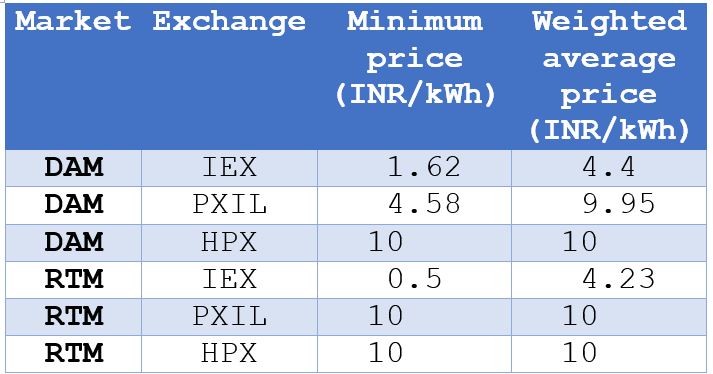
To eliminate this imbalance, while allowing multiple exchanges to compete on value-added services, CERC proposed market coupling in 2023. It involves aggregating bids across all exchanges to determine a single, uniform market-clearing price. The objectives are to improve competition (by removing the dominance of a single exchange and allowing all to compete on services and innovation), maximise economic surplus (by combining bids across exchanges to clear more volume and reduce unexecuted trades), and optimise the use of transmission capacity (by jointly allocating corridors to ensure flows occur where they yield the highest welfare).
However, the July 2025 report of the Grid Controller of India Limited (GRID-India) for a four-month shadow auction shows less than encouraging results. The overall welfare increases reported were a mere 0.3 per cent and 0.01 per cent for DAM and RTM coupling, respectively. Yet, CERC directed GRID-India to initiate the process for implementing market coupling in a phased manner, starting with DAM in January 2026.
Stakeholder responses to market coupling
In August 2023, CERC sought comments and recommendations on market coupling, receiving detailed submissions from the three operating power exchanges. Two of them, PXIL and HPX, supported the measure, arguing that the reform would prevent the near-monopoly of a single exchange and foster innovation, efficiency and improved service quality for participants. They also highlighted that the current liquidity concentration in one platform has fragmented social welfare and created structural disadvantages for newer exchanges.
IEX, however, opposed the proposal. It argued that there is no real need for coupling because the move would have a negligible impact on the stated objectives, further cautioning that such a move would diminish the role of power exchanges to mere bid collectors. Other sceptics of market coupling argued that it should not be rushed without a detailed assessment, given its potential impact on competition, high transition costs for traders and the risk of reducing the role of exchanges that smaller traders rely on for market information.
To make market coupling more effective and credible, HPX and PXIL recommended a rotational model for the Market Coupling Operator (MCO) among exchanges to leverage existing technology and expertise. They also advocated adopting a transparent and robust common algorithm similar to that in the European model, ensuring strong governance for clearing and settlement and aligning the mechanism with broader reforms such as General Network Access, ancillary markets and future electricity derivatives.
What India can learn from the European Union (EU) market coupling experience
Market coupling in Europe began in 1993 with a common spot market between Norway and Sweden, later expanding to Finland, Denmark, France, Belgium and the Netherlands by 2006. In 2010, 15 countries launched the Price Coupling of Regions initiative, developing the Pan-European Hybrid Electricity Market Integration Algorithm (EUPHEMIA) to calculate prices across markets. The algorithm is designed to maximise economic surplus by applying marginal pricing and incorporating transmission constraints, ramping and renewable variability. This ensures that prices reflect actual grid conditions rather than just bids.
The process was formalised in 2015 through the Capacity Allocation and Congestion Management (CACM) Regulation, which governs the single day-ahead and intraday market coupling. Although the European market coupling is more ambitious, spanning multiple sovereign national markets, India can draw valuable lessons from its execution.
Scheduling and congestion management
In Europe, market coupling was developed to ensure that electricity flows from cheaper regions (surplus) to more expensive regions (deficit). To do so, the EU uses implicit market coupling with bidding zones and traders place their bids in their regional zone. Subsequently, EUPHEMIA clears bids across all zones, considers transmission constraints and then sets the zonal price reflecting congestion. The clearing is performed by a single operator that handles both pricing and transmission planning.
In India, the proposed market coupling framework would centralise bid collection to determine a single market-clearing price. However, discussions so far suggest that transmission capacity would still be allocated separately after price discovery, meaning prices would not reflect congestion. As a result, market coupling would fail to provide market signals for surplus power to flow to deficit regions—an issue particularly relevant for renewable energy, where resource potential is concentrated in specific states.
Lessons for India
- Move beyond a single national price by piloting zonal or regional pricing so that congestion costs are reflected in prices.
- Test different market coupling models such as price coupling and volume coupling (loose coupling or tight coupling).
- Use simulation-based pilots to compare the current curtailment-led congestion management with price-based congestion signals under high-renewable and high-demand scenarios.
Pricing algorithm development and fallback option
Under the CACM Regulation, transmission system operators and power exchanges jointly developed EUPHEMIA. Notably, the Regulation also mandates fallback options if the central system fails, thereby preserving market continuity. Equally important are scalability, transparency, and iterative refinement of the algorithm through stakeholder feedback.
India
- Adapt principles of scalability and transparency of the algorithm to ensure it remains relevant and iterative as the market evolves.
- Design and test fallback procedures—such as reverting to local exchange auctions—so that trading continues even if the central system fails.
- Test embedding congestion, renewable variability and regional demand patterns for India’s algorithm.
Accountability and transparency
Accountability and transparency are central to the EU’s market coupling framework. Under the CACM Regulation, transmission operators must compensate participants if curtailments occur after gate closure, while results, methodologies and prices are published openly.
The Agency for the Cooperation of Energy Regulators (ACER), the centralised EU electricity regulator, has also developed a structured monitoring framework with detailed indicators covering algorithm performance (processing times and order volumes), outputs (matched trades and capacity utilisation), and network constraints (congestion instances). Regular regulator monitoring and public reporting create a feedback loop that promotes trust, deters manipulation and ensures continuous improvement in market operations.
Lessons for India
- Make the results of simulations and pilots public.
- Mandate public disclosure of methodologies, clearing results and transmission curtailments.
- Introduce a compensation mechanism for participants affected by curtailments post gate-closure.
- Develop a monitoring performance framework with clear indicators to assess the algorithm performance on stated objectives.
The road ahead
Market coupling represents the next logical step in India’s evolving electricity market, promising greater transparency, efficiency and the optimal use of the transmission infrastructure. Yet, its roll-out will not be without challenges. Regulatory clarity under CERC is critical to ensure neutrality and instil market confidence. In particular, the neutrality and independence of the MCO are essential to prevent any bias towards any one exchange, which could compromise the level playing field market coupling intends to create. Equally important is the design of a robust algorithm that can optimise energy, reserves and transmission, while handling complexities of real-time bidding and settlement. Transparency in data sharing, without compromising confidentiality, will also be essential. Finally, more pilot studies are needed to test different algorithms and pricing methods, aiming to maximise the benefits of market coupling, particularly because the single shadow auction conducted did not yield favourable outcomes.
(Rishika Ranga is a Consultant and Kumar Preetam is a Senior Analyst in the Energy Policy and Regulations Group at the Centre for Study of Science, Technology and Policy (CSTEP), a research-based think tank.)