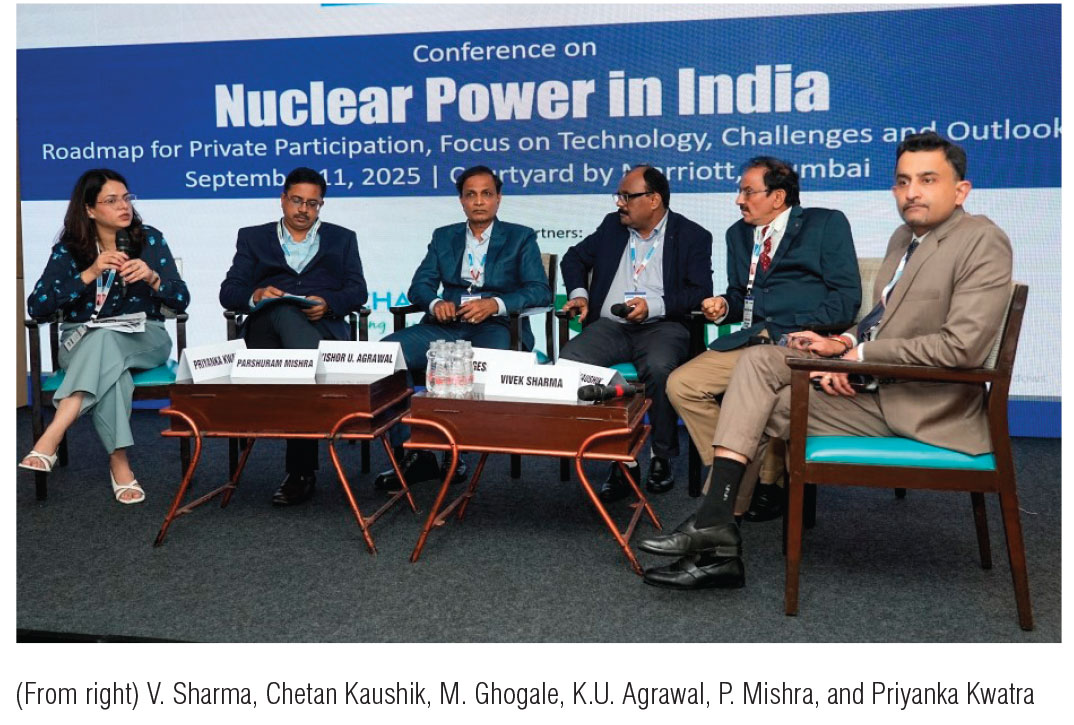
At Power Line’s conference session on “Nuclear Power in India – Industry Perspective”, leaders from across the nuclear energy value chain came together to deliberate on the key factors that are likely to shape the future of the country’s nuclear sector. The panellists included Neeraj Agrawal, President, Nuclear Power, JSW Energy; Chirag Doshi, Managing Director and Chief Executive Officer, Walchandnagar Industries; Dr Kalirajan S., Managing Director – Nuclear Projects India, EDF India; Kishor U. Agrawal, Vice President, Nuclear Business, Jindal India Power; Mangesh Ghogale, Head – Business Development, and Senior General Manager – Transport and Nuclear, Hindustan Construction Company; Dr Chetan Kaushik, Head – Nuclear Technology and Strategy, Core Energy Systems; Parshuram Mishra, Group Head – New Technology, Corporate Generation, Tata Power; and Vivek Sharma, Business Head – Nuclear Energy and Chief, Energy Strategy, Adani Power. They discussed the evolving nuclear power landscape, highlighting the challenges and opportunities for accelerating growth. Key takeaways from the session…

Sector overview
India’s rapidly growing economy and expanding industrial base are expected to drive electricity demand sharply upward in the coming decades. As renewable capacity scales up, its limitations, such as intermittency and seasonal variability, are becoming more apparent. In this context, nuclear energy stands out as a reliable, round-the-clock power source that can provide essential baseload support and complement variable renewable generation.
The panellists highlighted that the economic case for nuclear power should be assessed across the full life of a plant. Nuclear plants can function for 40 years or more, and advanced designs globally are projected to last up to 60-80 years. The longer lifespan allows capital costs to be amortised over a greater period, reducing the levellised cost of electricity. Fuel costs also remain relatively stable due to the small quantities required and long-term supply contracts. Thus, while capital investment is high, nuclear plants offer a combination of low variable costs and exceptional longevity that few other energy sources can match.
Current initiatives
After a period of limited project activity, India’s nuclear power sector is gradually gaining momentum. At the centre of this renewed effort is the adoption of the fleet mode approach for constructing a series of 700 MW pressurised heavy water reactors (PHWRs). The competitiveness of nuclear energy is closely tied to design standardisation. Frequent changes in design during construction have historically resulted in significant delays and cost escalations. Conversely, once a design is frozen and implemented repeatedly, costs fall sharply. The fleet mode model marks a deliberate departure from the earlier practice of developing projects on a standalone basis, by building multiple reactors in parallel based on a standardised design.
The benefits of this strategy are multidimensional. Standardisation shortens regulatory approval time, reduces the need for repeated design engineering and enables bulk procurement of key components, which lowers costs and ensures uniform quality across sites. More importantly, it provides long-term visibility of orders for vendors and contractors, allowing them to plan capacity expansions and optimise resources.
Encouraged by this greater visibility, several industrial players have begun expanding their manufacturing capabilities to meet future demand. Some have earmarked new land for dedicated nuclear manufacturing facilities, while others are upgrading existing facilities. These investments are expected to significantly enhance the country’s manufacturing capacity and enable faster project turnaround. In addition to greenfield development, attention is also turning towards refurbishment and life extension projects at existing nuclear plants, which will be vital as the country’s operating fleet ages.
Another major initiative is localisation and training in international design codes. Until recently, most of India’s supply chain was aligned with indigenous PHWR standards. However, as the country explores collaboration with global reactor technologies, domestic suppliers will need to comply with multiple code systems, such as American, French, Russian or Korean. Training efforts are under way to familiarise Indian engineers and manufacturers with these standards. For instance, EDF has restarted programmes to train the Indian industry in the French RCC codes, which are the design standards used for French nuclear plants. These initiatives are not only about technical compliance but also about building a quality culture that meets nuclear-grade expectations worldwide.
The sector is also seeing the emergence of technology transfer agreements and localisation efforts for critical equipment. Indigenous manufacturing of large reactor internals and coolant pumps is being prioritised under the Atmanirbhar Bharat framework. Developing domestic capability for such items will help reduce dependence on imports and long supply chains that can cause project delays.
Additionally, the discussion centred on the possibility of opening nuclear power generation to private players. Until now, the ownership and operation of nuclear facilities have remained exclusively within the public domain. By allowing private participation, benefits such as greater efficiency, faster project execution, more flexible decision-making and access to advanced technologies can be realised. In fact, large energy-intensive companies have already started exploring nuclear power as a means of ensuring secure, long-term supply for their captive use. Together, these initiatives mark a sector transitioning towards scale, self-reliance and global competitiveness.
Key challenges
Despite optimism, the panellists outlined several challenges that must be confronted if India is to move from the current 8.8 GW of installed capacity to the ambitious target of 100 GW by 2047.
First, several nuclear projects in India have taken significantly longer than their intended schedules, with some extending over a decade despite initial timelines of four to five years. The recurring cause behind such overruns lies in the continuous evolution of plant designs and regulatory standards during construction. Reducing construction and commissioning schedules is crucial because interest during construction significantly affects project economics. The engineering, procurement and construction (EPC) players also highlighted that even when design and procurement are well planned, project start dates are often delayed by slow site approvals and sequential clearance processes.
Second, while India has abundant engineers, the number of personnel trained to nuclear-grade standards remains limited. Nuclear engineering demands meticulous adherence to quality codes and safety culture. Moreover, the slowdown in new nuclear orders following global events such as Fukushima led many skilled engineers and technicians to move to other industries, creating a significant gap in the talent pipeline.
Third, although the domestic industry can produce many long-lead items competitively, certain specialised components, such as coolant pumps, still depend on a single domestic supplier. These supply chain bottlenecks create a systemic risk, since any disruption or delay from a single supplier can ripple through the entire project schedule. There is also the issue of limited specialised testing facilities for nuclear-grade components, requiring many critical equipment items to be sent abroad for testing and certification, adding time and cost.
Fourth, the financing of nuclear projects remains challenging as they are inherently capital-intensive, involving large initial outlays and long construction phases. As a result, financing costs accumulate rapidly, and high interest rates exacerbate the burden. The absence of access to concessional or climate-linked financing further limits viability.
Fifth, the country also lacks access to enriched uranium, which limits the country’s ability to adopt advanced Generation IV reactor technologies. India’s current dependence on PHWRs stems from the fact that they can operate on natural uranium, which is more readily available domestically. Without reliable access to enriched uranium from international sources, India’s transition to next-generation reactor technologies will remain constrained.
Additionally, EPC representatives noted that while the new quality and cost-based selection system encourages competition, it must be implemented carefully as inexperienced firms might quote unrealistically low prices without having the quality systems to deliver nuclear-grade work. Furthermore, the issue of financing affects contractors directly, as delayed payments or extended project durations multiply costs several times over.
Possible solutions
Despite these hurdles, the panellists saw substantial opportunities for the industry in the coming decades. First, a practical solution for successful nuclear project implementation is for industry players to begin with well-established reactor designs, such as 220 MW Bharat Small Reactors, which leverage existing domestic expertise.
Second, a key opportunity lies in the ongoing localisation drive, which has the potential to transform India into a globally competitive hub for nuclear equipment manufacturing. Currently, efforts are under way to strengthen domestic testing infrastructure as well.
Third, human capital development is another major area of focus. With only a few institutes currently offering postgraduate courses in nuclear engineering, expanding training to a wider set of universities could create a new generation of nuclear professionals. Notably, partnering with premier institutions such as the IITs and NITs to design hybrid training programmes for technicians and officers can aid the sector’s growth. The panellists also recommended the engagement of experienced professionals, for example, retiring atomic energy personnel to mentor younger engineers, and apprenticeship and skilling programmes to close the skill gap.
Fourth, if the sector opens to 49 per cent foreign direct investment (FDI), foreign partners could contribute both capital and advanced reactor technologies. India’s proven competence in designing and constructing indigenous PHWRs, coupled with its experience in refurbishing and extending the life of older reactors, will be useful for such partnerships. Moreover, the refurbishment and life extension market itself is poised to grow as several operating reactors approach midlife.
Fifth, project delays can be minimised by freezing plant designs at the outset and ensuring that regulatory approvals are final before groundbreaking begins. The discussion also underscored the need for a single-window clearance system that allows parallel processing of environmental, safety and design permissions. Further, the commercial competitiveness of nuclear power is also expected to improve as the sector matures. The panellists highlighted that the increasing adoption of digital technologies such as digital twins, predictive maintenance and automation in monitoring systems can reduce operations and maintenance costs and extend asset life. Capex can be optimised through government support, vendor coordination and improved supply chain.
Lastly, the government should place greater emphasis on quality and project delivery. For ensuring quality, the EPC players also recommended that fleet-mode nuclear projects actively involve experienced industry contractors with expertise in civil infrastructure and plant construction, due to the specialised requirements of nuclear construction, such as precise concrete pouring and stringent temperature control.
India’s nuclear power sector has reached a defining moment where the alignment of policy, finance, regulation and industrial capability will determine its trajectory in the coming decades. To realise the government’s long-term capacity ambitions, a series of enabling reforms and institutional measures are essential.
The most immediate among these is the amendment of existing legislation, particularly the Atomic Energy Act, 1962, and the Civil Liability for Nuclear Damage [CLND] Act, 2010. The Atomic Energy Act currently vests ownership of nuclear facilities solely in the central government, while the CLND Act imposes unique conditions that deter private and foreign participation in the sector. It was emphasised that amending these legislations is a precondition for private developers to invest meaningfully, while also paving the way for international technology partnerships and FDI.
A key suggestion from the panel was to establish a common insurance pool to manage nuclear liability risks. Under this mechanism, power producers, EPC contractors and equipment manufacturers would contribute to a shared fund by paying premiums in proportion to the number and size of projects they execute. Such a pooled approach would spread risk efficiently and reduce individual insurance costs, while still maintaining robust safety and compensation coverage.
Further, the panellists underscored the need for officially recognising nuclear power as a green or clean energy source. This would open the door to long-term, concessional financing and sustainability-linked funding instruments, thereby lowering borrowing costs. They also proposed innovative funding frameworks, including vendor advances and blended finance, to ease the working capital burden on equipment suppliers.
Additionally, a transparent and time-bound approval framework, structured around clearly defined checklists for each stage, from site selection and design clearance to construction approval and operational licensing, would bring predictability and speed up project development. Once all stipulated conditions are met, approvals should be automatic, thereby eliminating the need for repetitive review cycles.
Beyond policy and regulation, the long-term success of India’s nuclear programme will depend on a broader change in mindset across all stakeholders. Nuclear projects are inherently different from thermal or renewable ones. Once commissioned, a nuclear plant cannot simply be shut down and requires continuous management of decay heat and cooling systems for decades. This requires a long-term commitment and an understanding that the technology’s complexity and safety requirements naturally extend timelines and costs. A culture that values long-term stability over short-term returns will be fundamental to the sector’s sustainability.
Overall, India’s nuclear industry already possesses a solid technical base and an expanding industrial ecosystem. Now, what is needed is the alignment of laws, financing structures, regulatory predictability and skilled manpower to translate potential into large-scale, commercially viable capacity. If these enablers are implemented cohesively, nuclear power can evolve from a specialised niche into a mainstream pillar of India’s clean energy architecture.