
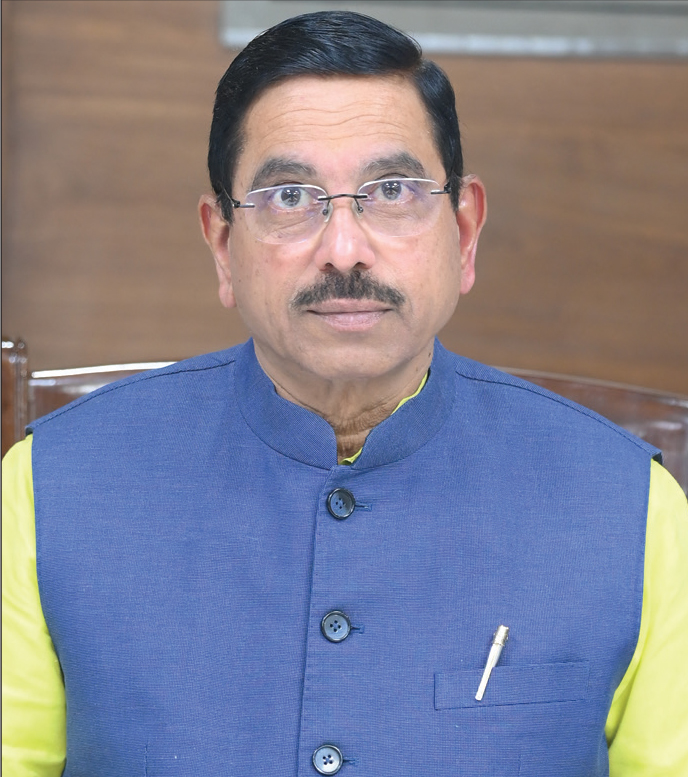
 Pralhad Joshi, Union Minister of New and Renewable Energy and Consumer Affairs, Food and Public Distribution, inaugurated the Windergy India 2025 event. In his address, he spoke about India’s rapid economic growth and parallel advancements in renewable energy. Excerpts from his address…
India’s approach to renewable energy remains grounded in the traditional belief that nature can meet human needs but not human greed. This philosophy is shaping the country’s transition towards energy generation, protecting natural resources while meeting rising energy demand. Over the years, the country has moved steadily toward solutions that balance growth and sustainability, strengthening its position in global renewable energy.
India, once counted among the “fragile five” economies, is now the world’s fourth largest economy. The country also ranks fourth in total renewable energy capacity and fourth in global wind capacity. The national objective is to advance to the third position across these indicators, including becoming the third largest in renewable manufacturing, renewable generation and wind energy. Achieving this requires strong infrastructure, which has expanded rapidly over the past decade.
National highway development provides a clear example. India had about 90,000 km of national highways built in the first 60 years after independence, including around 30,000 km constructed between 1998 and 2004. Between 2014 and 2024, another 60,000 km of highways have been added. Even a 10-lane highway is counted as 1 km, underscoring the scale of work completed. This accelerated development directly contributes to rising electricity demand across sectors.
Railway electrification has grown at an even faster pace. For decades, total electrified track length stood at around 21,000-22,000 km. Over the past 10-14 years, India has added 43,000 km, taking total electrification to nearly 64,000 km. As electrification expands, electricity requirements rise sharply, and meeting this demand through clean energy becomes essential.
India is witnessing energy transition at a scale unmatched globally. Capacity additions since 2014 show the pace of change. Solar power capacity has grown from less than 33 GW in 2014 to 128 GW today. Wind capacity has increased from about 21 GW to 54 GW, with another 30 GW in the pipeline. India’s total non-fossil fuel capacity has reached 257 GW. International delegations frequently express disbelief at the scale of installations until they observe the projects across states.
India has also achieved its goal of generating 50 per cent of its electricity from non-fossil sources five years ahead of the 2030 target. This progress reflects the combined strength of policy, industry participation and long-term planning in renewable energy.
When government and industry move in harmony, a nation’s potential expands beyond imagination – and the progress of India’s renewable sector stands as a compelling example. Over the years, the steady hum of wind turbines across Tamil Nadu and other wind-rich states such as Gujarat, Karnataka and Maharashtra has come to symbolise the country’s green energy targets. India’s wind capacity today stands at 54 GW, marking an impressive 150 per cent increase over the past decade, a rise shaped significantly by proactive policy support.
The pace of expansion has only accelerated. In the first six months of the current fiscal year, wind installations reached 3.1 GW, with another 3 GW expected before the year ends – bringing total annual additions to 6.1 GW. Around 30 GW of wind projects are already progressing through various stages of development, reflecting strong coordination among government bodies, industry players and organisations such as the Indian Wind Turbine Manufacturers Association (IWTMA).
India has set ambitious clean energy goals: 500 GW of non-fossil capacity by 2030, with 100-110 GW expected to be contributed by wind energy. Wind power is not merely a segment of this vision – it forms the backbone of the renewable energy framework. The country has begun unlocking its offshore wind potential as well, targeting 30 GW, with initial tenders emerging from Tamil Nadu. This transformation also calls for developing the full technology ecosystem within India, guided by the broader vision to “manufacture in India and manufacture for the world.”
A young, skilled workforce further strengthens this ambition. India hosts a mature wind turbine manufacturing ecosystem with an annual production capability of 20 GW. Fourteen domestic companies now produce 35 certified turbine models ranging from the early 225 kW machines to today’s 5.2 MW turbines, catering to both domestic requirements and international markets. In FY 2024-25 alone, exports of turbines and components stood at nearly 4 GW, highlighting India’s growing global competitiveness.
Solar potential adds another dimension, with total estimates hovering around 3,300 GW due to its flexibility of deployment across farmlands, rooftops, canals and buildings. Wind energy, in contrast, depends on optimal land availability, making efficiency and land utilisation critical. As the global industry moves toward turbines of up to 17 MW, India is being encouraged to explore similar possibilities. With land resources limited and electricity demand rising sharply, scaling turbine capacities and strengthening research and development (R&D) have become essential considerations.
India’s broader industrial expansion underscores the urgency of increasing renewable supply. Mobile phone manufacturing, once non-existent, now captures nearly 30 per cent of the global market share. Steel production targets 300 million tonnes by 2030 and will require massive electricity inputs, while global carbon norms will increasingly demand renewable-powered manufacturing. Ensuring adequate clean energy availability has therefore become a necessity, not an option.
For sustaining this momentum, two elements stand out as crucial: enhanced R&D and more flexible policy design. India’s aspiration is to claim 10 per cent of the global wind supply chain by 2030 and 20 per cent by 2040. Yet, challenges persist. Repowering older wind sites, particularly in Tamil Nadu, offers a high-impact opportunity to boost efficiency and create new employment. Updated policies now support the repowering of prime wind locations. Persistent issues, such as outdated turbine fleets and payment delays from utilities, remain bottlenecks, requiring streamlined PPA practices and coordinated efforts across central and state authorities.
Land acquisition hurdles and right of way challenges for transmission infrastructure continue to slow progress. Extensive engagement with state leaders and senior officials is under way to ease these roadblocks, aligned with the national priority of reducing compliance burdens and improving ease of doing business.
Looking ahead, addressing these gaps and deepening R&D will be vital to positioning India as a global hub for wind manufacturing. Wind power is expected to remain a cornerstone of the country’s clean energy future. With sustained collaboration between government, industry and institutions, India is well-placed not just to meet but to exceed its renewable energy goals.
India’s broader non-fossil fuel capacity and rapid clean energy transition have strengthened its global standing. From digital infrastructure to renewable energy, the country’s achievements have gained recognition worldwide. The shift from fossil-based generation to wind, solar and other non-fossil sources is not only meeting growing demand but also aligning India with long-term sustainability goals.
The progress of India’s wind sector reflects the outcomes of consistent policy direction, infrastructure growth and active participation from industry players. Organisations such as IWTMA have played a key role in shaping the sector’s development and ensuring that Windergy India evolves into a major global platform for the wind industry.