
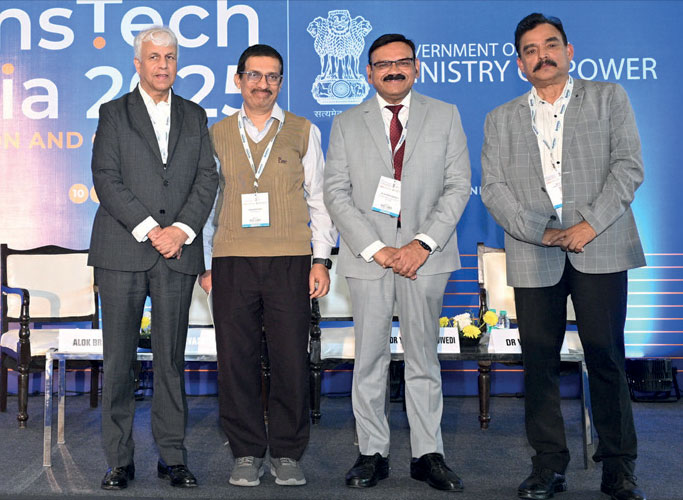
At Power Line TransTech India 2025, the session on “Skill Development for Transmission” featured a panel discussion among Dr Yatindra Dwivedi, Director, Personnel, Power Grid Corporation of India (PowerGrid); Srinivasan Ravi, Chief General Manager, HRD, TG Transco; and Dr V.K. Singh, Chief Executive Officer, Power Sector Skill Council. The discussion focused on workforce requirements arising from rapid sector growth, emerging skill gaps, and initiatives to build a sustainable talent pipeline for the transmission sector. Edited excerpts from the interaction…
Current scenario and challenges
The key challenge facing the power sector today is not attrition, but the workforce requirement that is emerging from the sheer scale and pace at which the sector is growing. As generation capacity continues to expand rapidly across the country, the transmission network is also being scaled up to keep pace. This expansion is driving a sharp increase in manpower requirements in the transmission sector. Notably, there is a need for skilled professionals who can plan, construct, operate and maintain this increasingly complex network.
While the availability of engineers is not a major constraint, skill gaps are evident in specialised areas such as undersea cabling, cybersecurity and management of renewable energy. Renewable energy assets often require night-time maintenance, adding pressure on workforce deployment. Another significant challenge is the acute shortage of ground-level manpower in the engineering, procurement and construction (EPC) contracting segment. Transmission line construction depends heavily on fitters, linesmen and technicians. These roles involve working in remote and difficult locations, frequent migration, and exposure to harsh conditions. Many trained workers also tend to exit soon after training, making mobilisation and retention difficult. For contractual construction workers, health and safety risks are also higher due to the mobile nature of the work and short project cycles.
Skill gaps are also visible in the operations and maintenance segment. While there are structured induction programmes, incidents and equipment-related issues require deeper, hands-on training for field staff, particularly in substations and line maintenance. Several state utilities are also facing the consequences of limited recruitment in earlier years and an upcoming wave of retirements, even as network size continues to expand. Moreover, younger engineers increasingly prefer urban, desk-based and IT-oriented roles, creating a mismatch with the transmission sector’s largely remote and field-based work.
Ongoing initiatives
In response to these challenges, utilities and institutions are improving their hiring, training and retention frameworks. Classroom learning is being combined with extended on-the-job training. Entry-level engineers are being trained on transmission systems, substations, construction, testing and commissioning, followed by supervised field exposure before regularisation. As a part of the skill upgradation efforts, mid-career employees receive functional, cross-functional and leadership training, in addition to mandatory e-learning when moving between roles. Training content is also evolving to reflect new technologies. Utilities are imparting training in advanced construction methods, including the use of cranes, helicopters and drones, along with focused modules on safety and cybersecurity. Large-scale programmes in artificial intelligence and machine learning are also being launched to prepare the workforce for future operational and asset management needs.
Notably, given the acute shortage at the ground level, the Power Sector Skill Council has prioritised large-scale skilling of fitters and line workers. It plans to train personnel in this area over the next two years through programmes focused on practical, site-based learning. As a part of its corporate social responsibility, the council is also mobilising unemployed rural youth, training them in transmission line erection and stringing, and linking them directly with EPC contractors.
To improve retention, facilities such as housing and connectivity are being provided at remote locations. Furthermore, utilities are strengthening health, safety and environment practices through mandatory safety training.
Through these initiatives, the transmission sector will be better positioned to meet its growing manpower and operational demands.