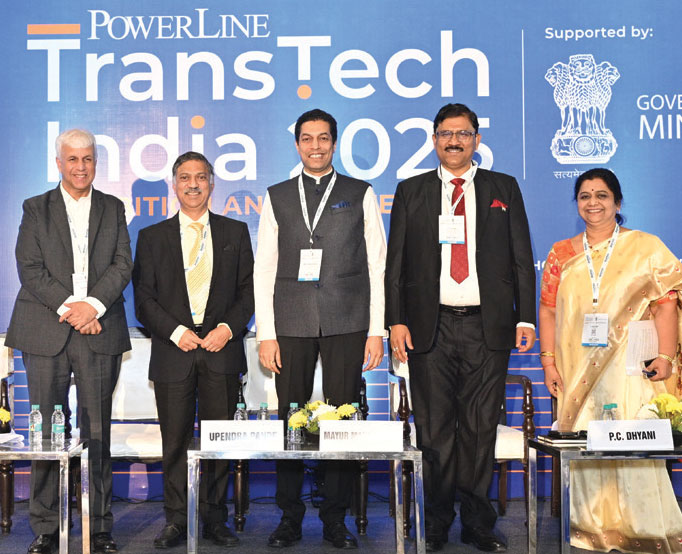
The “State Initiatives and TBCB” session at TransTech 2025 featured insights from senior leaders of state transmission utilities, including Power Transmission Corporation of Uttarakhand Limited (PTCUL), Uttar Pradesh Power Transmission Corporation Limited (UPPTCL), Gujarat Energy Transmission Corporation Limited (GETCO), and Transmission Corporation of Telangana Limited (TGTRANSCO). The panellists discussed ongoing developments, operational challenges and the major programmes being undertaken to strengthen state transmission networks. Edited excerpts…
P.C. Dhyani, Managing Director, PTCUL
Uttarakhand’s transmission sector has improved significantly in recent years, supported by strong institutional coordination, tight project monitoring and efforts to resolve long-standing bottlenecks. Earlier, transmission projects in the state faced persistent delays, weak contractor participation and unresolved staff-related issues. There has now been a broad institutional reset, with greater emphasis on HR-led grievance redressal, improved communication with field teams and renewed efforts to build a sense of ownership among employees.
Additionally, contractors have been repositioned as development partners rather than as merely executors. Regular joint reviews have helped address right-of-way (RoW), forest clearances and payment-related issues. As a result, project execution timelines have been reduced significantly. Daily project monitoring through dedicated teams for each scheme, has further improved coordination among stakeholders.
Mayur Maheshwari, Managing Director, UPPTCL
Uttar Pradesh has been undertaking major initiatives to strengthen its transmission sector amid rising energy demand. In recent years, the state has added the largest transmission capacity in the country. The roll-out of an enterprise resource planning system has helped digitalise vendor billing and payments. This has reduced delays, improved transparency and allowed vendors to mobilise equipment faster, accelerating substation and line construction.
Drone-based patrolling has improved the visibility of equipment issues. Moreover, the state transco has replaced transmission lines with high-temperature low-sag (HTLS) conductors on a large scale, enabling higher transfer capability without major RoW expansion. The state also plans to scale up its network and integrate large-scale renewables and storage. It is also installing static synchronous compensators (STATCOMs) to improve voltage stability.
Upendra Pande, Managing Director, GETCO
Gujarat has focused on improving both physical infrastructure as well as institutional capacity. Over the past 18 months, the state has commissioned more than 50 transmission lines using HTLS conductors. The state has also increased the use of monopoles and narrow-based towers to overcome land constraints and introduced integrated stack-top substations to handle high renewable penetration.
The rapid growth of solar power has altered load patterns and created daytime surpluses. Gujarat has addressed this by supplying surplus solar energy to agricultural feeders during the day, aligning demand with generation. Looking ahead, peak demand is expected to rise significantly by 2035. To support this, the state plans large-scale additions of substations and transmission lines, with investment requirements of over Rs 1,500 billion by 2035.
D. Latha Vinod, Director, Projects, TGTRANSCO
Telangana is simultaneously strengthening urban and rural networks in response to rising renewables, industrial growth and agricultural demand. Gas-insulated substations are being deployed in dense urban areas, while monopoles are planned along key ring road corridors. Large-scale reconductoring with HTLS conductors is also underway, especially where substation expansion space is limited. Project execution is being accelerated through drone-based surveys and AI-enabled tools.
However, delays in the supply of breakers, transformers and other equipment is affecting project timelines. The rapidly changing load profile is adding further pressure.
Looking ahead, Telangana plans to expand transformation capacity, scale up solar and decentralised generation, and deploy pumped storage, battery systems and solutions such as STATCOMs, reactors and enhanced capacitor banking to maintain system stability.