
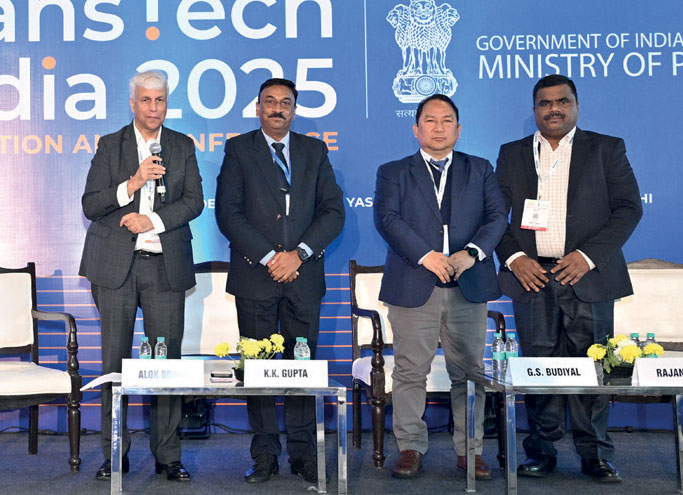
G.S. Budiyal, Director (Operations), Power Transmission Corporation of Uttarakhand Limited (PTCUL); K.K. Gupta, Executive Director, Power Grid Corporation of India Limited (PowerGrid); and Rajan M.P., Chief Engineer, Kerala State Electricity Board (KSEB) shared their insights on procurement scale, supply chain constraints, and execution challenges at Power Line TransTech India 2025. The discussion focused on rising capital expenditure, equipment availability, manpower shortages, cost pressures, indigenisation priorities and evolving procurement practices in the transmission sector. Edited excerpts…
India’s transmission sector is undergoing rapid expansion, driven by large-scale renewables integration and rising electricity demand. This growth has significantly increased procurement volumes, while exposing structural challenges in equipment supply, skilled manpower availability and project timelines.
Scale of procurement
PowerGrid currently handles an annual capital expenditure of Rs 200 billion-Rs 300 billion. This level of investment has remained consistent in recent years and is expected to continue, or even rise, at least until 2030. Procurement is largely focused on 765 kV and 400 kV transmission lines and substations, HVDC transmission lines and converter stations, STATCOM projects for reactive power compensation, synchronous condensers and associated transmission equipment.
While manufacturing capacity for most transmission equipment has improved, the sector is facing a fundamental shift in project timelines. Renewable energy generation projects now come online within a year, whereas transmission systems face inherent constraints such as right-of-way issues, land acquisition challenges, forest clearances, and cross-country construction requirements. Even with process optimisation, transmission project gestation periods cannot realistically be compressed to below two years. This mismatch has intensified pressure on supply chains and project execution.
Issues and challenges
Today, not only is equipment availability a challenge but so is the shortage of skilled manpower. While manufacturing capacity can be expanded through capital investment, skilled manpower development requires time and effort. Transformers and reactors were equipment of concern a few years ago and were subject to price escalations and supply delays. With government intervention, this situation has stabilised. Powergrid has adopted advance and bulk procurement of transformers and reactors, even ahead of project awards, to smoothen supply and reduce uncertainty.
Gas-insulated switchgear (GIS), particularly gas-insulated bus ducts, remain a concern due to limited domestic manufacturing capacity. HVDC systems are another critical bottleneck, as global suppliers are few and often unable to execute multiple large projects simultaneously. Additional constraints arise from technology-specific limitations for voltage source converters and line-commutated converters. STATCOMs also face supply pressures due to limited manufacturers and rising demand. Cost escalation remains a concern, especially for transformers and reactors, where prices have increased sharply over the past years. This has been partly driven by higher copper prices.
State transmission utilities face similar constraints, albeit on a smaller scale. To address this, utilities are bundling projects into larger EPC packages to attract major players. State utilities also experience extended delivery timelines, particularly for large transformers, GIS equipment and breakers. They also faces difficulties competing with bigger utilities that are bulk buyers. To improve bidder participation, utilities have relaxed EPC contract conditions, revised payment terms, reduced bank guarantees and ensured quicker payments.
The way forward
Indigenisation and the Make in India initiative are increasingly important for the transmission sector. Powergrid has developed indigenous 1,200 kV tower designs and established testing facilities, although commercial manufacturing has yet to scale up due to limited demand. Payment timelines have also improved significantly.
Overall, addressing procurement challenges in the transmission sector will require coordinated efforts across equipment manufacturing, skilled workforce development, standardisation of specifications, and sustained indigenisation to support India’s power system.