

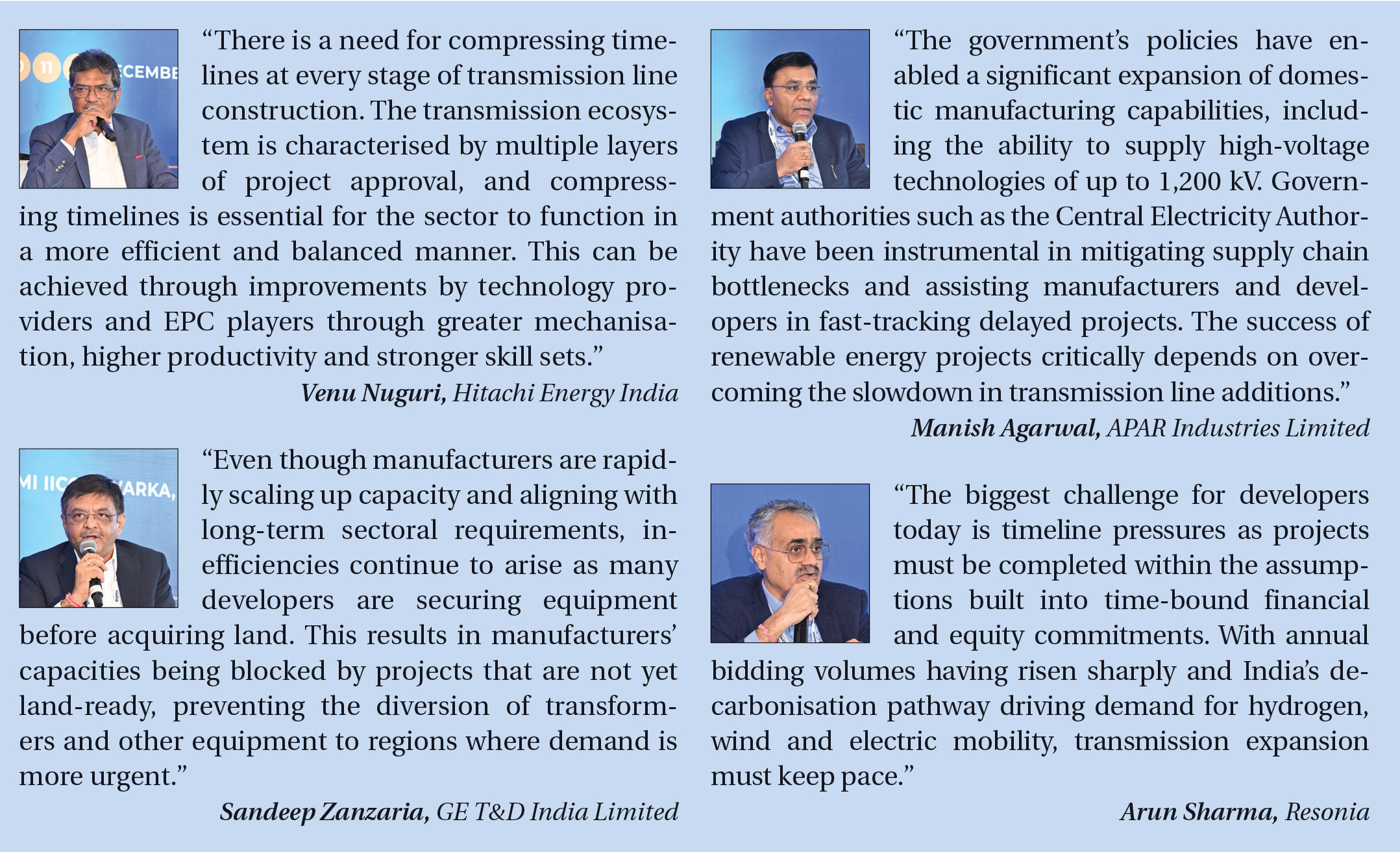
In a panel discussion among Manish Agrawal, Chief Executive Officer (CEO), Conductors and Telecom Businesses, APAR Industries Limited, and Managing Director (MD), APAR T&D Projects Private Limited; Venu Nuguri, MD and CEO, Hitachi Energy India; Arun Sharma, CEO, Resonia; and Sandeep Zanzaria, CEO and MD, GE T&D India Limited, critical issues facing the sector, such as right-of-way constraints and the need for faster project execution, were discussed. The panellists highlighted how digitalisation, advanced technologies such as monopoles and gas-insulated substations, and policy reforms could help bridge infrastructure gaps in the transmission sector. Edited excerpts…
Efficient evacuation of renewable power has become central to the viability of the clean energy sector, underscoring the need for timely strengthening of the transmission network. While generation capacity continues to scale rapidly, delays in transmission development could create stranded assets and undermine investor confidence.
One of the most effective pathways to rapidly enhance grid capacity is through augmenting existing transmission corridors. Given India’s high population density and limited land availability, reconductoring and uprating of already-built lines offer a cost-effective and time-efficient alternative to developing new corridors. Several transmission assets in the country have been in operation for four to five decades, making their upgradation essential, not only for capacity enhancement but also for long-term reliability and safety.
Right-of-way constraints remain a persistent challenge across both greenfield and brownfield transmission projects. Land acquisition complexities, social resistance and procedural delays continue to impact project timelines and costs. To mitigate these constraints, utilities are increasingly being encouraged to adopt advanced design and construction solutions. Technologies such as monopoles, insulated cross-arms and compact tower configurations can significantly reduce land requirements while enabling higher power transfer capacity.
Another important dimension in transmission planning is greater consideration of technical losses during project evaluation. Loss capitalisation remains underutilised in current procurement frameworks, despite its potential to influence long-term system efficiency and emissions reduction. By explicitly accounting for losses and incorporating them into project evaluation, utilities can justify the adoption of conductors and equipment with higher current-carrying capacity and lower resistive losses within the same physical footprint.
Technology adoption
Digital transformation is expected to be a key driver of change in the transmission sector. As renewable energy penetration increases, grid operations are becoming more complex and less predictable. Real-time visibility of power flows, supported by advanced forecasting tools and digital monitoring platforms, is becoming essential for maintaining system stability. Asset performance management systems are being deployed to monitor the health of critical equipment such as transformers, circuit breakers and transmission lines, enabling predictive maintenance and reducing unplanned outages.
Artificial intelligence and data analytics are playing a growing role in grid management. Integrated digital platforms that combine generation, transmission and distribution data are improving forecasting accuracy and demand management. These systems allow operators to respond proactively to changing grid conditions, optimise asset utilisation and enhance overall reliability.
Project execution timelines have emerged as a central concern for the sector. Historically, the transmission industry has experienced cyclical phases of excess capacity and subdued demand. While the current environment is characterised by high demand and perceived supply shortages, many of the underlying challenges stem from legacy planning and execution processes. Lengthy approval cycles, extended bidding timelines and prolonged construction periods continue to delay project commissioning and create systemic inefficiencies.
Compressing timelines across all stages of project development is, therefore, essential to improve sectoral efficiency. This requires coordinated action across stakeholders, including technology providers, engineering, procurement and construction (EPC) players, and policymakers. Greater mechanisation, productivity improvements and workforce upskilling can help reduce execution durations at the site level, while process reforms can help streamline approvals and bidding.
An emerging driver reshaping transmission demand is the rapid growth of data centres and digital infrastructure. Facilities that once operated at modest capacities are now moving towards gigawatt-scale deployments at single locations. Artificial intelligence workloads are contributing to sharp, momentary demand spikes that significantly increase energy requirements. Data centre-driven demand also has implications for equipment requirements. Such facilities typically require substantially higher transformer capacity and redundancy compared to conventional loads.
While interstate transmission systems have seen significant expansion, intrastate networks, particularly those below the extra-high voltage level, will require greater investment going forward, to support distributed renewable generation and emerging loads. Multi-year planning visibility is critical in this context, enabling technology providers and EPC players to prepare for upcoming requirements and align manufacturing capacities accordingly.
Challenges and outlook
Project timelines and financing constraints remain closely intertwined. Project delays can have significant financial implications, particularly in an environment where demand for transmission capacity has risen sharply over the past three years.
Conventional construction methods alone may be insufficient to meet the requirements of new transmission infrastructure. To this end, reducing man-hours and execution durations through advanced technologies, mechanisation and improved planning will be essential.
The rise of electric mobility is also reshaping demand patterns, with “green electrons” increasingly flowing through state-level networks. This trend underscores the need for states to upgrade their transmission infrastructure, potentially through public-private partnership models. Experiences in certain states demonstrate that such models can accelerate asset creation while leveraging private capital and expertise.
The transmission market is expected to grow significantly over the next three to four years, driven by large-scale investments in digital infrastructure and data centres. With rising renewable penetration, grid stability will depend heavily on robust static and dynamic compensation systems, grid-forming inverters, and storage-linked solutions.
Overall, the outlook for India’s transmission sector remains positive. However, translating this potential into timely infrastructure delivery will require faster execution, deeper technology adoption, improved coordination across stakeholders, and a sustained focus on quality, safety and workforce capability.


