

The Central Electricity Regulatory Commission (CERC) has issued a staff paper to address the concern of connectivity granted through the letter of award (LoA) route, where the signing of power purchase agreements (PPAs) or power sale agreements (PSAs) is being delayed. The staff paper examines the growing quantum of such connectivity and its impact on the utilisation of the interstate transmission system, and proposes a framework for freeing up and reallocating stranded connectivity.
The LoA route permits connectivity to be granted based on an LoA issued by a renewable energy implementing agency, with the expectation that a PPA or PSA will be signed subsequently. In practice, project execution typically begins only after signing of the PPA or PSA. Delays in the execution of PPAs have, therefore, resulted in connectivity granted under the LoA route remaining unutilised for extended periods, even as the associated transmission systems are commissioned or under implementation. This has led to suboptimal utilisation of transmission assets and constrained availability of connectivity for projects that are ready for execution.
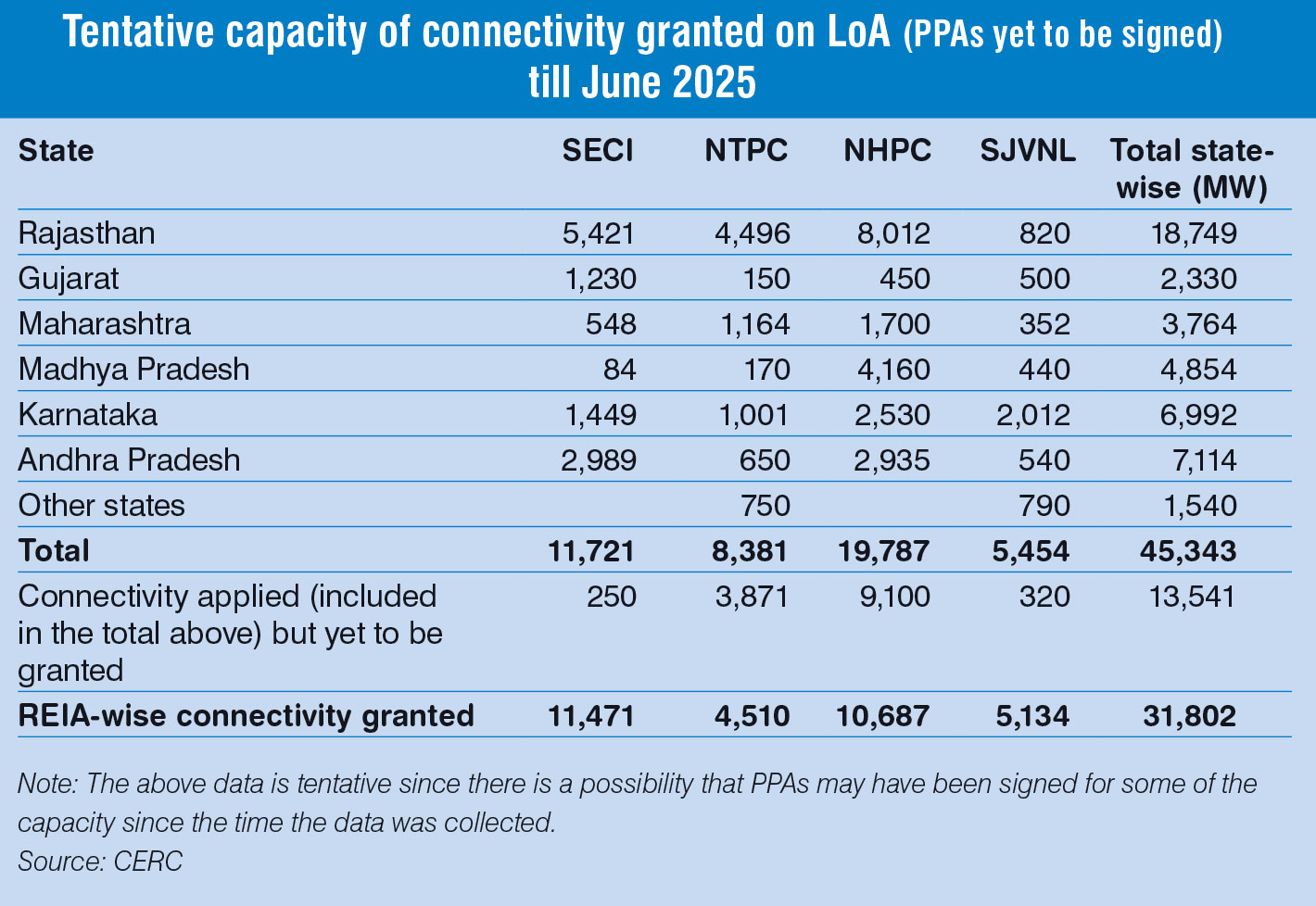
As per data compiled by the CERC from renewable energy implementing agencies, as of June 2025, connectivity for around 31.8 GW had been granted on the basis of LoAs for which PPAs were yet to be signed. After including applications that were submitted but not yet granted connectivity, the total quantum rose to about 45.34 GW.
This stranded connectivity is primarily concentrated of Rajasthan, Karnataka, Andhra Pradesh, Maharashtra, Madhya Pradesh and Gujarat. These states account for a significant share of both existing and planned renewable energy capacity and house major transmission corridors developed to evacuate power from renewable energy zones.
Transmission infrastructure is capital-intensive due to long planning and implementation timelines. When generation projects linked to such infrastructure are delayed, the resulting underutilisation leads to inefficiencies in cost recovery. Transmission charges are socialised among users, and underutilised assets ultimately increase the burden on consumers.
At the same time, developers with signed PPAs and the readiness to execute projects are unable to obtain connectivity at suitable locations because existing capacity is already allocated under the LoA route.
Proposed framework
Based on stakeholder inputs and system-level considerations, the CERC staff paper proposes a structured framework for addressing connectivity granted on the LoA route where PPA signing has been delayed beyond 12 months. The proposals aim to balance the need for fairness to developers with the imperative of ensuring optimal utilisation of the transmission system. Entities falling under this category would be required to opt for one of three options within a defined period.
Option 1: The first option allows an entity to exit the LoA route without surrendering connectivity. Under this option, the original LoA would cease to be a valid document for obtaining connectivity, and the developer would be required to furnish an additional performance bank guarantee of Rs 10 lakh per MW. Existing connectivity bank guarantees would remain valid. The scheduled commercial operation date would be capped at 18 months from the date of conversion, while the firm start date of connectivity would remain unchanged. Developers opting for this route would be required to submit land documents within 12 months and achieve financial closure within 15 months. Delays in meeting these milestones would attract milestone extension charges, and failure to meet the extended timelines would result in revocation of connectivity and encashment of applicable guarantees. This option is intended to allow serious developers to proceed with project execution, including on a merchant or alternative offtake basis, while imposing clear accountability for timelines.
Option 2: The second option permits the substitution of the LoA under which connectivity was granted with a PPA signed under another LoA. This option addresses situations where developers have secured PPAs under different bids but face connectivity constraints at the required locations. Substitution would be allowed subject to conditions, including that the firm start date of connectivity under the substituted PPA is at least six months later than the original connectivity start date. The PPA could be signed by the connectivity applicant, its parent company, its subsidiary, or another subsidiary of the same parent company, subject to no-objection certificates from the concerned implementing agencies. Financial closure and commissioning timelines would thereafter be aligned with the substituted PPA. Failure to meet milestones would result in revocation of connectivity and treatment of bank guarantees as per existing regulations.
 Option 3: The third option provides for an exit from connectivity altogether. Entities choosing this route would be required to surrender connectivity to CTUIL. In such cases, Conn-BG1 would be encashed, while Conn-BG2 and Conn-BG3 would be returned, subject to applicable sharing charges.
Connectivity not opted for under any of the three options within the prescribed period would be deemed surrendered. Vacated connectivity would then be reallocated through an auction mechanism. Auctions would be conducted by CTUIL or a designated agency using an established bidding platform. The proposed base price for the auction is Rs 0.3 million per MW, reflecting the cumulative bank guarantee exposure under existing regulations. Minimum bid sizes of 50 MW are proposed, along with strict timelines for commissioning, the submission of land documents, and the achievement of financial closure.
Different auction modalities have been proposed, depending on whether the associated substation is operational, under construction with commissioning expected within 12 months, or at the planning stage. Winning bidders would be required to furnish performance bank guarantees and comply with milestone requirements, with penalties or revocation applicable in case of delays.
The way forward
In addition to addressing legacy connectivity granted under the LoA route, the staff paper examines the options for future connectivity allocation. One proposal is to discontinue the LoA route altogether and allow connectivity only against signed PPAs under government competitive bidding guidelines. The rationale is that developers typically commence project execution only after PPA signing, and LoAs may not serve a meaningful purpose in securing timely utilisation of transmission infrastructure.
Another proposal is to move to a fully auction-based mechanism for granting connectivity in the future. Under this approach, all existing routes for connectivity allocation would be done away with, and connectivity would be awarded through auctions with firm commissioning commitments. Financial closure would be required at least six months before the declared commercial operation date, and land documents would need to be submitted in line with defined milestones.
Both approaches are aimed at ensuring that connectivity is allocated only to committed projects with a high likelihood of timely commissioning. By treating connectivity as a scarce resource and linking its allocation to firm execution timelines, the proposed framework seeks to improve transmission utilisation and reduce system-level inefficiencies.
Overall, the staff paper highlights the need for a more disciplined approach to connectivity allocation as renewable energy capacity scales up. While recognising that delays in PPA signing are not always within the control of developers, it underscores that transmission capacity cannot remain blocked indefinitely. The proposed mechanisms aim to strike a balance between flexibility for developers and the broader objective of efficient and timely use of the transmission system, with stakeholder feedback expected to shape the final regulatory approach.
Aastha Sharma