Grid Controller of India Limited (GRID-INDIA) has released a discussion paper examining the possible applications of grid-forming (GFM) inverter technology in the Indian power system. As India moves towards its target of achieving 500 GW of non-fossil capacity by 2030, the power sector is witnessing a shift from conventional synchronous generators to inverter-based resources (IBRs) such as solar, wind and battery storage. While this is essential for meeting national climate and energy goals, it also brings challenges, particularly related to voltage stability and system response during grid disturbances. These issues underscore the need to evaluate advanced technologies that can support reliable grid operation under conditions of high renewable energy penetration.
GFL vs GFM inverter technology
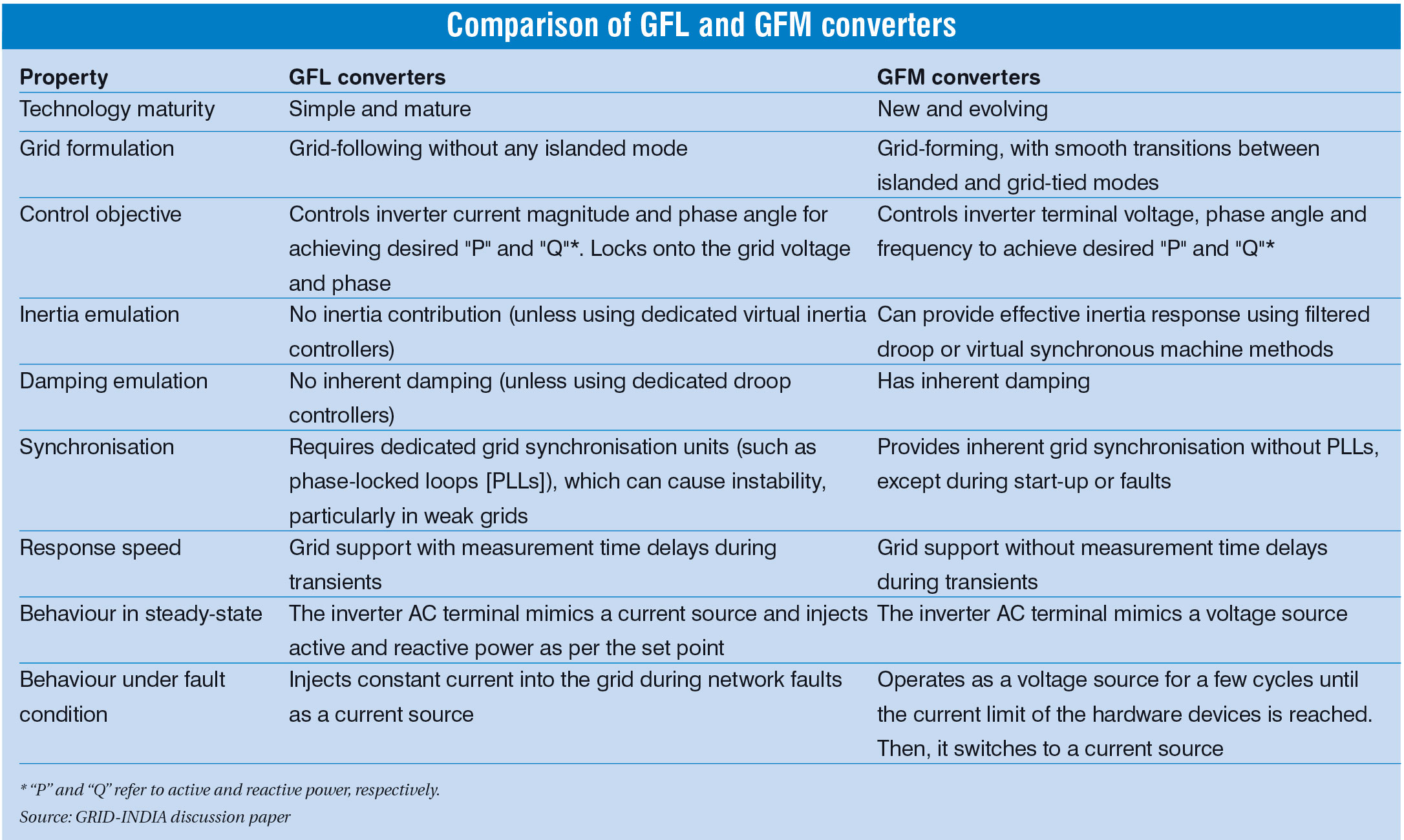
Most renewable energy plants in India are currently connected to the grid using grid-following (GFL) inverters. These inverters synchronise with the existing grid voltage and frequency and inject power based on these external references. This approach has facilitated large-scale renewable energy integration, particularly in systems where grid strength is high, and conventional synchronous generators continue to provide stable voltage and frequency. However, because GFL inverters depend on an external voltage reference, their performance can deteriorate under weak grid conditions or in systems with a high share of IBRs.
To address this attention is now being directed towards GFM technology. Unlike GFL inverters, GFM inverters operate as controllable voltage sources. Rather than relying on the grid for voltage and frequency references, they can establish and regulate these parameters independently. As a result, GFM inverters are better suited for operation in weak grids and low-inertia systems, where they actively contribute to building and sustaining system strength instead of merely following existing grid conditions.
Key features of GFM inverters
One of the defining capabilities of GFM inverters is their ability to operate in islanded modes. Even in the absence of synchronous generators, they can independently establish and regulate voltage and frequency, enabling the formation of stable and self-sustained microgrids. This capability also supports black-start operation, allowing GFM inverters to energise a de-energised network after a widespread outage. In addition, it enables seamless transitions between grid-connected and islanded modes of operation. During grid disturbances, a local network can disconnect from the main grid and continue operating without interruption, as the inverter maintains stable voltage and frequency. Once normal grid conditions are restored, reconnection can occur smoothly without causing instability.
Additionally, GFM inverters contribute to frequency stability in low-inertia power systems. As a result, they are capable of providing essential grid services, including primary and secondary frequency control, reactive power support and damping of power system oscillations. However, many of these functions depend on the availability of a power reserve, since the inverter must be able to rapidly adjust its output to stabilise the system. For this reason, GFM inverters are commonly deployed with battery energy storage systems (BESSs).
Simulation-based study results
A simulation-based study using an all-India power system model evaluated the impact of introducing GFM inverters under different grid conditions, with a focus on renewable energy complexes in Rajasthan. The study identified several benefits associated with GFM deployment:
- Better performance in weak grids: While GFL inverters can become unstable when grid strength is low, GFM inverters remain stable and support reliable grid operation.
- Better voltage stability: During grid disturbances, GFM inverters improve voltage performance through effective reactive power response and inherent damping. This helps reduce the severity of voltage dips during faults and limit post-fault voltage spikes.
- Faster recovery after disturbances: In scenarios involving multiple line outages or delayed recovery from GFL-based plants, GFM technology accelerates active power recovery and reduces the risk of transmission overvoltage.
- Stronger frequency response: By emulating inertia, GFM inverters respond rapidly to frequency deviations. This rapid response lowers the rate of change of frequency (RoCoF), particularly near disturbance locations, and helps prevent cascading outages.
- Impact of placement strategy: The effectiveness of GFM deployment depends on where the inverters are installed. Distributing GFM capability, rather than concentrating it at a single node, provides wider improvements in voltage performance and RoCoF across the system.
- Scalable benefits with higher penetration: The study indicates a positive relationship between GFM penetration and overall system performance. Higher levels of deployment are associated with improved voltage stability, faster fault recovery and reduced RoCoF.
Importantly, the results show that the benefits of GFM technology are not uniform across the system. They are most pronounced in weak grid areas and regions with high IBR penetration, suggesting that targeted deployment is likely to deliver greater value than a uniform, system-wide roll-out.
The way forward
GFM technology is already being deployed in several countries, including Australia, Great Britain, the US and the Middle East. This highlights the need for well-defined functional specifications and rigorous performance validation to ensure consistent implementation across different power systems. Recognising this, many system operators, research institutions and regulatory bodies have published technical requirements and guidelines for GFM capabilities. Continued research in this area is expected to further drive progress toward international standardisation and enable the smoother integration of IBRs. These international developments also provide useful reference points for the evolution of India’s grid codes and technical standards.
GRID-INDIA has proposed a set of measures to support the adoption of GFM technology in the Indian power system. Given the growing role of BESS, it is recommended that new BESS installations above 50 MW, particularly in remote or weak-grid areas, incorporate GFM capability. A phased roll-out is suggested, beginning with large pilot projects using BESS-backed GFM inverters. These pilots would provide operational experience and help stakeholders make informed decisions for wider deployment. In parallel, aligning Indian standards with international testing and performance frameworks, would help ease the transition.
Effective implementation will also require close coordination between technology providers, renewable and storage developers, system operators and regulators. This is essential to ensure that different technologies interact safely and reliably within the grid. Looking ahead, further research may also focus on the conversion of existing GFL inverters to GFM operation, standardisation of equipment and development of technical specifications for black-start applications. The paper also emphasises the need to integrate fault recording and sequence-of-events recording within GFM inverters to allow detailed assessment of control performance during disturbances. In addition, it calls for stronger compliance verification, improved model transparency and targeted stability studies in weak-grid areas.
At present, the primary focus remains on inverter-level applications in solar, wind and BESS. However, future studies may also explore the application of GFM concepts at the transmission level, including their use in static synchronous compensators and high-voltage direct current converter stations. Overall, the discussion paper outlines a structured roadmap for the adoption of GFM inverter technology in India, marking an important step toward a more stable and resilient power system increasingly characterised by high renewable energy penetration.