
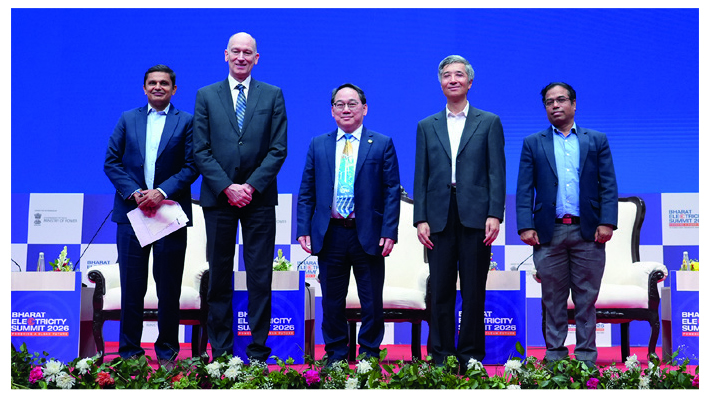
 At BES 2026, the session on “AI for Power and Power for AI: Revolutionising performance, upgrading distribution and elevating grid intelligence” featured insights from Gerhard Salge, Global Chief Technology Officer, Hitachi Energy; Dr Kwok Wai Ma, Senior Director, Industrial and Infrastructure, Infineon Technologies; Jogendra Behera, Head, Policy, Regulatory and Non-Utility Markets, Apraava Energy; and C.Y. Chung, President, IEEE Power and Energy Society. It was moderated by Prabhav Sharma, Partner, McKinsey and Company. The discussion focused on the convergence of artificial intelligence (AI) and electricity systems to enhance grid performance, distribution efficiency and overall system intelligence. Edited excerpts…
Power systems are undergoing a significant transformation as they become more complex and dynamic. At the core of this transformation is a structural shift in how power systems are built. Traditional grids, based on copper and iron, are gradually being replaced by systems dominated by power electronics. This transition has been under way for the past two to three decades, driven by the growth of renewable energy sources such as solar and wind, advancements in transmission technologies such as high voltage direct current, and rising electricity demand from applications such as electric vehicles.
Unlike conventional synchronous systems, these new systems are largely converter-interfaced. They operate with faster response times and rely on power electronics for interaction with the grid. While this makes them smaller, lighter and more efficient, it also creates a fundamental challenge, as conventional grids are not designed to accommodate such fast and highly dynamic components. As a result, power systems must increasingly manage high levels of variable renewable energy. In some regions, solar generation can exceed demand during certain hours, requiring careful management of power flows. At the same time, maintaining voltage and frequency stability becomes more complex in systems with high renewable penetration.
To address these challenges, advanced technological solutions are being deployed. These include the intelligent control of converters, which plays a central role in managing power flows, and grid-forming technologies, which are emerging as critical tools for maintaining system stability. These can be implemented within converters or alongside energy storage systems such as batteries and supercapacitors.
Focus on automation
As system complexity increases, automation is becoming essential. Modern power systems rely on a closed-loop framework involving sensors, communication networks and control systems, enabling continuous monitoring and response. To fully utilise this framework, a robust overall architecture is required, along with the integration of intelligence through AI.
This supports applications such as modelling power system components and developing digital twins using real-time data. However, automation and AI cannot function in isolation. They must be co-designed with generation, transmission and digital networks to ensure cost-effective and efficient system operation.
Several use cases of AI are already being implemented. These include generation forecasting, which is critical for grid management and increasingly important for demand-side management. AI is also being used in internet of things-based predictive maintenance to reduce operations and maintenance costs and extend asset life.
Challenges and the way forward
Despite these advancements, scaling AI remains a challenge. While pilot projects have shown promising results, transitioning to fully operational models at scale remains difficult. This is further complicated by the dynamic nature of power systems, which requires continuous calibration of AI models to maintain effectiveness.
Nevertheless, as the sector evolves, AI is expected to play a growing role in hybrid projects involving multiple technologies, particularly in optimising battery charge and discharge decisions. It will also support resource management and participation in complex market mechanisms, including pricing.
Going forward, the effective integration of AI and automation will depend on the development of robust system architecture, the embedding of intelligence within operational frameworks and the ability to scale solutions. Achieving this will require a strong focus on standardisation and interoperability to ensure long-term success.