India’s power sector is undergoing a period of rapid transition, driven by rising electricity demand, large-scale renewable energy integration and the need to improve the financial sustainability of utilities. In this evolving landscape, electricity regulators play a central role in ensuring reliable supply, maintaining financial discipline in the sector and protecting consumer interests.
The Power Foundation of India, in collaboration with REC Limited, has released a comprehensive assessment titled the “Rating of Regulatory Performance of States and Union Territories”. The report provides a structured evaluation of the functioning of electricity regulatory commissions across India. By benchmarking regulatory outcomes and identifying best practices, the study seeks to strengthen accountability and encourage improvements in regulatory processes across states and union territories (UTs).
The rating exercise assesses the performance of electricity regulators on a 100-point scale, based on a set of measurable parameters linked to sectoral outcomes. The assessment draws upon verifiable regulatory documents such as tariff orders, true-up orders, regulations and other directives issued by state commissions up to mid-2025. The findings highlight significant variations across states and UTs in terms of regulatory performance. While several regulators have demonstrated strong governance practices, timely tariff determination and proactive policy frameworks, others continue to face challenges in areas such as financial oversight, long-term planning and energy transition readiness.
Framework for assessment
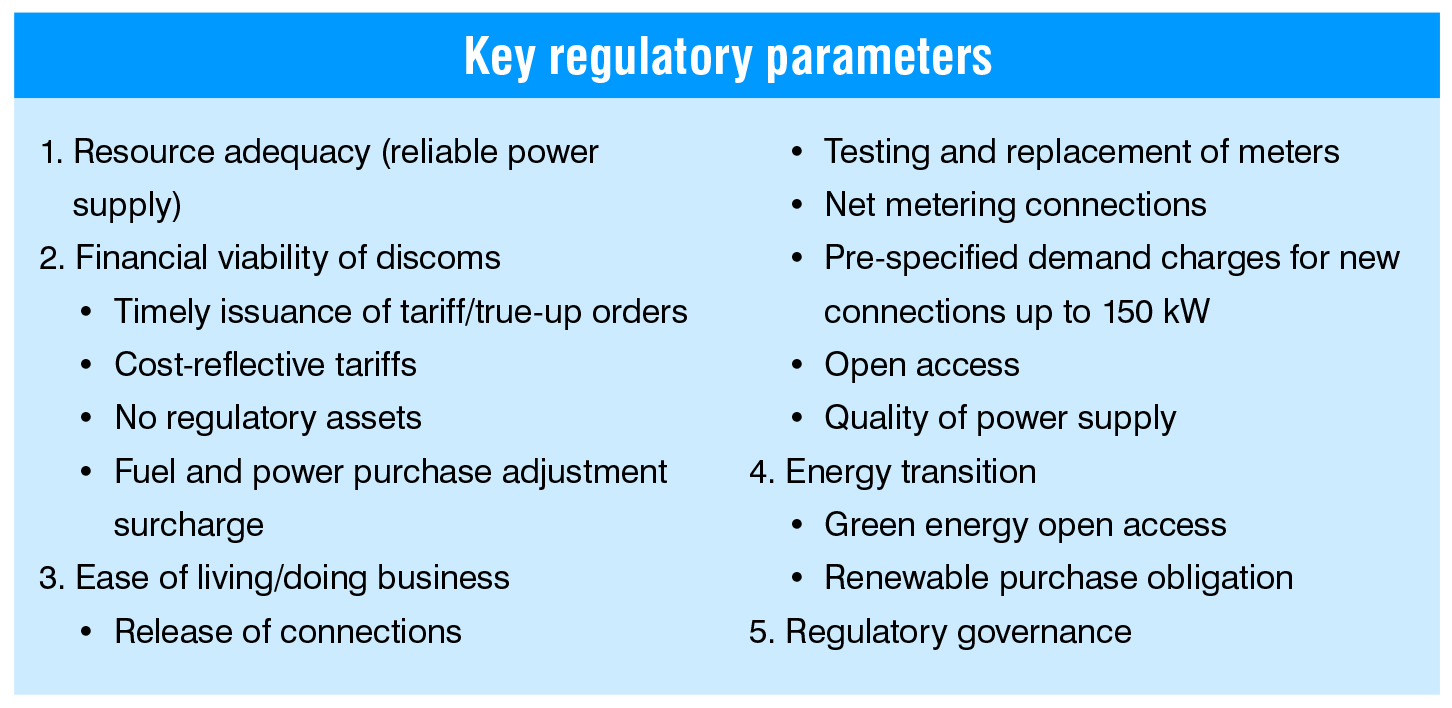
The evaluation framework adopted in the report is built around five key pillars that capture different dimensions of regulatory performance. These include resource adequacy (32 marks), financial sustainability (25 marks), ease of living and doing business (23 marks), energy transition (15 marks) and regulatory governance (5 marks). The report categorises states and UTs into different performance grades based on their overall scores.
 Overall performance trends
The overall ranking of regulators shows a mix of strong performers and lagging jurisdictions. Among the top-performing states, Punjab emerged as the highest-ranked regulator in the country, followed closely by Karnataka and Maharashtra. Other high-performing jurisdictions include Assam and Arunachal Pradesh, which also recorded strong overall scores in the assessment. At the other end of the spectrum, some states recorded significantly lower scores in the overall ranking. Tripura emerged as the lowest-ranked jurisdiction in the assessment, followed by Rajasthan, Delhi, Uttar Pradesh and Jammu & Kashmir.
The wide variation in scores across states highlights the uneven pace of regulatory development in the country. While some regulators have adopted best practices and strengthened institutional frameworks, others continue to struggle with structural and operational challenges.
Resource adequacy
Resource adequacy is a critical aspect of power sector regulation, as it determines whether adequate generation capacity will be available to meet future demand while maintaining system reliability. Regulators play an important role in approving long-term procurement plans, evaluating demand projections and ensuring that utilities maintain sufficient reserves.
Assam, Arunachal Pradesh, Madhya Pradesh, Haryana, Karnataka, Maharashtra, Mizoram, Jharkhand, Meghalaya and Punjab emerged as the top performers in the resource adequacy category, achieving the highest scores in the evaluation. Rajasthan and Tripura recorded the lowest scores in this category, indicating potential shortcomings in regulatory oversight of long-term supply planning. Other states/UTs such as Uttar Pradesh, Delhi and Jammu & Kashmir also recorded relatively low scores, suggesting the need for stronger planning frameworks.
Financial sustainability
The financial sustainability pillar of the assessment evaluates the role of regulators in addressing the challenges facing the distribution companies through tariff determination, true-up processes and regulatory oversight of utility finances. States such as Assam, Arunachal Pradesh, Himachal Pradesh, Gujarat and Mizoram emerged as the top performers in this category. These regulators have taken proactive measures to improve cost recovery and enforce financial discipline through regulatory processes. In contrast, Delhi recorded the lowest score in the financial sustainability category, followed by Rajasthan and Puducherry. Tripura and Goa also ranked among the weaker performers.
Ease of doing business and consumer services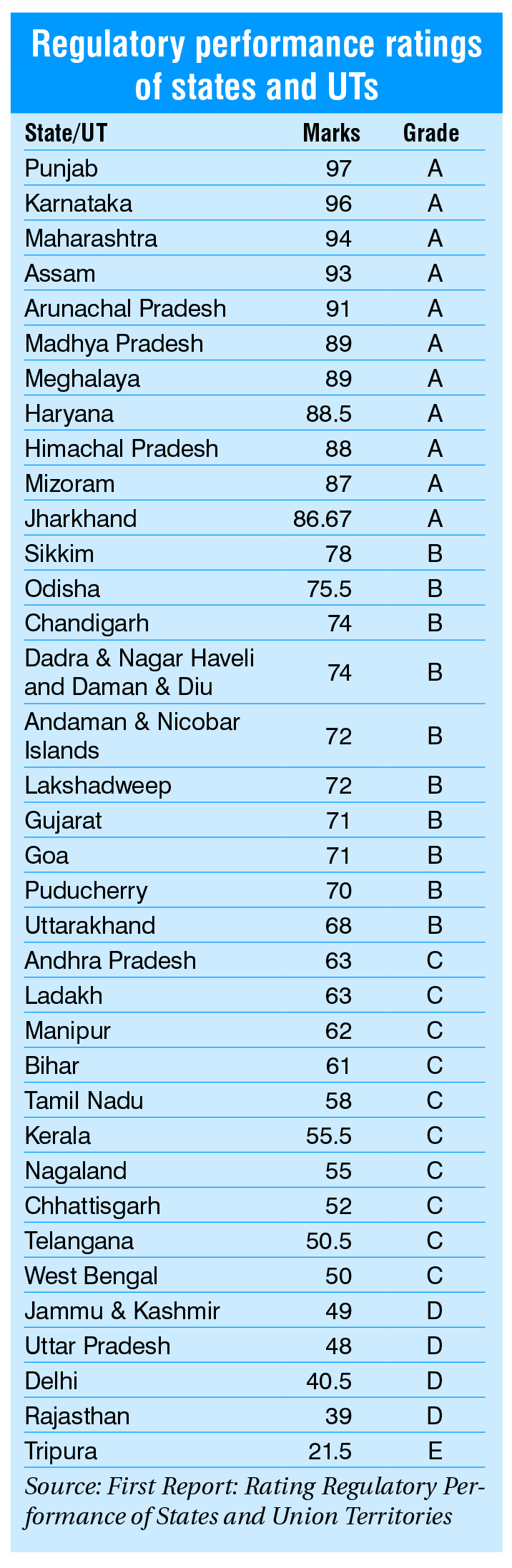
Another important dimension of regulatory performance relates to consumer services and the ease of accessing electricity. Efficient regulatory processes can significantly improve the experience of consumers and businesses by simplifying procedures for obtaining electricity connections and ensuring timely grievance redressal.
In this category, Punjab emerged as the leading performer, reflecting strong regulatory initiatives aimed at improving consumer services and regulatory transparency. Chhattisgarh and Karnataka also ranked among the top performers, demonstrating effective regulatory frameworks that facilitate easier access to electricity services. Other states, such as Rajasthan and Madhya Pradesh, also recorded strong performance in this category. However, several states continue to face challenges in this area. Tripura recorded the lowest score in the ease of doing business category, followed by Telangana. Ladakh, Jammu & Kashmir and Mizoram also ranked among the weaker performers.
Energy transition
The report indicates that several states have taken proactive steps towards facilitating the energy transition. Andhra Pradesh, Arunachal Pradesh, Assam, Chandigarh and Uttarakhand, among others, have achieved the highest scores in the energy transition category, reflecting strong regulatory support for renewable energy deployment and integration. At the same time, some states/UTs lag behind in terms of regulatory frameworks for clean energy. Nagaland, Sikkim and West Bengal recorded the lowest scores in this category, while Chhattisgarh and Tripura also performed relatively weakly. Strengthening regulatory mechanisms for renewable energy integration will be crucial as India accelerates its clean energy transition.
Regulatory governance
Regulatory governance forms the foundation of effective electricity regulation. Transparent decision-making processes, timely issuance of orders and stakeholder engagement are essential for ensuring credibility and efficiency in regulatory institutions.
The assessment shows that many regulators performed well in this category, with several states and UTs achieving the maximum score. These include the Andaman & Nicobar Islands, Andhra Pradesh, Arunachal Pradesh, Assam and Chandigarh. Strong institutional processes and transparency measures have contributed to higher scores in these jurisdictions. However, Tamil Nadu and Tripura recorded the lowest scores in regulatory governance, indicating potential gaps in institutional functioning and regulatory processes.
Conclusion
As the power sector continues to evolve, regulators will need to address emerging challenges such as large-scale renewable energy integration, energy storage deployment and the increasing digitalisation of power systems. Strengthening regulatory capacity and improving institutional processes will therefore be essential. The rating exercise is intended not as a competitive ranking but as a benchmarking tool that enables regulators to compare their performance with peers and identify areas for improvement. By highlighting best practices and encouraging greater transparency, the assessment aims to promote stronger regulatory frameworks across the country.
As India moves towards a more complex and dynamic electricity system, the role of regulatory institutions will become even more critical. Ensuring consistent and effective regulation across states will be key to supporting the country’s energy transition, attracting investment in the power sector and delivering reliable electricity services to consumers.
Aastha Sharma