
Today, 45 per cent of all electricity is converted into motion by motors in industries and commercial buildings. The integral optimisation of electric-motor-driven systems, including the use of high-efficiency, well-sized components is the key strategy to effectively maximise their overall efficiency.
Equipment is designed and sized accounting for various contingencies and extreme scenarios, resulting in under-utilisation of their capacities during normal operation. Though the higher cost of purchase for oversized equipment is justified, most of the equipment, including motors, has low efficiency in part loads. While the standards continue to focus on rated load efficiency, any attempt to improve the part load efficiency also majorly contributes towards energy savings.
Using variable frequency drives (VFDs) has helped mitigate this problem to a large extent by running the loads at desired duty points without mechanical controls such as valves and dampers. This is also saving tremendous amount of energy from the driven equipment perspective.
Advanced motor technologies such as Synchronous Reluctance Motors (SynRM) and Permanent Magnet Assisted Synchronous Reluctance Motors (PMASR) allow improving energy efficiency of many industrial applications, even at part loads. Considering the motors for variable torque loads operated with VFDs, it has been proven that SynRM motors outperform induction motors in achieving better efficiencies at part loads.
Ongoing innovation in AC motor technology is driven by several factors, including increased focus on lifetime cost reduction, electric vehicle boom, material sustainability concerns and IE4/IE5 mandates. The market is shifting from traditional AC induction motors towards high-efficiency and specialised synchronous alternatives, which achieve higher efficiency levels, including SynRM and PMASR motors.
Integration of sensors and edge-AI modules
Integration of sensors and edge-AI modules is a significant trend in the global motors and drives market, driven by several factors – the need for real-time operational efficiency, extended asset lifetimes, cost of unplanned downtime and growth in data volume. This integration shifts the market from reactive, scheduled maintenance to data-driven, highly proactive management of assets. The data collected by the sensors embedded on the motors and drives, is processed further by a localised computing system called the edge-AI module.
This module runs a machine learning (ML) algorithm for real-time data analysis, instantaneously acting and predicting potential failure. The cost of unplanned downtime is very high, pushing companies to adopt sensor-based motors and drives to schedule the maintenance proactively. Specialised AI chips and sensor technology have become powerful enough to be retrofitted onto industrial equipment. Traditional cloud processing would introduce latency, which was difficult for high-speed industrial environments. Edge AI has resolved such difficulty by reducing latency.
Manufacturers, too, are keeping up with the launch of higher efficiency products. The launch of ABB’s IE5 ultra-premium efficiency motors marks a significant milestone in its commitment to industrial energy efficiency and sustainability. With power ratings from 45 kW to 1000 kW, this is India’s first IE5 motor range built on proven induction motor technology – free from rare-earth metals and engineered for high performance and reliability, even in the most demanding industrial environments. Custom-engineered for Indian operating conditions, these motors operate seamlessly on both Direct-On-Line starters and VFDs, making them ideal for industries such as metals, cement, textiles, pharmaceuticals, food and beverage, and paper. With up to 40 per cent lower energy losses compared to IE3 motors, they deliver faster returns on investment, reduced total cost of ownership and a longer operating life.
VFDs play a critical role in optimising mechanical processes throughout sugar manufacturing, an industry that India is a global leader in, second only to Brazil – from cane handling to centrifuge operation. Danfoss’ VACON® and VLT® series drives are engineered to successfully deliver precise control, minimise energy consumption and withstand harsh environments. For sugar mills using tandem rollers or multiple drive units, its Sync Solutions offer precise electronic synchronisation—eliminating the need for mechanical gearboxes. This reduces maintenance, enhances flexibility and improves overall process reliability. The company’s latest iC7 drives are built with advanced computational power, enhanced safety features and robust industry-specific capabilities. Engineered to operate in humid, dusty and vibration-heavy environments typical of sugar mills and ethanol distilleries, they ensure long-term stability with minimal maintenance.
In 2025, ABB also unified a motor and drive in a streamlined plug-and-play platform in Switzerland. This delivers the benefits of a high-efficiency motor and variable speed drive (VSD) technology in a single, compact, customisable, plug-and-play solution.
Data centres
India is building substantial data centre facilities to support the country’s projected trillion-dollar digital economy. A combination of factors has created the conditions for this unprecedented build-out – the largest and most data-intensive mobile user base in the world, the roll-out of ubiquitous 5G, a government mandate for data sovereignty, and the rapidly changing demands of artificial intelligence (AI). As per KPMG, projections of industry analysts forecast that the total installed power of India’s data centres will reach over 2 GW in 2026, and will grow fivefold by 2030 to over 8 GW.
Data centres house massive amounts of IT equipment, which tend to generate heat. Precise temperature control is essential to keep these facilities operational, and their heating, ventilation and air-conditioning (HVAC) systems have two viable options to keep energy costs low while controlling their carbon footprint – Electronically Commutated (EC) fans, and separate drives and motors. EC fans are highly efficient, intelligent fans using a brushless DC motor with integrated electronics to run on AC power. It combines the best of AC and DC technology, featuring 100 per cent speed control, lower noise and up to 50 per cent lower energy consumption compared to traditional fans. They are typically used in large numbers and are “plug-and-play” replacements for traditional AC fans, offering superior efficiency and performance.
The alternative is to use drives and motors, where VSDs are added to fixed-speed motors that propel the centrifugal fans traditionally used in precision cooling units. On balance, compared to EC fans, drives and motors appear to be a well-oiled machine. They have fewer points of failure, are easier to maintain and perform better at partial loads when SynRM motors are in the picture. Ultra-low harmonic drives ensure that the network is not wasting energy by keeping the harmonic disturbance to a minimum and riding through mains disturbances; thus, they are key to sustainable data centres because they improve motor control. Furthermore, the cost savings that EC fans bring with favourable upfront price tags are recovered through drives and motors’ lifetime savings.
Despite innovations and advanced technologies, it is imperative to first select the right motor or drive based on the actual load profile and matching benefits from high-efficiency motors and drives. For existing installations, an energy audit is crucial before taking decisions for replacement or energy-efficient measures, as explained in the case studies below.
 Energy saved at Flipkart
The space cooling across all floors in the Flipkart building was managed by the centralised air-conditioning system, which was distributed by air-handling units (AHUs). One of the primary problems Flipkart faced was inconsistent hot and cold spots across the office spaces in their buildings. Additionally, it lacked scheduling of the AHUs and there was no building management system in place. The site was managed by a small thermostat to control the valve, with all of their 60 AHUs manually controlled. The firm needed a solution that could help them save on energy costs and improve the energy efficiency of the HVAC operations.
Flipkart implemented the consultant’s recommendations – dynamic airflow balancing (DAB), dynamic chilled water balancing (DCWB) and indoor air quality monitoring (IAQM) solutions – across its 837,279 square feet Bengaluru campus. These solutions optimised HVAC operations, reduced energy consumption, delivered end-to-end automation and provided completely customisable energy dashboards. The installation was completed in 45 days without disrupting ongoing operations. Post-implementation, Flipkart also earned the UL Certification for Indoor Air Quality.
The DAB used machine learning algorithms to optimise cooling by redirecting conditioned air away from unoccupied and sparsely occupied areas to the zones that required additional cooling. The systems deployed to modulate the VFDs based on sensory inputs, helped in maintaining optimal comfort levels while providing significant energy savings.
In the first month post installation, Flipkart achieved energy savings of 66,549 kWh – a 27 per cent saving compared to the baseline consumption.
NMRP case study
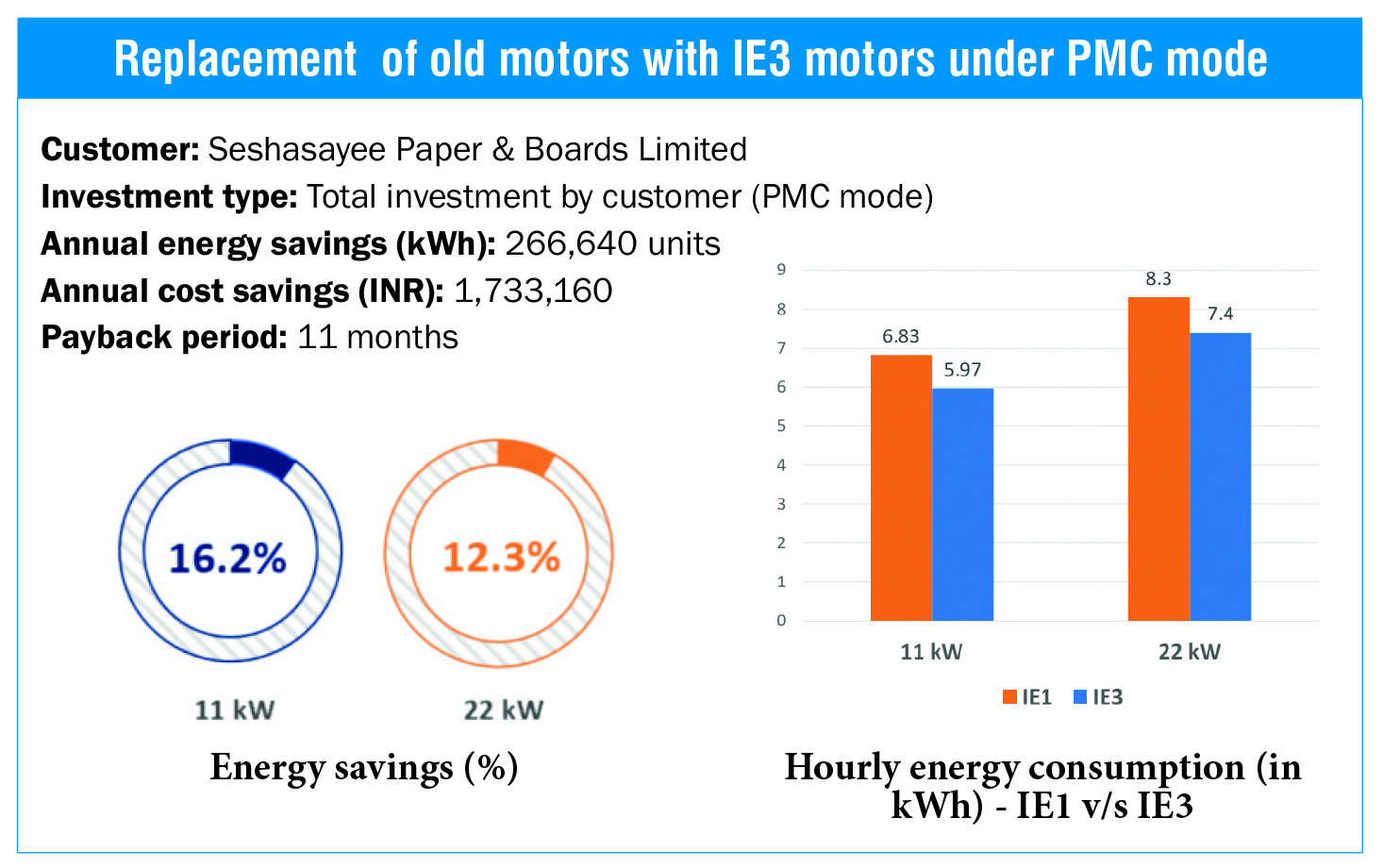
India’s National Motor Replacement Program (NMRP) – a first-of-its-kind nationwide initiative aimed at promoting energy efficiency and reducing energy consumption in the industrial sector – focuses on replacing inefficient motors with premium-efficiency IE3 motors. The accompanying case study from the paper sector highlights the energy and cost savings achieved.
Anita Khuller