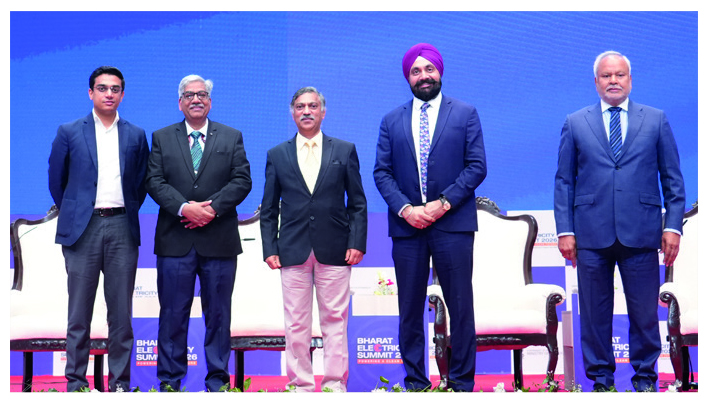
 The BES 2026 session on “Re-engineering Transmission Delivery: RoW innovation and infrastructure execution” brought together a distinguished panel of policymakers and industry leaders deliberating on the critical challenges in power infrastructure development. Moderated by Umang Shah, Managing Director (MD) and Partner, Boston Consulting Group, the discussion features insights from Dr D. Saibaba, Additional Secretary, Ministry of Power, Government of India; Upendra Pande, MD, Gujarat Energy Transmission Corporation Limited; Kanwaljeet Singh Kukreja, Global Vice-President, Infrastructure Segment, Energy Management, Schneider Electric; and R.N. Nayak, Independent Director, Yash Highvoltage. Edited excerpts…
Transmission expansion is becoming increasingly difficult at the execution stage, even as planning and capital allocation remain strong. A key constraint continues to be right-of-way, with land acquisition and stakeholder engagement absorbing a disproportionate share of institutional effort. Compensation frameworks have been progressively refined over time, with recent revisions moving more closely towards market-linked valuation principles. These frameworks aim to provide fairer and more structured compensation to landowners, with differentiated treatment across urban, semi-urban and rural areas, along with clearer valuation guidelines.
The challenge is becoming sharper as transmission infrastructure expands to meet rising system requirements. This expansion is not only technical in nature, but also deeply social, with growing emotional and logistical friction between infrastructure developers and landowners. While transmission agencies, manufacturers and developers enter such projects willingly, landowners are often reluctant participants and, in some cases, continue to resist even when compensation is increased. This has strengthened the case for a more empathetic and efficient planning approach, particularly through the creation of common corridors capable of carrying multiple utilities such as power lines and pipelines. There is also a growing argument for rethinking compensation itself, moving beyond one-time payments towards periodic or annual payouts that can create a more sustained sense of partnership and reduce resistance to essential infrastructure development.
At the same time, the operational demands placed on transmission systems are rising across every stage of the asset life cycle, from planning and construction to operations and maintenance. The growing integration of artificial intelligence is increasing the need for data, but the larger challenge lies in converting that data into efficient systems that support reliability and decarbonisation. Technology providers are increasingly focused on management and regulation systems capable of handling the distinctive challenges introduced by renewable energy. In this context, prediction mechanisms and pilot programmes for regulation management are emerging as important components of the broader transmission architecture.
The regulatory environment is also shifting in response to these new demands. Recent policy roll-outs have been seen as supportive, but their effectiveness will depend on swift implementation across states and utilities. The focus is no longer limited to data protection and testing. It is expanding towards a more comprehensive approach to cybersecurity across the sector.
Land pressures are being further intensified by the changing structure of the transmission network itself. The growing number of renewable energy pooling stations and the convergence of multiple transmission lines at modern substations are increasing land use intensity, particularly in rapidly urbanising areas. A more forward-looking planning framework, one that takes future urban expansion into account from the outset, is therefore becoming essential. Technology also has a direct role in reducing corridor pressures. Compact tower designs, advanced insulator configurations and improved management of conductor swing can help optimise land use without compromising system reliability. International practice also points towards wider use of multi-circuit configurations on single towers in order to maximise transmission capacity within constrained corridors. In parallel, re-engineering construction methodologies through modularisation and mechanisation can shorten execution timelines and reduce repeated disruption at project sites. Faster compensation disbursement, combined with shorter construction periods, can in turn improve stakeholder acceptance and ease right-of-way constraints during project delivery.